Author: The Organic Agronomist Agronomic review: Tim Stemwedel, CCA & Founder
Published by The Organic Agronomist
California Organic Fertilizers, Inc.
A fertilizer can meet the crop’s need for one nutrient while supplying too much of another. Understanding where those surplus nutrients go helps growers avoid long-term accumulation, nutrient imbalance, salinity, and unnecessary losses.
Executive Summary
A fertilizer supplies nutrients in a fixed ratio, but a field rarely needs nitrogen, phosphorus, and potassium from fertilizer in that same ratio. Crops also obtain nutrients from soil reserves, mineralization of organic matter, irrigation water, crop residues, and previous fertilizer applications.
When a fertilizer is applied mainly to satisfy the need for one nutrient, the other nutrients in that material may be supplied in excess. Those surplus nutrients do not simply wait harmlessly for the next crop. Depending on the nutrient and soil conditions, they may accumulate, enter less-available soil pools, be taken up without increasing yield, interfere with uptake of another nutrient, or leave the root zone through leaching or gaseous loss.
The First Mistake: Confusing Crop Uptake With Fertilizer Requirement
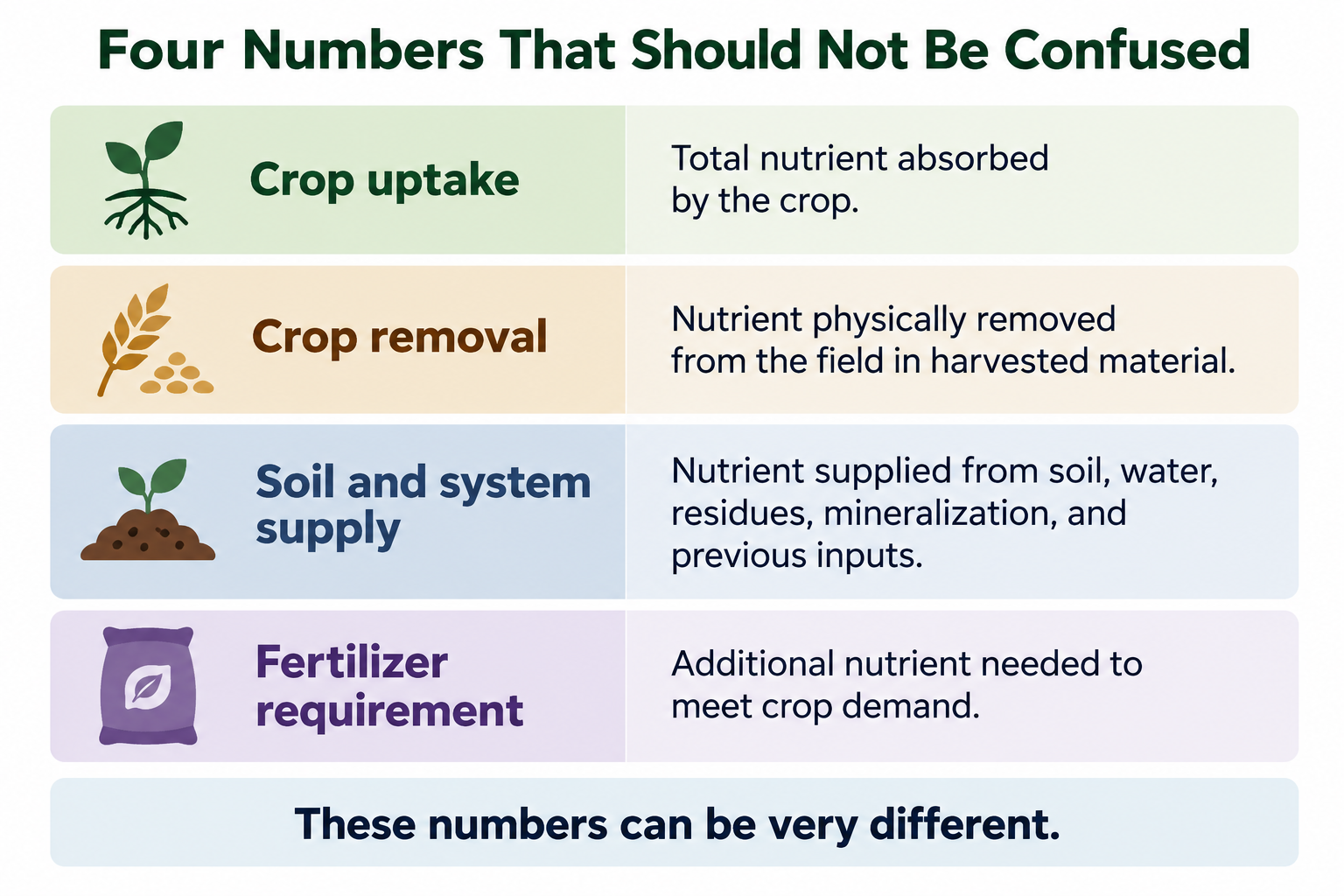
Infographic defining four nutrient-management terms: crop uptake, crop removal, soil and system supply, and fertilizer requirement, with a reminder that these values can be very different.
Processing Tomatoes Show Why This Matters
California processing tomatoes provide a useful example.
Research in high-yielding California tomato fields has documented crop nitrogen accumulation well above the amount of fertilizer N commonly required in many fields. Hartz and Bottoms found that drip-irrigated processing tomato N requirements depended on crop uptake and soil N supply, while Castro Bustamante and Hartz showed that soil and plant monitoring can be used to estimate N sufficiency in organic processing tomato production.
The practical lesson is simple: a crop may accumulate far more nitrogen than the fertilizer application rate because part of its N requirement is supplied by the soil and other sources.
A crop requiring a nutrient is not the same thing as a field requiring that nutrient to be applied as fertilizer.
Lettuce May Need Phosphorus Without Needing Phosphorus Fertilizer
The same principle applies to phosphorus.
Lettuce requires phosphorus for normal growth. But that does not mean every lettuce field requires phosphorus fertilizer.
Johnstone and colleagues conducted 12 commercial-field lettuce trials in California’s Salinas Valley on soils already containing high bicarbonate-extractable phosphorus. The work showed little justification for routine additional phosphorus where soil-test phosphorus was already high.
The crop still needed phosphorus.
The soil was supplying it.
Applying fertilizer simply because a crop contains or removes phosphorus ignores the nutrients already available in the field. This is one reason soil testing matters.
A Fertilizer’s Three Numbers Are Not an Elemental N:P:K Ratio
When a fertilizer is called 4-4-2, those numbers do not mean:
4% elemental nitrogen,
4% elemental phosphorus, and
2% elemental potassium.
Under the U.S. fertilizer convention, the analysis is reported as N-P₂O₅-K₂O: nitrogen as N, phosphorus as phosphate equivalent, and potassium as potash equivalent. California fertilizer regulations use the same convention.
So directly comparing a crop’s elemental N:P:K accumulation with a fertilizer’s labeled 4-4-2 analysis is not an apples-to-apples chemical comparison.
That does not make fertilizer grades misleading. The convention is well established and useful. It simply means growers need to understand what the numbers represent.
Organic Fertilizers Add Another Layer: Nutrient Release
Many organic nutrient sources contain substantial amounts of nutrients that are not immediately plant available.
Organic nitrogen commonly must be mineralized by microorganisms. Phosphorus availability can depend strongly on its chemical form, soil pH, and other soil conditions. Potassium is often considerably more soluble.
That means nutrients contained in the same fertilizer may become available to the crop at dramatically different rates.
Research Spotlight: What Did a 4-4-2 Release?
University of California researchers evaluated nutrient release from organic fertilizers under Central Coast field conditions. In one 2016 trial, a 4-4-2 fertilizer was incorporated about three inches deep and evaluated for 71 days. The average soil temperature was about 61°F.
The trial found very different release rates from the same fertilizer:
Nitrogen: 60.5% released
Phosphorus: 9.6% released
Potassium: 91.0% released
These percentages apply only to the specific material, placement, soil, irrigation, temperature, and trial period studied. They should not be treated as universal release rates for every 4-4-2 fertilizer.
The larger lesson is:
Guaranteed analysis tells us what is in the fertilizer. It does not necessarily tell us how much of each nutrient will become available to the crop during its growing season.
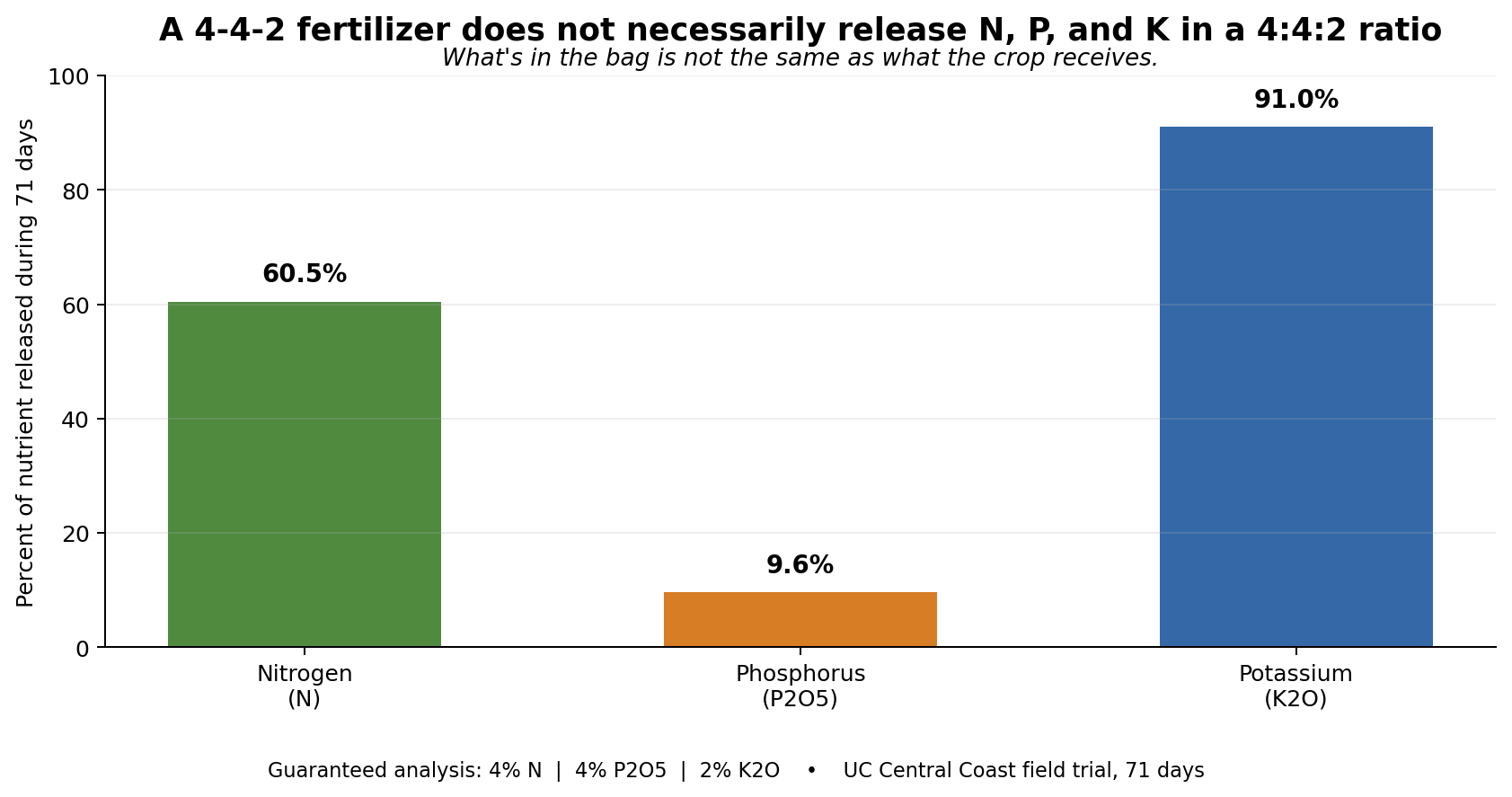
Graph showing that a 4-4-2 organic fertilizer released nitrogen, phosphorus, and potassium at very different rates during a 71-day UC Central Coast field trial.
Figure 1. Why a 4-4-2 fertilizer does not necessarily release nutrients in a 4:4:2 ratio. University of California Central Coast field-trial results illustrate how differently nitrogen, phosphorus, and potassium can be released from the same organic fertilizer over a 71-day period.
Why Was Phosphorus Release So Low?
In the UC Central Coast evaluations, phosphorus release from the 4-4-2 materials tested was low under the field conditions studied. Most sites had alkaline soil conditions, and much of the phosphorus in the fertilizer was associated with bone-derived sources. The researchers noted that phosphorus solubility under these conditions could be limited.
Potassium behaved very differently because it was largely water soluble and moved with water through the fertilizer and soil. Nitrogen behaved differently again because its release depended strongly on microbial mineralization and placement.
One pellet can therefore contain three nutrients that follow three very different paths after application.
Total Nutrient Content Is Not Plant-Available Nutrient Supply
This distinction is especially important in organic agriculture.
The guaranteed analysis tells a grower how much nutrient is contained in a fertilizer according to established fertilizer-analysis conventions.
The crop responds to something different:
Plant-available nutrient × location × timing.
A pound of nitrogen that mineralizes after the crop’s period of maximum demand cannot do the same job as a pound that becomes available at the right time.
Phosphorus that remains poorly soluble during a short vegetable crop may have limited influence on that crop even though laboratory analysis correctly shows that phosphorus is present.
Potassium released quickly into the active root zone behaves differently again.
For organic fertilizers, therefore, total nutrient content and plant-available nutrient supply should not be treated as interchangeable.
The Crop’s Nutrient Ratio Is Not Constant Either
There is another reason a single “ideal crop N-P-K ratio” is difficult to defend:
Plants do not demand nutrients at one constant ratio throughout their lives.
Nutrient uptake changes with growth stage. California processing tomato research shows relatively slow nitrogen uptake early after transplanting followed by much greater demand as crop biomass and fruit develop.
Leafy green research likewise shows that crop nitrogen demand can accelerate sharply during periods of rapid growth.
The useful question is therefore not simply:
“What is the crop’s seasonal N:P:K ratio?”
It is:
Which nutrients must be available, in what amounts, in the active root zone, at each important stage of crop development?
When Fixed-Ratio Fertilizers Can Become a Problem
None of this means fertilizer ratios are irrelevant.
Ratios matter when a fertilizer is repeatedly used to satisfy the requirement for one nutrient while simultaneously supplying other nutrients that the field does not need.
Long-term California research compared nutrient budgets in cropping systems receiving different nutrient sources. Systems relying heavily on manure or compost tended to develop larger phosphorus surpluses because those materials supplied nitrogen and phosphorus in relatively constrained proportions. Organic systems using higher-N:P fertilizer sources developed smaller phosphorus surpluses, while mineral-fertilizer systems offered greater flexibility to adjust nitrogen and phosphorus independently.
Research Spotlight: The Fixed-Ratio Problem
Maltais-Landry et al., 2016
Principal finding: Nutrient sources with constrained, relatively low N:P ratios tended to produce larger phosphorus surpluses when application rates were driven mainly by crop nitrogen requirements.
Practical importance: If a soil already contains adequate phosphorus, repeatedly applying a material primarily to satisfy nitrogen demand can continue adding phosphorus that the crop does not need from fertilizer.
This is why nutrient budgeting matters across multiple crop cycles, not just one season.
Short-Term Availability and Long-Term Accumulation Are Different Questions
There is an important qualification.
Low short-term phosphorus release does not mean phosphorus disappears.
Some nutrient that is poorly available to today’s crop can remain in the soil and contribute to future nutrient pools. Repeated additions can therefore create long-term accumulation even when short-term crop availability is limited.
Growers need to ask two separate questions:
How much becomes available to this crop?
What happens to the remainder after repeated applications over many years?
Short-term crop nutrition and long-term soil nutrient balance are related, but they are not the same problem.
What Happens When Fertilizer Creates a Nutrient Surplus?
A nutrient surplus is the portion of nutrient input that is not matched by crop removal and other useful sinks over the period being considered. It is a nutrient-budget concept; it does not mean every surplus pound is immediately soluble or immediately available.
The important point is that surplus nutrients do not all behave the same way. Their fate depends on nutrient form, soil mineralogy, pH, water movement, biological activity, crop uptake, and time.
If the crop does not use a nutrient, the next question should be: where can it go?
Surplus Nitrogen Is Mobile and Chemically Transformable
Nitrogen can move through several forms after application. Organic nitrogen may remain in organic matter for a period or mineralize to ammonium. Ammonium may be taken up by roots, temporarily held on cation-exchange sites, immobilized by microorganisms, or converted by nitrification to nitrate.
Nitrate behaves differently. Because nitrate is weakly retained by most agricultural soils, water moving below the root zone can carry it with it. Field research has shown that reducing unnecessary nitrogen supply can substantially reduce nitrate leaching.
Under wet, oxygen-limited conditions, nitrate may also be lost through denitrification as gaseous nitrogen compounds. Ammoniacal nitrogen can be lost through volatilization under conditions that favor that pathway.
This means a nitrogen surplus may be temporarily retained, biologically recycled, leached, or lost to the atmosphere. It is much less likely than phosphorus to simply accumulate indefinitely in the same surface-soil pool.
Surplus Phosphorus Tends to Accumulate
Phosphorus is generally much less mobile than nitrate because phosphate reacts strongly with soil minerals. Depending on soil chemistry, it can be adsorbed to mineral surfaces or precipitated into less-soluble forms.
That retention can make phosphorus look harmless in the short term, but repeated additions can build large residual pools. Agricultural researchers refer to phosphorus remaining from historical applications as legacy phosphorus.
As soil phosphorus loading and saturation increase, the potential for phosphorus movement in runoff, eroded sediment, and in some soils subsurface flow can increase.
So low short-term availability does not mean the phosphorus is gone. It may become part of a long-term soil inventory that influences both future fertility and environmental risk.
Surplus Potassium Can Be Stored, Taken Up, or Lost
Potassium remains as the K⁺ ion rather than becoming part of a large family of chemical forms like nitrogen.
In many soils, potassium can be held on cation-exchange sites. Some clay minerals can also retain potassium in less readily exchangeable positions, while coarse-textured soils with low cation-exchange capacity have less ability to retain it.
Plants can also absorb more potassium than is required to increase yield. This is known as luxury consumption. Large field datasets have documented increased potassium uptake at fertilizer rates above the point associated with additional yield response.
Luxury consumption is not automatically harmful to the crop, but it is agronomically important: fertilizer can move into plant tissue without producing a corresponding yield increase.
A Surplus of One Nutrient Can Affect Another
Nutrient balance matters because ions interact in both soil and plant uptake.
Potassium, magnesium, and calcium are all cations. High concentrations of one can influence uptake of the others. Controlled research has shown that excessive potassium relative to magnesium can depress magnesium nutrition and impair plant growth and physiology under susceptible conditions.
That creates a situation that can seem contradictory:
A field may contain more total fertility while the plant becomes less balanced nutritionally.
A nutrient surplus can therefore contribute to an induced deficiency of another nutrient even when that second nutrient is present in the soil.
Surplus Fertilizer Can Add to the Soil Salt Load
Fertilizers and soil amendments can add soluble ions to the soil solution. Where soluble salts accumulate faster than they are removed by crop uptake or leaching, soil electrical conductivity can rise.
Salinity restricts plant water uptake and can reduce growth. The risk depends on fertilizer source, application rate and placement, irrigation-water quality, soil drainage, and the amount of leaching.
This does not mean every nutrient surplus will create a salinity problem. It means that unused soluble fertilizer is part of the field’s total salt budget, particularly in irrigated agriculture where salts from water and fertilizer must both be managed.
The Fate of a Surplus Depends on the Nutrient
Nitrogen
Possible fates include microbial immobilization, retention in organic pools, nitrification, nitrate leaching, volatilization, and denitrification.
Long-term concern: Loss from the root zone, reduced nitrogen-use efficiency, and water or air-quality impacts.
Phosphorus
Possible fates include adsorption, precipitation, accumulation in residual soil pools, and particulate or dissolved loss.
Long-term concern: Legacy phosphorus buildup and increasing loss risk where soil phosphorus becomes excessive.
Potassium
Possible fates include retention on exchange sites, fixation by some clay minerals, crop uptake including luxury consumption, and leaching in soils with low retention capacity.
Long-term concern: Inefficient potassium use and possible nutrient imbalance.
The practical lesson is not that every surplus is immediately harmful. It is that a fertilizer application has consequences beyond the crop that is in the field today.
What Should a Balanced Fertility Program Actually Do?
A balanced fertilizer is sometimes imagined as a product with visually balanced numbers—perhaps 4-4-4 or 5-5-5.
That is not agronomic balance.
A field that already contains abundant phosphorus but is short of plant-available nitrogen does not become better balanced merely because equal amounts of nitrogen and phosphorus are applied.
Likewise, a field capable of supplying substantial potassium does not necessarily need fertilizer potassium simply because the crop absorbs large amounts of potassium.
A genuinely balanced fertility program attempts to:
Estimate crop nutrient demand.
Measure or estimate nutrient supply already present in the system.
Determine when the crop needs those nutrients.
Estimate how much of the fertilizer nutrient will become available during that period.
Apply the additional nutrients needed to close the meaningful deficit.
Track nutrient balances across crop cycles, not just within one season.
Monitor soil-test trends where nutrients are repeatedly applied in fixed combinations.
That is much closer to how plants actually experience fertility.
Practical Agronomy
Before selecting a fertilizer because its N-P-K ratio appears to resemble crop uptake, ask:
What is already in the soil?
Use appropriate soil testing to identify nutrients the field can already supply.
What is becoming available from organic matter?
Mineralization can contribute meaningful plant-available nitrogen, but the rate varies with the material, soil, temperature, moisture, and management.
What is present in the irrigation water?
Nutrients delivered in irrigation water belong in the nutrient budget.
What did previous applications leave behind?
Residual nutrients do not disappear because a new crop has been planted.
When does the crop need the nutrient?
Total seasonal availability is less useful if nutrient release occurs after the period when the crop can increase yield or quality.
How quickly will this fertilizer release its nutrients?
For many organic materials, guaranteed analysis alone cannot answer that question.
If the crop does not use the nutrient, where is it likely to go?
Consider whether the nutrient is likely to accumulate, be retained in a less-available pool, move below the root zone, be lost to the atmosphere, or affect the availability of another nutrient.
Fact vs. Fiction
“The best fertilizer has approximately the same N-P-K ratio as the crop.”
“The best fertilizer has approximately the same N-P-K ratio as the crop.”
Evidence rating: Unsupported
Crop uptake does not account for nutrients supplied by the soil, irrigation water, residues, mineralization, or other sources.
“If a crop takes up a lot of potassium, it needs a lot of potassium fertilizer.”
Evidence rating: False as a general rule
The crop needs access to potassium. Whether that potassium must come from fertilizer depends on soil and system supply.
“A 4-4-2 fertilizer supplies plant-available N, P, and K in a 4:4:2 ratio.”
Evidence rating: False as a general rule
Guaranteed analysis describes nutrient content. Nutrient release and plant availability can differ dramatically, as the UC Central Coast field research illustrates.
“Applying a nutrient the crop does not currently need can still affect the field.”
Evidence rating: Strong Evidence
Repeated nutrient surpluses can alter long-term soil nutrient balances.
“Surplus nutrients simply stay in the soil until a future crop needs them.”
Evidence rating: False as a general rule
Phosphorus may accumulate for long periods, but nitrogen can be leached or lost to the atmosphere, and potassium can be stored, taken up in excess of yield requirements, or lost depending on soil conditions.
Management Recommendations
Do not select a fertilizer formulation solely because its N-P-K numbers resemble published crop uptake data.
Instead:
Build fertility programs around nutrient budgets.
Use soil testing to identify nutrients the soil can already supply.
Account for residual fertilizer, irrigation water, and mineralization where practical.
Consider plant availability, not merely total nutrient content.
Match nutrient release with the crop’s period of demand.
Track nutrient inputs and crop removals across multiple seasons.
Watch for long-term accumulation when fixed-ratio materials are repeatedly applied.
Pay attention to nutrient interactions when one cation, particularly potassium, is repeatedly supplied at high rates relative to other cations.
Consider soil EC where soluble nutrient inputs and irrigation-water salts can accumulate.
Use complementary nutrient sources when one material cannot supply nutrients in the proportions the field actually requires.
Future Research
Organic agriculture still needs better field-scale information describing the actual release of nitrogen, phosphorus, and potassium from commonly used organic fertilizers under different:
soil temperatures,
soil moisture conditions,
pH levels,
application methods,
soil types,
microbial environments, and
cropping systems.
Guaranteed analysis is well defined.
Plant-available analysis over time is much less well defined.
Reliable nutrient-release curves for organic fertilizers could substantially improve nutrient-management precision. Long-term nutrient-balance studies are also needed to connect short-term release data with soil accumulation, nutrient interactions, and losses over repeated crop cycles.
Conclusion
A crop’s nutrient composition is not a fertilizer recipe.
Plants need nitrogen, phosphorus, and potassium, but fertilizer only needs to provide the portion of those nutrients that the soil-crop system cannot adequately supply at the right time.
Organic fertilizers make this distinction particularly important because nutrients contained in the same material can become available at dramatically different rates.
And when fertilizer supplies more of a nutrient than the crop can use, the surplus does not have one universal fate. Nitrogen may be transformed or lost, phosphorus may accumulate, and potassium may be retained, taken up without additional yield response, or contribute to nutrient imbalance depending on soil and crop conditions.
The lesson is straightforward:
The fertilizer grade, nutrient release, nutrient availability, crop requirement, and fate of any surplus are different parts of the fertility equation.
A fertilizer should therefore not be judged simply by how closely its N-P-K numbers resemble crop uptake.
A balanced fertilizer is not necessarily one with balanced numbers. A balanced fertility program is one in which plant-available nutrient supply from all sources is matched as closely as practical to crop demand over time—without repeatedly creating unnecessary surpluses.
Key Takeaways
Crop nutrient uptake and fertilizer requirement are not the same thing.
Soil, irrigation water, residues, and mineralization can supply part of crop nutrient demand.
Fertilizer labels report N-P₂O₅-K₂O, not elemental N:P:K.
Organic fertilizer nutrients may become available at very different rates.
A UC field trial of one 4-4-2 material found dramatically different nitrogen, phosphorus, and potassium release during a 71-day period.
Crop nutrient demand changes throughout the growing season.
Repeated use of fixed-ratio nutrient sources can create nutrient surpluses.
Surplus nitrogen can be transformed, leached, or lost to the atmosphere; surplus phosphorus commonly contributes to residual soil phosphorus; surplus potassium can be retained, taken up through luxury consumption, or lost depending on soil conditions.
Excess of one nutrient can sometimes interfere with uptake of another, particularly among potassium, magnesium, and calcium.
The goal is not to match fertilizer analysis to plant composition. The goal is to match plant-available nutrient supply to crop demand while minimizing unnecessary nutrient surpluses.
Related Articles
The Difference Between Organic Nitrogen Sources: Why All Organic Nitrogen Is Not Created Equal
Feed the Soil, Feed the Crop
References
References
Maltais-Landry, G., Scow, K. M., Brennan, E. B., Torbert, E., & Vitousek, P. M. (2016). Higher flexibility in input N ratios results in more balanced phosphorus budgets in two long-term experimental agroecosystems. Agriculture, Ecosystems & Environment, 223, 197–210. View research article.
Maltais-Landry, G., Scow, K. M., Brennan, E. B., & Vitousek, P. M. (2015). Long-term effects of compost and cover crops on soil phosphorus in two California agroecosystems. Soil Science Society of America Journal, 79, 688–697. View research article.
Hartz, T. K., & Bottoms, T. G. (2009). Nitrogen requirements of drip-irrigated processing tomatoes. HortScience, 44, 1988–1993. Read the research PDF — UC ANR.
Castro Bustamante, S., & Hartz, T. K. (2015). Nitrogen management in organic processing tomato production: Nitrogen sufficiency prediction through early-season soil and plant monitoring. HortScience, 50, 1055–1063. View research article.
Johnstone, P. R., Hartz, T. K., Cahn, M. D., & Johnstone, M. R. (2005). Lettuce response to phosphorus fertilization in high phosphorus soils. HortScience, 40, 1499–1503. View research article.
Hoque, M. M., Ajwa, H., Othman, M., Smith, R., & Cahn, M. (2010). Yield and postharvest quality of lettuce in response to nitrogen, phosphorus, and potassium fertilizers. HortScience, 45, 1539–1544. Read the research PDF.
Smith, R., Cahn, M., Hartz, T., Geisseler, D., et al. (2016). Evaluation and Demonstration of Nitrogen Management of Organic Vegetable Production in Leafy Green Vegetables on the Central Coast. University of California Cooperative Extension / California Department of Food and Agriculture, Contract 15-0522. Read the CDFA final report.
Lloyd, M., Geisseler, D., Lazicki, P., Muramoto, J., Smith, R., et al. (2022). Estimating Nitrogen Availability in Organic Annual Production: For Nitrogen Budgeting and Other Purposes. University of California Agriculture and Natural Resources, Publication 8712. Read the UC ANR publication.
USDA Natural Resources Conservation Service. Nutrient Management, Conservation Practice Standard 590. View the USDA-NRCS standard.
California Department of Food and Agriculture. Fertilizing Materials Laws and Regulations. Nutrient guarantees expressed as N, P₂O₅, and K₂O. Read the CDFA regulations.
Andrews, N., & Foster, J. (2007). Organic Fertilizer Calculator: A Tool for Comparing the Cost, Nutrient Value, and Nitrogen Availability of Organic Materials. Oregon State University Extension Service, EM 8936-E. Read the calculator guide.
Hu, R., Leytem, A. B., Moore, A. D., & Strawn, D. G. (2024). Long-term dairy manure amendment promotes legacy phosphorus buildup and mobility in calcareous soils. Journal of Environmental Quality, 53, 365–377. View research article.
van Es, H., Ristow, A., Nunes, M. R., Schindelbeck, R., Sela, S., & Davis, M. (2020). Nitrate leaching reduced with Dynamic-Adaptive nitrogen management under contrasting soils and tillage. Soil Science Society of America Journal, 84(1), 220–231. View research article.
Sharpley, A., Jarvie, H. P., Buda, A., May, L., Spears, B., & Kleinman, P. (2013). Phosphorus legacy: Overcoming the effects of past management practices to mitigate future water quality impairment. Journal of Environmental Quality, 42(5), 1308–1326. View research article.
Zhan, A., Zou, C., Ye, Y., Liu, Z., Cui, Z., & Chen, X. (2016). Estimating on-farm wheat yield response to potassium and potassium uptake requirement in China. Field Crops Research, 191, 13–19. View research article.
Garcia, A., Crusciol, C. A. C., Rosolem, C. A., Bossolani, J. W., Nascimento, C. A. C., McCray, J. M., dos Reis, A. R., & Cakmak, I. (2022). Potassium-magnesium imbalance causes detrimental effects on growth, starch allocation and Rubisco activity in sugarcane plants. Plant and Soil, 472, 225–238. View research article.
University of California Agriculture and Natural Resources. Soil Salinity Management. Agronomy Fact Sheet No. 11. Read the UC ANR fact sheet.
Suggested Citation
The Organic Agronomist. (2026). When Fertilizer Ratios Create Nutrient Surpluses. California Organic Fertilizers, Inc.
Permission to Use
© 2026 California Organic Fertilizers, Inc. All rights reserved. Readers may download, save, and print this publication for personal, educational, or internal business use. Brief excerpts may be quoted with attribution to The Organic Agronomist and a link to the original article. This publication may not be republished, altered, sold, distributed commercially, or presented as another party’s work without prior written permission from California Organic Fertilizers, Inc.
Need help saving a PDF? Click here for instructions.
To save a copy to your computer:
- Right-click the yellow PDF button above.
- Choose Save link as... from the menu.
- Choose where to save the file, such as Downloads.
- Click Save.
Already opened the PDF? Click the printer icon, select Save as PDF as the printer or destination, then click Save.