Published by The Organic Agronomist
Agronomic review: Tim Stemwedel, CCA & Founder
Why Tiny Nutrients Can Have a Big Impact on Crop Performance
Executive Summary
Micronutrients are required in very small quantities, but they regulate many of the biochemical processes that determine crop yield, quality, and stress tolerance. Iron, zinc, manganese, copper, boron, molybdenum, chlorine, and nickel are all essential to normal plant growth.
Micronutrient shortages can develop without dramatic symptoms. A crop may remain green and appear reasonably uniform while photosynthesis, root development, reproductive growth, or nitrogen metabolism is already being restricted. Once visible symptoms become obvious, part of the crop's yield potential may already be lost.
The practical goal is not to apply every micronutrient routinely. It is to identify the actual limiting factor through field history, soil conditions, properly interpreted soil tests, and crop-specific plant tissue analysis.
Introduction
Growers naturally focus on nitrogen, phosphorus, and potassium because crops require them in large quantities. Micronutrients are needed in much smaller amounts, which can create the impression that they are secondary to crop performance.
They are not secondary. A nutrient is considered essential because a plant cannot complete its life cycle without it. The amount required may be small, but the function it controls may be fundamental. A shortage of one micronutrient can reduce the efficiency of the entire fertility program.
Micronutrients are also easy to mismanage. Their useful range may be narrow, and symptoms can resemble root disease, compaction, salinity, water stress, herbicide injury, or another nutrient imbalance. Effective management begins with diagnosis, not routine supplementation. Micronutrients_The_Quiet_Yield_…
Scientific Background
What Are Micronutrients?
Plants require eight mineral micronutrients: iron (Fe), zinc (Zn), manganese (Mn), copper (Cu), boron (B), molybdenum (Mo), chlorine (Cl), and nickel (Ni). They are needed in lower concentrations than macronutrients, but a deficiency in any one can reduce crop quality or yield. Excess availability can also create toxicity.
Why Small Quantities Matter
Many micronutrients act as enzyme cofactors. A cofactor is a component an enzyme needs in order to function. The plant may have adequate nitrogen, carbon, and energy, but a metabolic reaction can still slow if the required cofactor is missing.
This is why micronutrient deficiencies can have effects that appear disproportionate to the amount of nutrient involved. The nutrient is not supplying bulk plant material; it is enabling the biochemical machinery that builds and regulates that material.
The Hidden Micronutrient Network
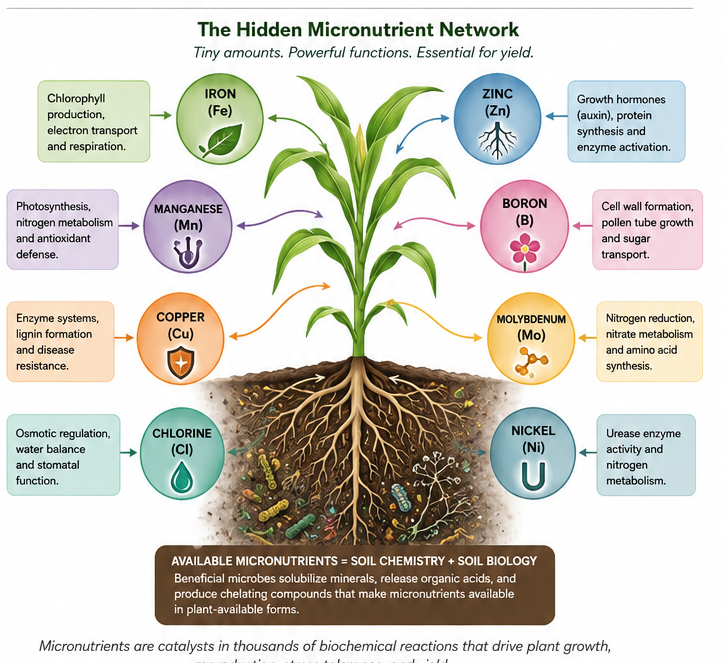
Illustration showing a crop plant, roots, soil biology, and the roles of iron, zinc, manganese, boron, copper, molybdenum, chlorine, and nickel in plant growth and nutrient function.
Figure 1. The hidden micronutrient network. Micronutrients support distinct but interconnected plant processes. Their availability is governed by both soil chemistry and biological activity.
How Individual Micronutrients Support the Crop
Iron (Fe)
Electron transport, chloroplast development, and processes associated with chlorophyll formation.
Zinc (Zn)
Enzyme activation, protein synthesis, and regulation of growth processes.
Manganese (Mn)
Photosynthesis, nitrogen metabolism, lignin synthesis, and antioxidant enzymes.
Copper (Cu)
Enzyme systems, lignin formation, electron transport, and reproductive growth.
Boron (B)
Cell-wall structure, membrane function, sugar movement, flowering, and pollen-tube growth.
Molybdenum (Mo)
Nitrate reduction and biological nitrogen-fixation enzymes.
Chlorine (Cl)
Osmotic balance, stomatal function, and photosynthetic reactions.
Nickel (Ni)
Urease activity and urea-nitrogen metabolism.
Why Deficiencies Often Go Undetected
Visible deficiency symptoms are useful clues, but they are not reliable diagnoses by themselves. Different stresses can produce similar patterns, and different crops may express the same deficiency differently.
Hidden hunger describes a condition in which nutrient supply is below the level needed for maximum performance but not low enough to produce unmistakable visual symptoms. The crop survives, yet yield, quality, maturity, or stress recovery may be reduced.
Soil Conditions Control Availability
Total soil content does not equal plant availability. Soil pH, aeration, moisture, texture, organic matter, redox conditions, and competing ions all affect whether a micronutrient remains in a form roots can absorb.
In many alkaline or calcareous soils, zinc, iron, manganese, and copper become less available as pH rises. Boron and chloride present a different risk: they can accumulate to toxic concentrations in certain soils or irrigation systems. The narrow margin between deficiency, sufficiency, and excess is one reason undiagnosed applications can be costly.
Soil Biology and Micronutrient Cycling
Soil organisms contribute to decomposition and nutrient cycling. Microbial activity can release organic acids and other compounds that influence mineral solubility. Roots and their associated microorganisms also modify the chemistry of the rhizosphere, the narrow zone of soil directly influenced by roots.
Biology does not eliminate the need for diagnosis. It helps explain why soils with similar total nutrient concentrations can differ in plant availability and crop response.
Practical Agronomy
When Micronutrient Risk Is Higher
Micronutrient problems become more likely under several common field conditions:
High-pH or calcareous soils
Low organic matter or restricted rooting
Cold, wet soils that slow root activity
Waterlogged or poorly aerated zones
Sandy soils with low nutrient-holding capacity
Drought or irregular irrigation
High phosphorus where zinc is marginal
Fields with known boron, chloride, or salinity concerns
Why Root Function Matters
A soil may contain enough of a micronutrient while the crop remains deficient because roots cannot reach or absorb it. Compaction, saturation, salinity, root disease, low temperature, and poor irrigation uniformity can all restrict uptake.
This means a micronutrient symptom may actually be a root-zone problem. Correcting the root environment can sometimes improve nutrient acquisition more effectively than adding fertilizer.
Diagnosis Before Treatment
A strong micronutrient program combines several lines of evidence:
Field history and symptom pattern
Soil pH, salinity, texture, drainage, and irrigation-water quality
Soil testing where the method is calibrated for the crop and region
Plant tissue analysis using the correct plant part and growth stage
Inspection of roots and irrigation uniformity
Review of recent fertilizer and amendment applications
Plant tissue analysis shows what the crop has absorbed, but interpretation depends on correct sampling. A result from the wrong leaf, the wrong growth stage, or a contaminated sample can be misleading.
Management Recommendations
Established Recommendations
Under that, add:
Confirm a suspected deficiency with appropriate soil and/or tissue testing before making a major corrective application.
Correct root-zone limitations such as compaction, saturation, salinity, poor drainage, or uneven irrigation.
Match the nutrient source, placement, rate, and timing to the crop and the diagnosed condition.
Use foliar applications as targeted corrections when appropriate, not as substitutes for a functioning root system.
Follow product labels and verify that materials are allowed under the farm's organic certification program.
Use replicated strips or untreated checks when local response data are limited.
Re-sample after correction when practical to determine whether plant status improved.
Field Observations
Growers and crop advisers often observe that correcting a confirmed micronutrient deficiency improves crop uniformity, color, root activity, fruit set, or recovery from stress. These observations are most useful when supported by tissue data, untreated comparisons, and yield or quality measurements.
Field response is not universal. A product that appears effective in one crop, soil, or season may produce little measurable benefit where the nutrient was not actually limiting.
Emerging Research
Research continues to examine how root exudates, microbial communities, organic amendments, and nutrient chelation affect micronutrient availability. These processes are biologically plausible and important, but their field effects vary with soil, climate, crop, and management.
What Not to Assume
More is not better. Micronutrients have relatively narrow margins between deficiency, sufficiency, and toxicity. A foliar application may temporarily correct an in-season deficiency, but it does not automatically correct the underlying soil chemistry or root problem.
Do not assume that every unusual symptom is a micronutrient deficiency or that a broad micronutrient blend is harmless. Diagnosis protects both yield and the long-term balance of the soil.
Future Research
Organic agriculture would benefit from more field research connecting soil biological communities, micronutrient speciation, root exudates, and crop response. Important questions include:
Which biological processes consistently improve micronutrient availability under field conditions?
How do repeated organic amendments affect long-term micronutrient balance?
Which tissue-testing intervals best detect hidden hunger before yield is lost?
How do micronutrient interactions influence crop quality, disease resilience, and nutrient-use efficiency?
When do foliar corrections provide a measurable economic return in organic production systems?
Conclusion
Micronutrients are quiet yield limiters because their effects often begin before the crop looks deficient. They regulate photosynthesis, enzyme activity, nitrogen metabolism, cell-wall development, reproduction, water balance, and stress response.
The correct response is not automatic supplementation. It is disciplined diagnosis, balanced fertility, attention to soil and root conditions, and carefully selected corrective applications when evidence shows that a micronutrient is truly limiting.
Key Takeaways
Micronutrients are essential even though crops require them in small amounts.
Yield and quality can be restricted before visible deficiency symptoms appear.
Soil pH, moisture, aeration, roots, and biology determine availability.
Tissue testing is most useful when the correct plant part is sampled at the correct stage.
Root-zone problems can mimic or intensify micronutrient deficiencies.
Routine applications without diagnosis can waste money or create toxicity.
Continue Your Learning
Feed the Soil, Feed the Crop
The Difference Between Organic Nitrogen Sources
References
Marschner, P. (Ed.). (2012). Marschner's Mineral Nutrition of Higher Plants (3rd ed.). Academic Press.
Barker, A. V., & Pilbeam, D. J. (Eds.). (2015). Handbook of Plant Nutrition (2nd ed.). CRC Press.
University of California Agriculture and Natural Resources. Crop Nutrient Requirements.
University of Minnesota Extension. Foliar Nutrient Tests for Fruit and Vegetable Crops.
University of Minnesota Extension. Micro- and Secondary Macronutrients.
Penn State Extension. Foliar Fertilization and Its Role in Vegetable Production.
USDA Natural Resources Conservation Service. Soil Biology Primer.
UC Small Farms Network. Soil Tests.
Suggested Citation
The Organic Agronomist. (2026). Micronutrients: The Quiet Yield Limiters. California Organic Fertilizers, Inc.
Permission to Use
© 2026 California Organic Fertilizers, Inc. All rights reserved. Readers may download, save, and print this publication for personal, educational, or internal business use. Brief excerpts may be quoted with attribution to The Organic Agronomist and a link to the original article. This publication may not be republished, altered, sold, distributed commercially, or presented as another party’s work without prior written permission from California Organic Fertilizers, Inc.
Need help saving a PDF? Click here for instructions.
To save a copy to your computer:
- Right-click the yellow PDF button above.
- Choose Save link as... from the menu.
- Choose where to save the file, such as Downloads.
- Click Save.
Already opened the PDF? Click the printer icon, select Save as PDF as the printer or destination, then click Save.