Why nitrogen availability during the final 30 days can make the difference in yield, quality, and profitability
Author: The Organic Agronomist
Reviewed by: Tim Stemwedel, CCA
Founder, California Organic Fertilizers, Inc.
Published by The Organic Agronomist
California Organic Fertilizers, Inc.
Executive Summary
Growing high-quality organic lettuce requires an adequate supply of nitrogen during a relatively short growing season. For growers in California's Salinas Valley, achieving that goal has become increasingly challenging as fertilizer costs, environmental concerns, and water-quality regulations place greater emphasis on nitrogen-use efficiency.
One approach to managing uncertainty about nitrogen availability is to apply large quantities of organic fertilizer before planting. Some growers use as much as three tons per acre of chicken-based fertilizer pellets, hoping that enough nitrogen will become available to support the crop throughout its growth cycle.
The difficulty is that total fertilizer nitrogen and plant-available nitrogen are not the same thing.
Much of the nitrogen in organic fertilizers must undergo biological decomposition before plant roots can absorb it. That process takes time, and its rate depends on the fertilizer material, soil conditions, moisture, and microbial activity.
Meanwhile, lettuce has a very specific nitrogen demand pattern. Research summarized by the California Department of Food and Agriculture (CDFA) indicates that approximately 70–80% of the crop's nitrogen uptake can occur during the final month before harvest.
This creates a fundamental challenge: a large application of organic fertilizer can contain substantial total nitrogen, yet still fail to deliver enough plant-available nitrogen during the crop's most important growth period.
The consequences can include reduced head development, uneven maturity, lower marketable yield, unnecessary fertilizer expense, and nitrogen remaining in the soil after harvest.
A more precise approach combines measured soil nitrogen, an understanding of organic fertilizer mineralization, and timely applications of plant-available nitrogen.
The goal is not simply to apply less nitrogen. It is to ensure that more of the nitrogen supplied contributes directly to producing a marketable crop.
Lettuce Builds Most of Its Yield Near Harvest
Lettuce has a short but highly dynamic growth cycle.
Early development is devoted to establishing roots and leaves. As the plant grows, its ability to intercept sunlight and manufacture carbohydrates increases.
During the final stages of development, the crop accumulates fresh weight rapidly. This is the period when nitrogen availability becomes particularly important.
Research summarized in CDFA's California Fertilization Guidelines indicates that approximately 70–80% of seasonal nitrogen uptake in lettuce may occur during the last month before harvest.
During peak demand, lettuce can absorb approximately 3–4 pounds of nitrogen per acre per day.
These values describe research-based uptake patterns, not universal daily fertilizer recommendations. Actual uptake depends on cultivar, season, growing conditions, and yield.
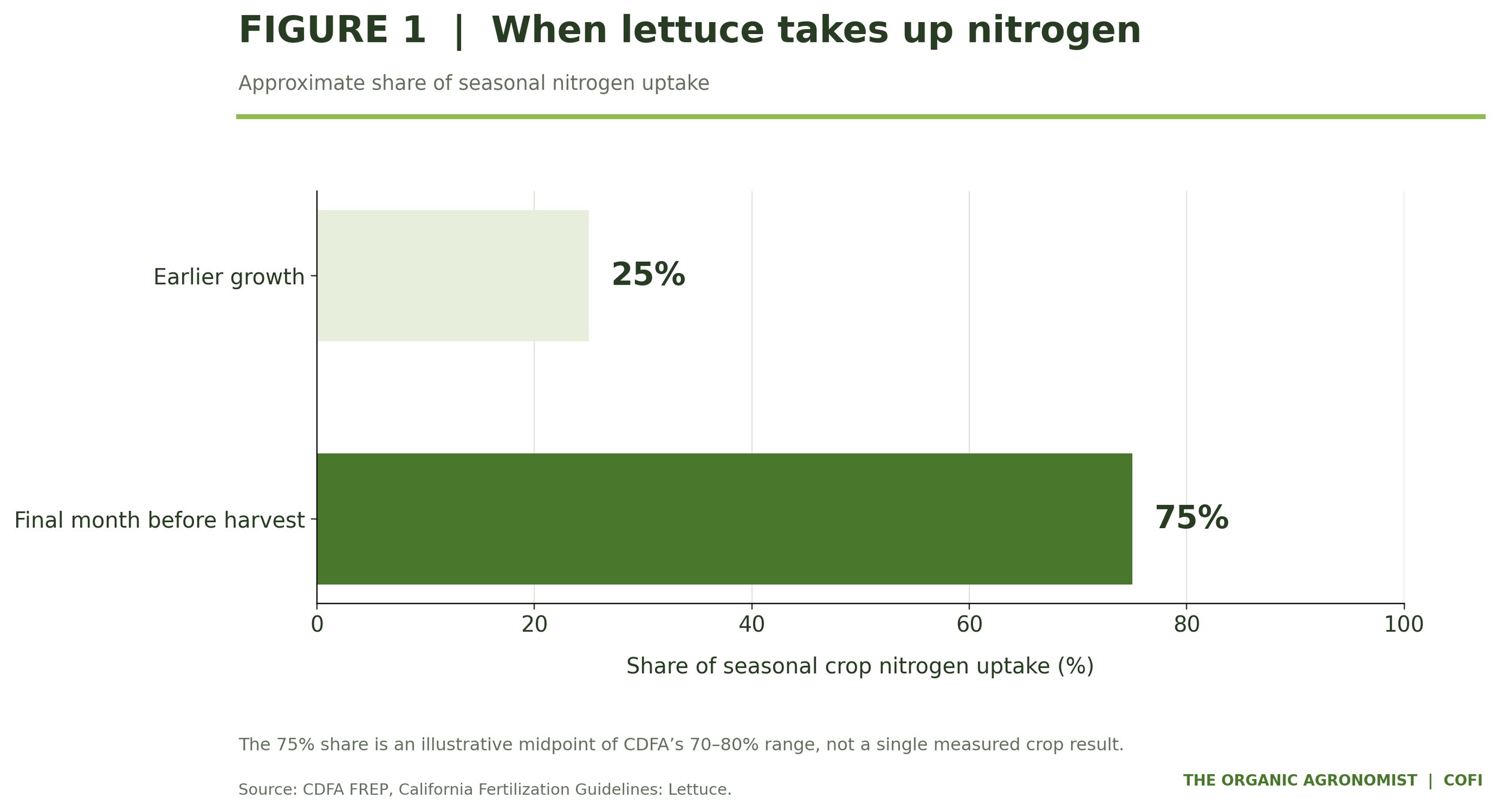
Chart showing approximately 75% of lettuce nitrogen uptake occurring during the final month before harvest and 25% during earlier growth.
Figure 1. Most Lettuce Nitrogen Uptake Occurs Late in the Crop Cycle
California research indicates that approximately 70–80% of lettuce nitrogen uptake may occur during the final month before harvest. This period of rapid growth makes timely nitrogen availability particularly important for marketable yield.
Why the late-season surge matters
Nitrogen is required for chlorophyll formation, photosynthesis, proteins, enzymes, and the development of new plant tissue.
When nitrogen is adequately supplied, lettuce can maintain photosynthetic activity and expand leaf area during the period of rapid biomass accumulation.
When nitrogen becomes limiting, growth can slow, leaves may become pale, and the plant may produce less harvestable fresh weight.
For iceberg lettuce, insufficient nitrogen during rapid growth can reduce head development and weight. For romaine, it can restrict leaf expansion, plant size, and harvestable biomass.
The timing of a deficiency matters.
A modest nitrogen shortage early in development may be corrected while considerable growing time remains. A shortage during the final weeks before harvest leaves much less opportunity for recovery.
Even when additional nitrogen eventually becomes available, the crop may not have sufficient time to develop the weight and uniformity required for a successful harvest.
This makes nitrogen timing an important factor in protecting marketable yield.
Why Large Preplant Applications Do Not Guarantee Adequate Nitrogen
Many organic lettuce growers rely on dry organic fertilizers applied before planting.
Chicken-based pellets are particularly common because they provide nitrogen, phosphorus, potassium, and other nutrients in a convenient form.
The challenge is that much of the nitrogen in these materials is organically bound.
Before plants can absorb that nitrogen as ammonium or nitrate, microorganisms must break down the organic compounds through a process called mineralization.
The rate of mineralization is influenced by:
Fertilizer composition and processing.
Soil temperature and moisture.
Microbial activity.
Placement and incorporation.
Soil properties.
The length of the crop's growing season.
Applying a greater quantity of fertilizer increases the total amount of nitrogen placed into the soil. It does not necessarily cause that nitrogen to become available at the rate required by the crop.
Consider a three-ton preplant application
A grower applying three U.S. tons per acre of chicken-based 4-4-2 fertilizer supplies:
Nutrient Amount applied per acre
Nitrogen (N) 240 lb
Phosphate (P₂O₅) 240 lb
Potash (K₂O) 120 lb
This represents a substantial nutrient investment.
However, the crop cannot necessarily use all 240 pounds of nitrogen during its growing season.
The actual amount of plant-available nitrogen depends on the material's initial mineral nitrogen content and the additional nitrogen mineralized during the crop cycle.
Some nitrogen may remain organically bound after harvest.
Some may become available when crop demand is low.
Some may be taken up by the crop, while some mineral nitrogen may be lost through leaching or other pathways.
The original fertilizer analysis alone cannot answer these questions.
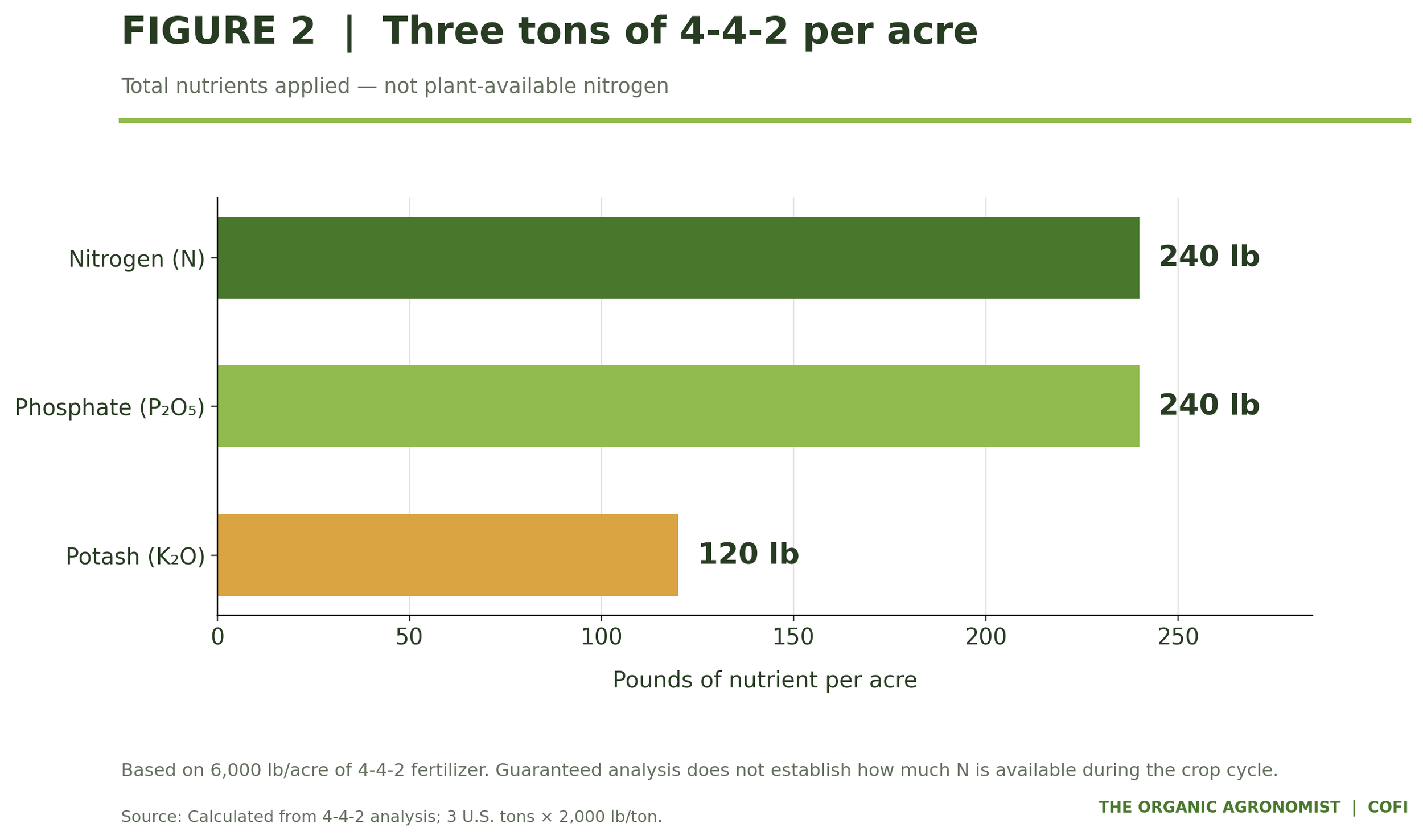
Bar chart showing 240 pounds of nitrogen, 240 pounds of phosphate, and 120 pounds of potash applied per acre through three tons of 4-4-2 organic fertilizer.
Figure 2. Nutrients Supplied by Three Tons of 4-4-2 Organic Fertilizer
A preplant application of three tons per acre of 4-4-2 fertilizer supplies 240 pounds of total nitrogen, 240 pounds of phosphate, and 120 pounds of potash per acre. These quantities represent total nutrients applied, not necessarily the amounts that become available to the crop during its growing season.
The problem of applying nutrients in the wrong proportions
An additional concern is nutrient balance.
Applying fertilizer primarily to meet nitrogen needs also supplies phosphorus and potassium according to the fertilizer's analysis, regardless of the proportions required by the crop.
Where soil phosphorus is already sufficient, repeated heavy applications may supply more phosphorus than the crop needs.
However, total phosphorus applied should not be confused with immediately available phosphorus. UC research on a specific 4-4-2 blend found that relatively little of its phosphorus solubilized during the evaluation period, particularly in high-pH soils.
The issue is therefore not simply the quantity of nutrients applied. It is whether those nutrients are needed, whether they become available, and whether their availability coincides with crop demand.
This is one reason why fertilizer programs should account for individual nutrient requirements rather than using a single fertilizer rate to satisfy every nutritional need.
What University of California Research Reveals About Organic Fertilizers
Research conducted by University of California Cooperative Extension provides valuable information about organic fertilizer mineralization under Salinas Valley conditions.
Richard Smith and Daniel Geisseler evaluated nitrogen release from organic fertilizers used in leafy green vegetable production.
Their field research included a blended 4-4-2 organic fertilizer containing chicken and meat-and-bone meal and a 12-0-0 feather meal fertilizer.
The fertilizers were evaluated both on the soil surface and incorporated into the soil during a romaine lettuce crop.
Over approximately 55 days, the percentage of nitrogen released differed substantially.
Fertilizer Surface applied Incorporated 4-4-2 blended organic fertilizer 36.1% 54.0% Feather meal 12-0-0 31.5% 86.0%
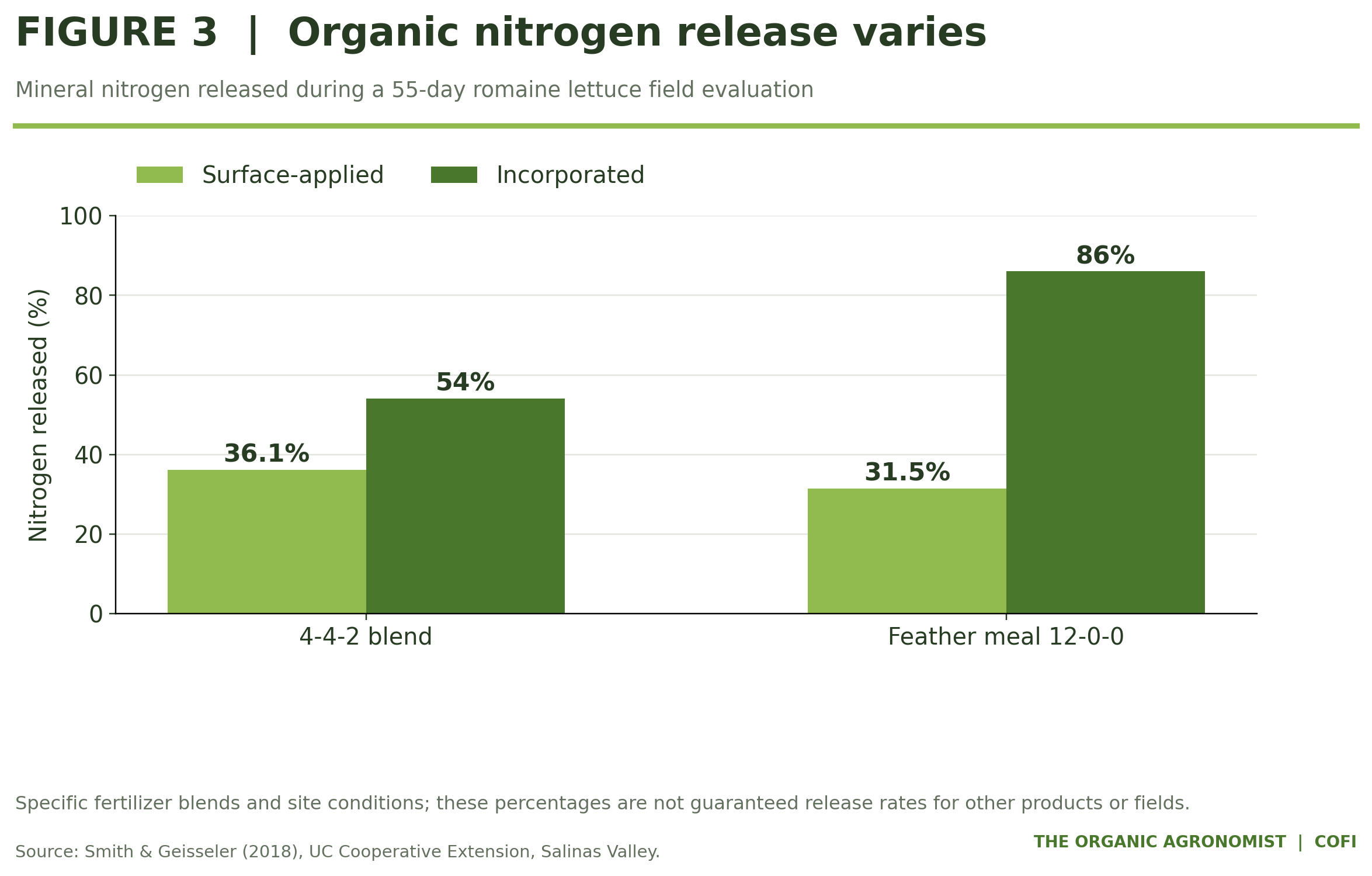
Bar chart comparing nitrogen release percentages from surface-applied and incorporated 4-4-2 organic fertilizer and feather meal 12-0-0 during a 55-day romaine lettuce field evaluation.
Figure 3. Organic Fertilizer Nitrogen Release: Surface Applied Versus Incorporated
University of California research demonstrated substantial differences in nitrogen release from organic fertilizers depending on the material and its placement. The results illustrate why total fertilizer nitrogen does not necessarily reflect nitrogen available during the crop cycle.
These results demonstrate two important principles.
First, organic fertilizers do not necessarily release nitrogen at the same rate, even when applied to the same soil.
Second, incorporating fertilizer into the soil can significantly change its release behavior.
In this particular study, incorporated feather meal released a much larger percentage of its nitrogen than the incorporated 4-4-2 material.
The research should not be interpreted to mean that these percentages will occur in every field. Organic fertilizers differ in manufacturing methods and raw materials, and soil conditions strongly influence nitrogen release.
Nevertheless, the findings establish why nutrient availability must be considered separately from fertilizer analysis.
A revealing calculation
Suppose a grower applies three tons of 4-4-2 fertilizer containing 240 pounds of total nitrogen.
Using the 54% release result from the UC field experiment for illustration:
240 pounds total nitrogen × 54% = approximately 130 pounds released.
The remaining approximately 110 pounds would not have been released during that particular evaluation period.
This is an illustrative calculation, not a validated prediction for every commercial chicken-pellet fertilizer.
It also does not mean that the lettuce necessarily absorbed all 130 pounds of released nitrogen. The amount actually taken up depends on root activity, soil nitrogen availability, losses, and other field conditions.
Still, the calculation demonstrates why applying 240 pounds of total organic nitrogen should not be considered equivalent to supplying 240 pounds of plant-available nitrogen.
Research Spotlight: Organic fertilizer mineralization
A peer-reviewed study published in California Agriculture in 2022 examined fertilizer management in organic cool-season leafy green crops.
The researchers found considerable variation in nitrogen mineralization among fertilizer types. In laboratory evaluations lasting 56 days, dry organic fertilizer materials released between approximately 15% and 61% of their initial nitrogen, while the liquid fertilizers tested released approximately 52–69%.
These findings reinforce the importance of fertilizer characteristics and growing conditions when estimating plant-available nitrogen.
They do not establish that every liquid fertilizer will perform better than every dry fertilizer. The tested products differed in composition, and mineralization measurements do not directly establish comparative marketable yields.
The practical lesson is that fertilizer programs should be evaluated according to the nitrogen they can supply during the crop's growing period rather than the total nitrogen printed on the bag.
The Final 30 Days: Why Liquid Nitrogen Can Make a Difference
One of the most important opportunities to improve nitrogen management in organic lettuce occurs during the final 30 days before harvest.
This is the period when lettuce growth accelerates, head development advances, and the crop accumulates much of its harvestable weight.
According to CDFA, lettuce may absorb approximately 70–80% of its total nitrogen during this final month. During peak demand, nitrogen uptake may reach 3–4 pounds per acre per day.
The practical significance is substantial.
A grower may have applied a large quantity of organic fertilizer before planting, but that does not guarantee enough nitrogen will be available during this critical period.
Some nitrogen may already have been released and taken up or lost, while another portion may remain bound in organic compounds awaiting mineralization.
The remaining crop growth period is relatively short. Nitrogen that becomes available after harvest cannot contribute to the current crop's marketable yield.
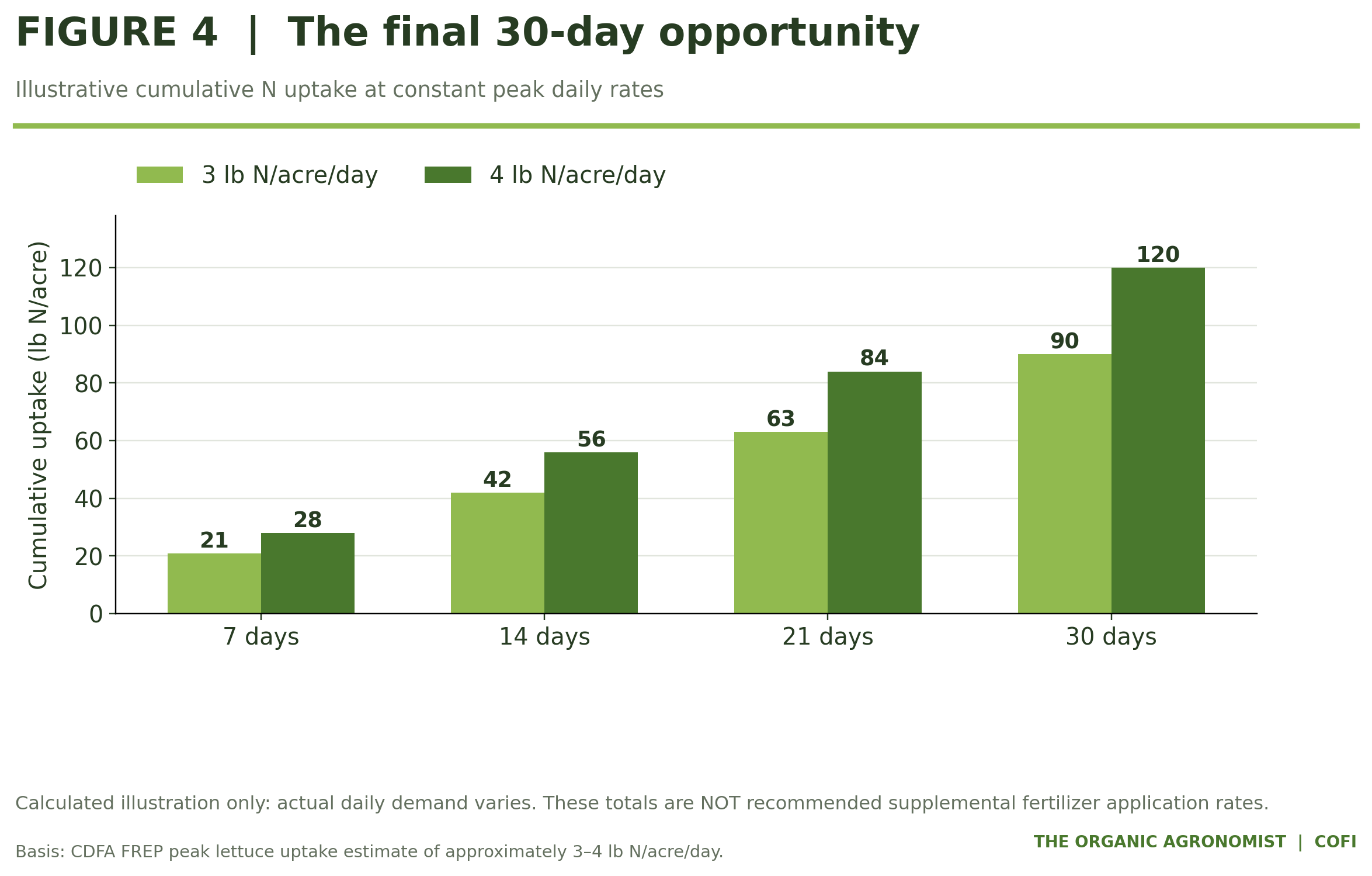
Bar chart illustrating cumulative nitrogen uptake at constant hypothetical rates of three and four pounds per acre per day over 7, 14, 21, and 30 days during late lettuce growth.
Figure 4. The Final 30-Day Nitrogen Opportunity
At peak nitrogen uptake rates reported in California lettuce research, the crop may absorb approximately 3–4 pounds of nitrogen per acre per day. The chart illustrates how rapidly crop demand can accumulate over short periods. Actual daily uptake varies, and these values are not supplemental fertilizer recommendations.
Why readily available liquid nitrogen offers an advantage
Liquid fertilizers containing readily plant-available nitrogen offer growers an opportunity to respond more directly to the crop's changing nutritional requirements.
Unlike organically bound nitrogen that must first undergo microbial mineralization, nitrogen already present in plant-available forms can contribute to crop nutrition without waiting for that initial conversion.
When supplied through an appropriately managed drip irrigation system, liquid nitrogen can be delivered into the active root zone in measured applications.
This offers several potential advantages.
Timely nitrogen availability. Supplemental nitrogen can be supplied during the period of rapid crop growth.
Greater application flexibility. Rates can be adjusted in response to soil tests and crop development rather than relying exclusively on a large preplant application.
More precise placement. Drip fertigation can place soluble nutrients within the irrigated root zone.
Reduced dependence on uncertain mineralization. Growers can supplement nitrogen released from preplant fertilizers when measured supplies are inadequate.
Potentially improved fertilizer efficiency. Supplying additional nitrogen when the crop needs it may reduce unnecessary early-season nitrogen loading.
The benefits depend on fertilizer chemistry, application rate, irrigation management, and the nitrogen already available in the soil.
Liquid fertilizer is not automatically more effective merely because it is liquid. The important distinction is how much nitrogen is already plant-available and how effectively it reaches the roots.
The opportunity to protect marketable yield
During the final weeks before harvest, lettuce is accumulating the fresh weight that determines much of its commercial value.
If nitrogen becomes limiting during this period, photosynthesis and leaf expansion may decline, potentially reducing head size, uniformity, and marketable production.
When a shortage is identified early enough, a supplemental application of readily available nitrogen may help maintain growth through the remaining development period.
However, supplemental nitrogen cannot necessarily recover yield already lost to prolonged deficiency, and additional nitrogen will not improve yields when soil supplies are sufficient.
This makes testing and timing essential.
The objective is to prevent avoidable nitrogen shortages before they restrict crop development—not to apply additional fertilizer simply because harvest is approaching.
A better alternative to relying entirely on preplant nitrogen
A more responsive fertility strategy combines a carefully calculated preplant program with the ability to provide supplemental nitrogen during periods of high demand.
For growers who traditionally rely on several tons of chicken-based pellets per acre, this approach creates an opportunity to reconsider how much nitrogen must be applied before planting.
Rather than attempting to supply the entire crop through uncertain mineralization, growers can establish an appropriate nutrient foundation and adjust subsequent applications using soil testing and crop development.
The objective is not necessarily to replace dry organic fertilizer with liquid fertilizer.
It is to use both types according to their strengths.
Dry organic fertilizers can establish a nutritional foundation. Readily available liquid nitrogen can help maintain adequate crop nutrition when uptake accelerates and measured soil supplies are insufficient.
For a short-season crop such as lettuce, this distinction can be particularly important.
Better Nitrogen Timing Can Improve Marketable Yield and Quality
Lettuce growers are paid for marketable production, not simply for total plant biomass.
A nitrogen program must therefore support both yield and crop quality.
When nitrogen is adequately supplied during rapid growth, lettuce can maintain the photosynthetic capacity necessary for leaf expansion and fresh-weight accumulation.
When nitrogen becomes limiting, growth may slow, potentially reducing head size and harvestable weight.
For iceberg lettuce, this may result in smaller or lighter heads.
For romaine, insufficient nitrogen can reduce leaf development and plant size.
These effects have economic consequences because marketable yield depends on producing lettuce that satisfies buyer specifications.
Crop uniformity matters
A successful lettuce harvest also depends on uniform crop development.
Plants that vary significantly in size or maturity can complicate harvest decisions and reduce the proportion of the crop meeting market requirements.
Inconsistent nitrogen availability can contribute to uneven growth, although irrigation, soil variability, temperature, disease, and other factors may also be responsible.
Soil testing and field observations are needed to distinguish nitrogen shortages from other production problems.
More nitrogen does not always improve quality
Adequate nitrogen supports growth and quality, but excessive nitrogen does not guarantee better lettuce.
CDFA's guidelines describe research indicating that high nitrogen and phosphorus applications can sometimes increase bacterial disease severity and reduce postharvest shelf life.
These effects depend on growing conditions and should not be interpreted as inevitable consequences of applying nitrogen.
The goal is balanced nutrition that supports vigorous growth without unnecessary nutrient accumulation.
Test the Soil Before Deciding How Much Nitrogen to Apply
Test the Soil Before Deciding How Much Nitrogen to Apply
One of the most useful tools available to coastal lettuce growers is the presidedress soil nitrate test.
Research in the Salinas Valley established that additional nitrogen fertilizer was generally unnecessary when soil nitrate-nitrogen in the upper foot of soil exceeded approximately 20 parts per million.
At 20 ppm, the upper foot of soil contains approximately 80 pounds of nitrate-nitrogen per acre using the regional conversion described by CDFA.
This does not mean that a single test guarantees adequate nitrogen through harvest. Continued crop uptake, irrigation, rainfall, and other factors can change the soil nitrate supply.
It does mean that growers can avoid some unnecessary applications by measuring nitrogen already present.
A practical decision example
Suppose a representative soil test shows 15 ppm nitrate-nitrogen before a planned sidedress application.
Under the conditions described in CDFA's regional guidance, approximately 4 pounds of nitrogen per acre are needed to increase soil nitrate-N by 1 ppm in the upper foot.
The difference between 15 ppm and 20 ppm is 5 ppm.
5 ppm × 4 pounds per acre = approximately 20 pounds of nitrogen per acre.
This illustrates why a relatively modest, well-timed application may sometimes be more appropriate than another large application made without knowing the soil nitrogen supply.
The calculation is a regional decision aid, not a universal prescription. Interpretation must account for the crop stage, soil conditions, delivery method, nitrogen source, and expected changes before the next evaluation.
Credit other nitrogen sources
Fertilizer is not the only source of nitrogen available to lettuce.
Growers should also consider:
Residual nitrate from previous crops.
Nitrate supplied by irrigation water.
Mineralization of soil organic matter.
Nitrogen released from incorporated crop residues.
Nitrogen released from earlier fertilizer applications.
These contributions may be important where multiple crops are produced on the same land during the year.
A current soil nitrate measurement may already include nitrogen released from prior applications. That nitrogen should not be counted twice.
A useful nutrient plan distinguishes measured available nitrogen, expected future contributions, and additional fertilizer requirements.
The Water Quality Challenge in the Salinas Valley
Nitrogen management has implications beyond individual crop performance.
Organic lettuce production in Monterey County takes place within a region where groundwater nitrate contamination is a major environmental concern.
The Central Coast Regional Water Quality Control Board regulates agricultural discharges through its Irrigated Lands Program.
Agricultural Order 4.0 establishes requirements for agricultural operations, including applicable nitrogen-management, monitoring, recordkeeping, and reporting provisions.
The regulatory framework has also been evolving following State Water Board review. Certain fertilizer-nitrogen application and groundwater discharge limits were remanded, and the Central Coast board has been considering amendments.
Growers should consult the currently applicable order and reporting guidance for the specific requirements governing their operations rather than assuming a single numerical nitrogen limit applies to every lettuce field.
Regardless of the regulatory details, the underlying environmental challenge remains.
Nitrogen that is not absorbed by the crop can remain in the soil, where nitrate may be vulnerable to movement with drainage water.
Organic nitrogen is part of the same nitrogen cycle
Organic fertilizer nitrogen is initially present partly in carbon-containing compounds.
As microorganisms mineralize those compounds, nitrogen can become available as ammonium.
Other microorganisms can convert ammonium to nitrate through nitrification.
Nitrate is readily transported in soil water.
Consequently, nitrogen originally supplied by organic fertilizer can eventually contribute to nitrate leaching if it is released when crop uptake is low and drainage occurs.
Organic fertilizer is not automatically protected from nitrogen loss simply because its original nitrogen was organically bound.
This is why efficient nitrogen management matters in certified organic agriculture.
Nitrogen remaining after harvest
A lettuce crop has a relatively short production cycle.
When organic fertilizer continues mineralizing after harvest, some of the released nitrogen may benefit the following crop.
However, nitrogen remaining without active plant uptake can also be vulnerable to loss, particularly when rainfall or excessive irrigation causes drainage.
Growers producing successive vegetable crops should therefore consider residual nitrogen from earlier applications instead of treating each planting as an entirely separate nutrient system.
Good nitrogen management considers both the current crop and the crop that follows.
Irrigation and Nitrogen Management Must Work Together
Even a well-designed fertilizer program can perform poorly when irrigation management is inadequate.
Lettuce has a relatively shallow active rooting zone.
Water moving below that zone can carry nitrate beyond the reach of the crop.
Excessive irrigation can therefore reduce nitrogen-use efficiency even when fertilizer rates appear reasonable.
Inadequate irrigation can also restrict nutrient movement to roots and slow crop growth.
A successful program coordinates nitrogen applications with irrigation management.
Important considerations include:
Soil moisture.
Crop development.
Evapotranspiration.
Rooting depth.
Irrigation uniformity.
Soil texture.
Nitrate concentrations in irrigation water.
Where drip irrigation is available, liquid nitrogen applications may allow more controlled delivery within the wetted root zone.
However, application uniformity and irrigation scheduling remain important.
Applying more fertilizer does not correct excessive irrigation, poor distribution, or other root-zone problems.
The Economic Opportunity: Better Yield per Pound of Nitrogen
Fertilizer efficiency is often discussed primarily as an environmental objective.
For lettuce growers, it is also a production and profitability issue.
A preplant program using three tons of fertilizer per acre involves substantial material, transportation, handling, and application costs.
If a carefully managed program can produce equivalent or better marketable yields with less total fertilizer, the economic benefits may include lower costs and improved nutrient-use efficiency.
If that program also prevents a nitrogen deficiency during rapid crop growth, it may protect marketable production.
These potential benefits should be tested in commercial field trials rather than assumed.
Comparing two fertility strategies
Traditional high-rate preplant strategy
Apply a large amount of dry organic fertilizer before planting and rely primarily on mineralization to support crop growth.
This approach can supply substantial total nutrients but offers less control over when organically bound nitrogen becomes available.
Measured preplant plus supplemental nitrogen strategy
Use soil testing to establish an appropriate preplant nutrient foundation.
Monitor plant-available nitrogen during crop development.
When testing and crop demand justify additional nitrogen, apply a source capable of supplying nitrogen within the remaining growth period.
This strategy allows growers to adjust their program as the crop develops.
What should growers measure?
A meaningful comparison should evaluate:
Total fertilizer expense per acre.
Total nitrogen applied.
Estimated plant-available nitrogen.
Marketable cartons per acre.
Average head weight.
Crop uniformity.
Harvest quality.
Residual soil nitrogen after harvest.
The objective is not simply to reduce fertilizer purchases.
It is to improve the relationship between fertilizer investment and profitable marketable production.
A program that saves fertilizer but significantly reduces yield may not be an improvement.
Likewise, additional fertilizer that produces no measurable yield or quality benefit represents an expense without a demonstrated return.
The most efficient nitrogen program is the one that supports profitable crop production with the least unnecessary nutrient input.
Practical Nitrogen Management Priorities for Organic Lettuce
A successful program begins before planting and continues through harvest.
1. Measure existing soil nutrients.
Test soil nitrate and other relevant nutrients before establishing fertilizer rates.
2. Establish an appropriate preplant foundation.
Choose fertilizer materials and rates according to crop requirements, soil conditions, and expected nutrient availability.
3. Understand fertilizer mineralization.
Consider the expected nitrogen-release characteristics of dry organic fertilizers, including their composition and placement.
4. Monitor nitrogen as crop demand increases.
Use soil nitrate testing and crop observations before the period of rapid growth.
5. Take advantage of the final 30-day management opportunity.
When available nitrogen is insufficient, consider timely supplemental applications of readily available nitrogen to support continued crop development.
6. Integrate nitrogen and irrigation decisions.
Maintain adequate moisture and nitrogen within the active root zone while minimizing unnecessary drainage.
7. Evaluate marketable yield and quality.
Measure crop performance and fertilizer costs rather than judging a program solely by total nitrogen applied.
8. Account for residual nutrients.
Consider nitrogen remaining after harvest when developing the program for the next crop.
These practices provide a framework for better management, but field-specific decisions should be based on soil conditions, crop development, and agronomic measurements.
Conclusion: Feed the Crop When It Needs Nitrogen
Organic lettuce growers face a difficult balancing act.
They must supply enough nitrogen to support rapid growth and marketable yield while managing fertilizer costs and limiting nitrogen losses.
Large preplant applications developed partly as a way to compensate for uncertainty about organic nitrogen availability.
California research demonstrates why this uncertainty matters.
Organic fertilizers differ substantially in nitrogen-release characteristics, and the timing of release does not always coincide with lettuce demand.
At the same time, lettuce absorbs most of its nitrogen during the final month before harvest.
This makes the final 30 days an especially important opportunity for well-timed nitrogen management.
Rather than relying entirely on large preplant applications, growers can establish an appropriate nutrient foundation, monitor available nitrogen, and use supplemental nitrogen sources when measured shortages justify them.
Readily available liquid nitrogen can be particularly useful because it allows growers to respond to crop demand without depending exclusively on continued mineralization of preplant materials.
This approach offers the potential to protect yield, improve crop uniformity, reduce unnecessary fertilizer expense, and limit nitrogen remaining vulnerable to environmental losses.
The goal is not to reduce crop nutrition.
It is to improve it.
Successful nitrogen management is not measured by how much fertilizer goes into the field. It is measured by how effectively available nitrogen supports marketable crop production.
Key Takeaways
Lettuce may absorb approximately 70–80% of its nitrogen during the final month before harvest.
Total fertilizer nitrogen is not equivalent to plant-available nitrogen.
Large preplant applications do not guarantee sufficient nitrogen during peak demand.
Three tons of 4-4-2 fertilizer supplies 240 pounds of total nitrogen, but only a portion may become available during the crop cycle.
University of California research demonstrates substantial differences in organic fertilizer nitrogen release depending on material and placement.
Liquid fertilizers containing readily available nitrogen can provide a useful supplemental tool during the final 30 days when soil nitrogen supplies are inadequate.
Soil nitrate testing helps growers avoid unnecessary applications and identify nitrogen shortages.
Better nitrogen management can help protect marketable yield and quality while creating opportunities to improve fertilizer efficiency.
Nitrogen and irrigation management must work together to minimize nutrient losses.
Fertilizer programs should be evaluated according to profitability, crop performance, and nutrient-use efficiency—not simply the amount of nitrogen applied.
References
California Department of Food and Agriculture, Fertilizer Research and Education Program. California Fertilization Guidelines: Lettuce.
https://www.cdfa.ca.gov/is/ffldrs/frep/FertilizationGuidelines/Lettuce.htmlCalifornia Department of Food and Agriculture. Nitrogen Fertilization: California Lettuce Fertilization Guidelines.
https://apps1.cdfa.ca.gov/FertilizerResearch/docs/LettuceBrochure.pdfSmith, R. F., and Geisseler, D. J. (2018). Release of Mineral Nitrogen from Organic Soils and Fertilizers Investigated. University of California Cooperative Extension, Salinas Valley Agriculture.
https://ucanr.edu/blog/salinas-valley-agriculture/article/release-mineral-nitrogen-organic-soils-and-fertilizersSmith, R. F., Cahn, M. D., Hartz, T., Geisseler, D. J., and Love, P. (2022). Fine-tuning fertilizer applications in organic cool-season leafy green crops can increase soil quality and yields. California Agriculture, 76(2–3), 77–84.
https://doi.org/10.3733/ca.2022a0010University of California Agriculture and Natural Resources. Soil Nitrate Quick Test and Nitrogen Management Resources.
https://ucanr.edu/Central Coast Regional Water Quality Control Board. Irrigated Lands Program: Regulatory Information and Agricultural Order 4.0.
https://www.waterboards.ca.gov/centralcoast/water_issues/programs/ilp/regulatory_information.html
Suggested Citation
The Organic Agronomist. (2026). Growing Organic Lettuce: Better Nitrogen Management, Better Yields, Less Waste. Reviewed by Tim Stemwedel, CCA. California Organic Fertilizers, Inc.
Permission to Use
© 2026 California Organic Fertilizers, Inc. All rights reserved. Readers may download, save, and print this publication for personal, educational, or internal business use. Brief excerpts may be quoted with attribution to The Organic Agronomist and a link to the original article. This publication may not be republished, altered, sold, distributed commercially, or presented as another party’s work without prior written permission from California Organic Fertilizers, Inc.
Need help saving a PDF? Click here for instructions.
To save a copy to your computer:
- Right-click the yellow PDF button above.
- Choose Save link as... from the menu.
- Choose where to save the file, such as Downloads.
- Click Save.
Already opened the PDF? Click the printer icon, select Save as PDF as the printer or destination, then click Save.