Published by The Organic Agronomist
Agronomic review: Tim Stemwedel, CCA and COFI Founder
“Feed the soil, not the plant” expresses a foundational principle of organic agriculture: productive farming depends on living soil, active nutrient cycling, and management that protects the biological system beneath the crop.
The phrase becomes misleading, however, when it is treated as a choice between microbes and plants. Crops feed soil organisms through roots, residues, and carbon-rich exudates. Soil organisms decompose organic materials, cycle nutrients, build aggregates, and influence the conditions in which roots grow. The crop is not separate from the soil food web; it is one of its principal participants.
The practical goal of organic fertility is to create a functioning soil-crop system that supplies nutrients in plant-available forms when the crop requires them. Some inputs support long-term soil development. Some depend on microbial mineralization. Others provide nutrients farther along the availability pathway. Strong programs understand and combine these functions.
Healthy Soil Is a Foundation of Organic Agriculture
Healthy soil is a living ecosystem in which minerals, organic matter, water, air, plant roots, and organisms interact.
That living system performs several functions that matter directly to growers:
Cycling carbon, nitrogen, phosphorus, sulfur, and other nutrients.
Decomposing residues and organic amendments.
Forming and stabilizing soil aggregates.
Regulating infiltration, drainage, and water storage.
Creating habitat for roots and soil organisms.
Diverse rotations, cover crops, living roots, organic amendments, reduced disturbance, and careful nutrient management work together to protect these functions.
What Does It Mean to Feed the Microbes?
Soil microorganisms require energy and nutrients. Much of their energy comes from carbon compounds supplied by living roots, crop residues, cover crops, composts, and other organic materials.
Plant roots release sugars, amino acids, organic acids, and other compounds into the narrow zone of soil surrounding them. This zone is called the rhizosphere. Root-derived compounds support biological activity where plants and microorganisms exchange resources and chemical signals.
Microorganisms also break down dead roots, residues, and organic fertilizers. During decomposition, some nutrients are temporarily held in microbial cells—a process called immobilization. Others are released in inorganic forms that roots can absorb.
The conversion of organically bound nutrients into plant-available inorganic forms is called mineralization. This process helps explain why the nitrogen percentage on a fertilizer label does not tell the whole story about when that nitrogen will become available to the crop.
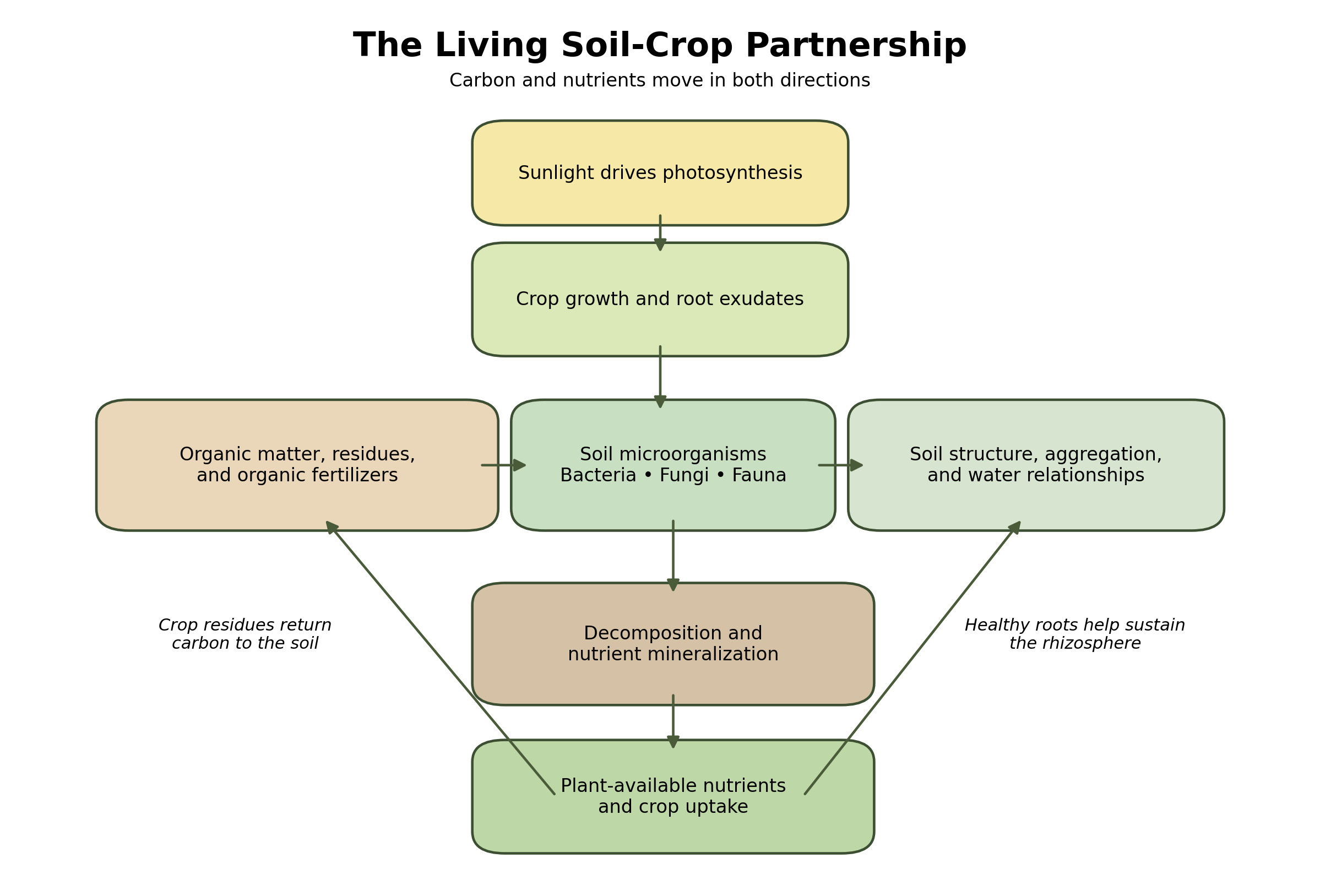
Diagram showing the relationship among crop growth, root exudates, soil organisms, decomposition, nutrient release, and root uptake.
Plants supply carbon through roots and residues. Soil organisms break down organic materials and release nutrients that support crop growth.
Crops Also Feed the Soil
A growing crop captures solar energy and converts it into carbon compounds through photosynthesis. Some of that carbon becomes leaves, stems, roots, and harvested yield. Some enters the soil through root exudates, and some remains after harvest as roots and residues.
Living roots feed the rhizosphere during the growing season. Crop residues and dead roots continue feeding decomposers afterward. Cover crops can extend this biological activity beyond the cash-crop season.
Healthy crops help sustain the biological system that supports future crops. Soil biology feeds the crop, and the crop feeds soil biology.
Why “Feed the Soil, Not the Plant” Is Incomplete
The traditional phrase reminds growers to consider more than the fertilizer label. A fertility program must account for soil organic matter, biological activity, rooting, moisture, temperature, pH, aeration, and the rate at which nutrients become available.
Plants absorb nutrients in particular chemical forms. Nitrogen, for example, is absorbed mainly as ammonium and nitrate. Most nitrogen bound in organic materials must first be released through decomposition and mineralization.
A more complete principle is: Feed and protect the soil so the soil-crop system can nourish the plant.
A successful organic program supports soil function while meeting crop demand at critical growth stages. Both matter for a productive, durable farming system.
Different Fertility Inputs Enter at Different Points
Organic fertility materials differ in composition and nutrient-release pattern. Some supply organic matter and nutrients that require substantial biological processing. Others contain nutrients already in forms roots can absorb.
When choosing an input, ask:
What nutrients and carbon compounds does it contain?
How much decomposition or mineralization is needed?
How quickly will that occur under current field conditions?
When will the crop need those nutrients?
Compost, cover crops, and crop residues support soil function while contributing nutrients over time. Protein meals depend on microbial decomposition to release their nitrogen. Liquid organic fertilizers vary: some contain a mixture of soluble nutrients and organic compounds that still require biological processing.
Sources containing plant-available nitrogen can help meet time-sensitive crop demand. Their performance still depends on placement, irrigation, and soil conditions.
These roles overlap. A strong fertility program combines inputs according to what the soil and crop need.
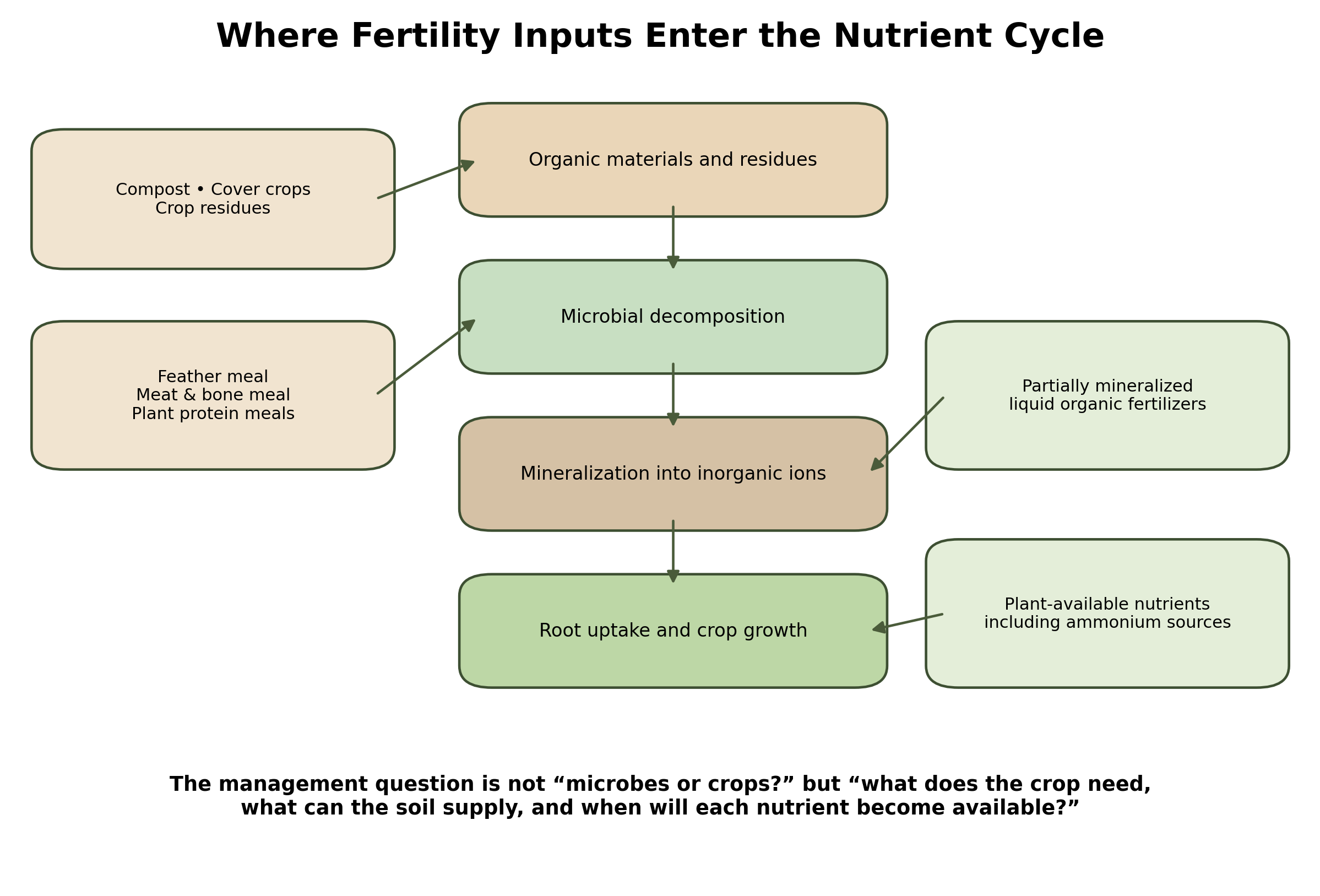
Diagram showing how compost, crop residues, protein meals, liquid organic fertilizers, and plant-available nutrients enter the pathway to crop uptake.
Fertility inputs enter the nutrient cycle at different points. Their composition and the biological processing required influence when nutrients become available.
Mineralization Depends on Field Conditions
A fertilizer may contain enough total nitrogen on paper and still release it too slowly for the crop. Microbial mineralization depends on field conditions, including:
Soil temperature.
Soil moisture and aeration.
Carbon-to-nitrogen ratio.
Particle size and physical form.
Microbial activity.
Soil pH.
Placement and incorporation.
Cold or dry soil can slow biological activity. Saturated soil can limit oxygen and change how nitrogen is transformed.
Carbon-rich materials may also encourage microbes to temporarily hold available nitrogen in their cells. This immobilization can reduce the nitrogen available to the crop during that period.
Treat nutrient-release estimates as planning guides. Use soil and tissue testing, field observations, and crop growth stages to check whether the program is meeting demand.
Immediate Plant Nutrition Does Not Exclude Soil Biology
Plant-available nutrients and biological soil management can work together.
Once nutrients enter the soil, several things can happen. Plants may absorb them, microorganisms may temporarily hold them, soil particles may retain them, and water may transport them.
A nutrient that is immediately available to roots still participates in the soil ecosystem. Its usefulness depends on application rate, placement, timing, crop demand, and the risk of loss.
The goal is balance: protect the living soil system while meeting the crop’s nutritional needs. Sources of plant-available nutrients can address a time-sensitive shortage while practices that support organic matter, living roots, and soil structure continue.
Building a Soil-Crop Fertility Program
A sound organic fertility program begins with the field. Use these steps to connect soil management with crop nutrition:
Estimate crop demand. Identify when nutrient uptake accelerates and which growth stages are most sensitive to shortages.
Estimate the soil’s contribution. Consider soil and tissue tests, field history, organic matter, crop residues, cover crops, and nutrients supplied by irrigation water.
Account for release timing. Separate total nutrient content from expected plant availability. Consider soil conditions, material form, placement, and time for mineralization.
Support living roots and carbon flow. Use rotations, cover crops, and residue management where practical.
Protect soil habitat. Limit compaction, erosion, and prolonged saturation. Soil organisms need suitable pore space, moisture, oxygen, and food.
Correct time-sensitive shortages. When crop demand exceeds nutrient release, use an appropriate source allowed by your organic certifier and follow its label.
Measure outcomes. Evaluate crop growth, tissue status, rooting, soil structure, infiltration, quality, and yield to guide adjustments.
Common Mistakes to Avoid
Assuming more microbial activity is always better. Microorganisms can release nutrients, but they can also temporarily hold nitrogen in their cells. Nutrient release may occur when no crop is present to use it. Interpret biological activity alongside crop demand and field conditions.
Confusing total nutrients with available nutrients. The nutrient percentage on a fertilizer label does not tell you how much the crop can use during a particular growth stage.
Ignoring carbon-to-nitrogen balance. Carbon-rich residues can encourage microbes to temporarily immobilize available nitrogen as they decompose the material.
Treating all organic fertilizers as equivalent. Materials differ in composition, processing, physical form, and release pattern. Compare their expected contribution to the crop during the period that matters.
Overlooking soil conditions. Temperature, moisture, aeration, and compaction influence biological processes. Adding fertilizer may not resolve a problem caused by poor root conditions.
Feed the Soil and Meet the Crop’s Needs
Organic fertility works through the relationship among soil, microorganisms, roots, and nutrients. Supporting that relationship means caring for soil function while making sure the crop receives nutrition when it needs it.
Build the long-term foundation with living roots, organic matter, and practices that protect soil structure. Match fertilizer sources and application timing to expected nutrient release and crop demand. Then use testing and field observations to adjust the program.
The goal is a functioning soil-crop system that supports productive crops season after season.
References and Further Reading
USDA NRCS — Soil Health. Natural Resources Conservation Service
USDA NRCS — Soil Biology Primer. Natural Resources Conservation Service
Ma and colleagues (2022) — Root exudates contribute to belowground ecosystem hotspots: A review, Frontiers in Microbiology.
Suggested citation
The Organic Agronomist. (2026). Feed the Soil, Feed the Crop: The Real Goal of Organic Fertility. California Organic Fertilizers, Inc.
Permission to Use
© 2026 California Organic Fertilizers, Inc. All rights reserved. Readers may download, save, and print this publication for personal, educational, or internal business use. Brief excerpts may be quoted with attribution to The Organic Agronomist and a link to the original article. This publication may not be republished, altered, sold, distributed commercially, or presented as another party’s work without prior written permission from California Organic Fertilizers, Inc.
Need help saving a PDF? Click here for instructions.
To save a copy to your computer:
- Right-click the yellow PDF button above.
- Choose Save link as... from the menu.
- Choose where to save the file, such as Downloads.
- Click Save.
Already opened the PDF? Click the printer icon, select Save as PDF as the printer or destination, then click Save.