Match nitrogen timing to crop growth and protect fruit quality
Published by The Organic Agronomist
Agronomic review: Tim Stemwedel, CCA and COFI Founder
California Organic Fertilizers, Inc.
A productive organic tomato crop needs a nutrient plan that changes with the plant. Early establishment, rapid canopy growth, fruit set, and ripening create different demands. The practical goal is to keep nutrients available when the crop can use them while protecting roots, irrigation water, and fruit quality.
Start with the production system
Much of California’s tomato nitrogen research concerns processing tomatoes grown for a concentrated harvest. Fresh-market varieties harvested over many pickings can have a different season and growth pattern. Use the research as a guide to timing, then adapt the plan to variety, planting method, field conditions, and harvest goals. [1, 2]
An early period of low nitrogen uptake is shorter in transplanted crops than in crops established from seed. A calendar date alone therefore gives an incomplete picture. Record crop stage alongside soil and tissue results so nutrition decisions follow the planting’s development. [2]
Test the field before building the nitrogen budget
replant soil testing helps identify nutrient needs and salinity concerns. Sample representative areas, and keep different soil types or management zones separate. A field with adequate residual nutrients may need a different plan from a field following a crop that depleted them. [3]
A soil nitrate test measures nitrate present at sampling. Account for that supply when estimating supplemental nitrogen, alongside irrigation-water nitrogen and expected contributions from previous organic inputs. Use the laboratory and adviser’s sampling protocol, including the appropriate depth and interpretation for your production system. [1, 3]
Plan for availability as well as application date
Organic production does not mean every nitrogen source becomes available at the same speed. Plants can take up mineral nitrogen, including ammonium and nitrate. Nitrogen bound in organic matter must pass through microbial mineralization before contributing to this mineral supply. [4]
The amount and timing of release depend on the material and soil conditions. Temperature and moisture influence microbial activity, and some materials can temporarily tie up nitrogen. Count expected availability during the target growth stage, rather than treating the full nitrogen analysis as immediately available. Keep previous compost, cover crop, and amendment applications in the budget. [4]
Support rapid growth without chasing vine growth
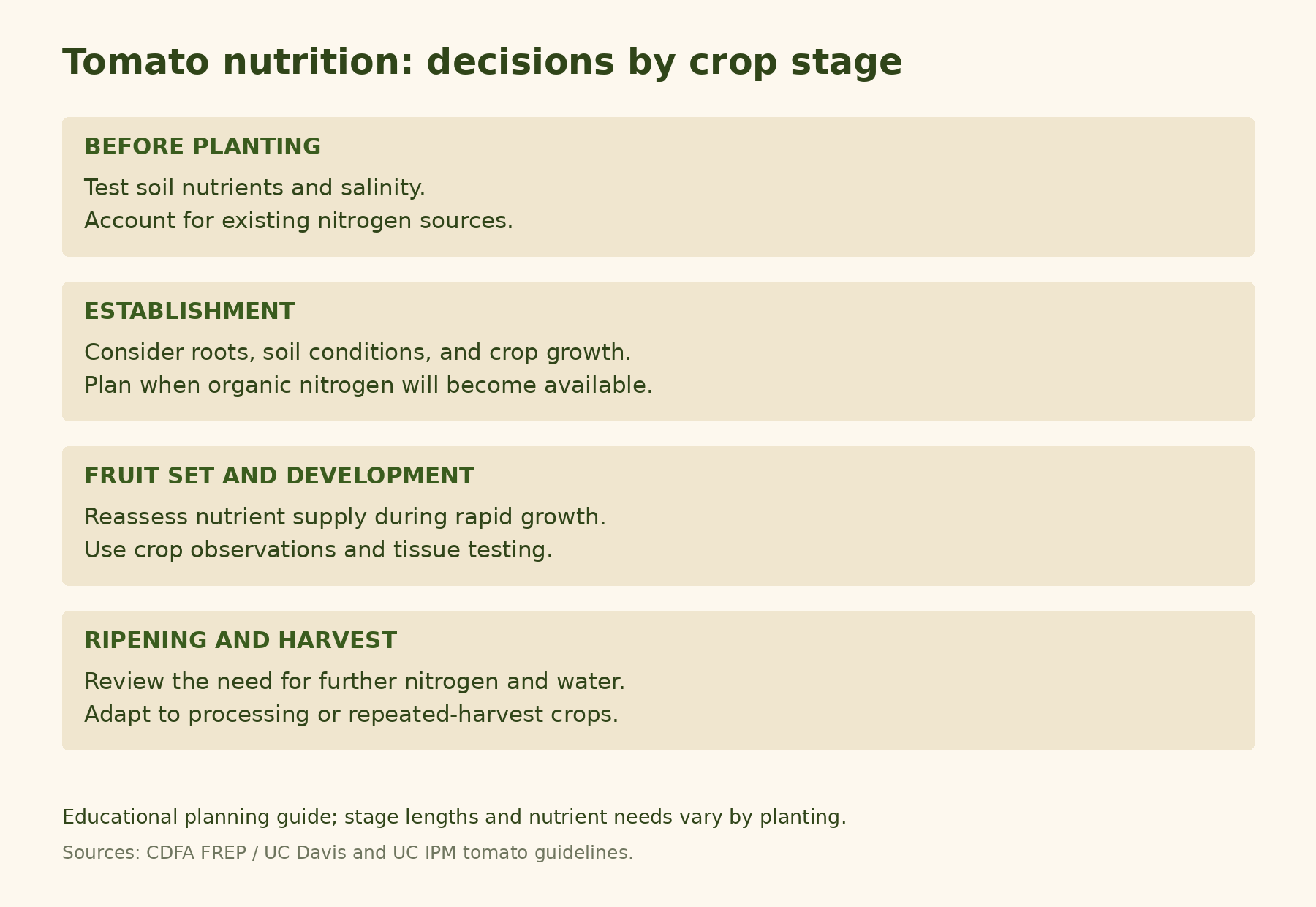
Tomato nutrition planning guide: test before planting, account for nitrogen release during establishment, reassess during fruit set and development, and review continuing need as fruit ripens. Processing and repeated-harvest crops need different decisions.
Figure 1. Tomato nutrition decisions by crop stage. This is an educational planning guide; stage lengths and nutrient needs vary with the planting and production system.
Manage irrigation as part of nutrition
Tomato water use increases as the canopy expands. In processing systems, demand is high during fruit development, while late-season irrigation decisions also affect maturity and soluble solids. Use weather-based crop water estimates with root-zone moisture observations and irrigation-system performance. [5]
Keep the root zone supplied without prolonged saturation or repeated drying. Fertigation timing should fit both nutrient demand and the irrigation needed by the crop. Adjust irrigation intervals and amounts for soil texture, drainage, and rooting conditions rather than repeating one fixed schedule throughout the season. [5]
Investigate fruit disorders before adding fertilizer
Blossom-end rot is associated with inadequate calcium in developing fruit and the plant’s water balance. High salinity and low soil moisture can aggravate it. Its appearance does not establish that the field simply needs more fertilizer. [6]
Check moisture patterns, salinity, root conditions, and crop observations before choosing a correction. The disorder is physiological rather than caused by a pathogen. Consistent root-zone moisture and appropriate fertilizer rates are part of prevention; variety also affects susceptibility. [6]
Use measurements to refine the next decision
Combine crop observations with soil and properly timed tissue tests. California processing-tomato guidance favors whole-leaf nitrogen analysis over petiole analysis for a more stable estimate of nitrogen status. Follow a consistent sampling protocol and interpret results against the crop stage. [1]
Keep records of inputs, irrigation, crop stages, yield, and fruit quality by field. Review those records with your crop adviser to identify where availability matched demand and where it did not. A useful organic tomato plan is one that can be adjusted with evidence from the planting.
References
CDFA FREP and UC Davis. Processing Tomato Fertilization Guidelines.
CDFA FREP and UC Davis. Tomato Nitrogen Uptake and Partitioning.
Suggested Citation
The Organic Agronomist. (2026). Growing Organic Tomatoes: Match nitrogen timing to crop growth and protect fruit quality. California Organic Fertilizers, Inc.
Permission to Use
© 2026 California Organic Fertilizers, Inc. All rights reserved. Readers may download, save, and print this publication for personal, educational, or internal business use. Brief excerpts may be quoted with attribution to The Organic Agronomist and a link to the original article. This publication may not be republished, altered, sold, distributed commercially, or presented as another party’s work without prior written permission from California Organic Fertilizers, Inc.
Need help saving a PDF? Click here for instructions.
To save a copy to your computer:
- Right-click the yellow PDF button above.
- Choose Save link as... from the menu.
- Choose where to save the file, such as Downloads.
- Click Save.
Already opened the PDF? Click the printer icon, select Save as PDF as the printer or destination, then click Save.