Match nitrogen supply to crop uptake, irrigation, and crop stage
ublished by The Organic Agronomist
Agronomic review: Tim Stemwedel, CCA and COFI Founder
California Organic Fertilizers, Inc.
A successful organic strawberry nitrogen program supplies nitrogen as the crop can use it while accounting for what the soil, irrigation water, and organic inputs already contribute. California field research shows a long, steady increase in crop nitrogen accumulation from spring through the fruiting season, making timing and irrigation management central to the plan.
Why timing matters in strawberries
Strawberry nitrogen demand changes sharply over the season. In commercial, fall-planted annual fields in the Salinas and Pajaro Valleys, aboveground crop nitrogen accumulation averaged about 20 pounds per acre through March. From April to mid-September, it rose steadily to about 190 pounds per acre. Including roots, seasonal uptake was estimated at about 200 pounds per acre. These values describe the crop in the studied fields; they are not fertilizer rates for every farm. [1, 2, 3]
The research also found that approximately half of the aboveground nitrogen was in harvested fruit and half in leaves and crowns. This illustrates why a crop’s nitrogen budget includes both harvested and remaining plant material. Variety, planting date, production region, yield, soil nitrogen, and management all affect the field’s actual requirement. [2, 3]
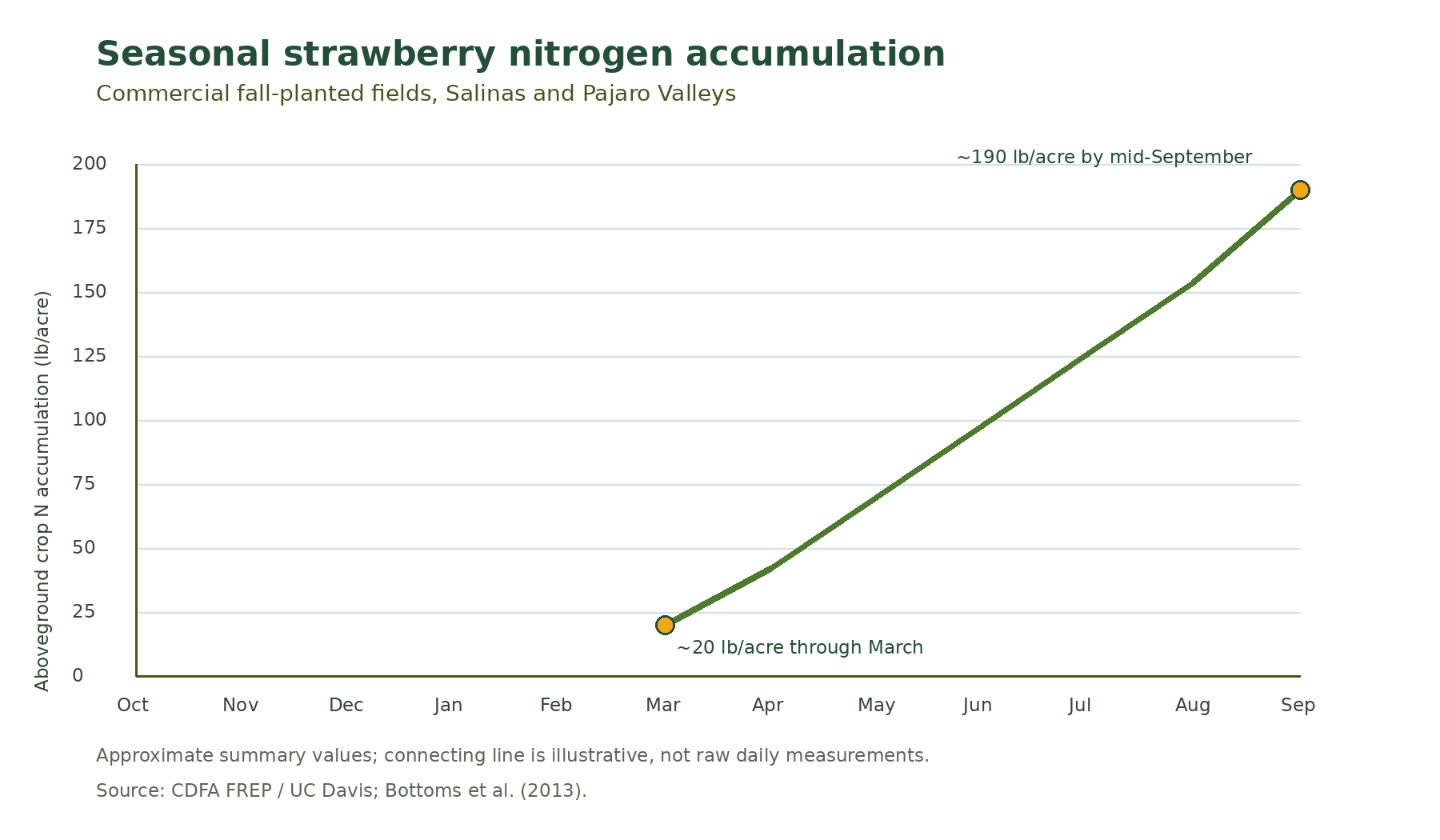
Approximate seasonal nitrogen accumulation in commercial fall-planted strawberry fields in the Salinas and Pajaro Valleys: about 20 pounds per acre through March and 190 pounds per acre by mid-September. The line between points is illustrative.
Figure 1. Seasonal aboveground nitrogen accumulation reported for commercial fall-planted strawberry fields in the Salinas and Pajaro Valleys. The line is a simplified visual guide between the published approximate reference points, not daily field measurements.
Why nitrogen form matters in strawberries
Nitrogen form affects how fertilizer moves through the soil and how plants use it. Roots can absorb both ammonium nitrogen (NH₄⁺) and nitrate nitrogen (NO₃⁻). Ammonium already present in a fertilizer is plant-available and does not need to become nitrate before roots can absorb it.
Ammonium’s positive charge allows it to attach to negatively charged soil particles, making it less susceptible to leaching than nitrate. Soil microorganisms can convert ammonium to nitrate through nitrification. The nitrogen balance around the roots therefore changes after application as plants absorb nitrogen and microorganisms transform it. [9]
California field research shows a useful role for ammonium
Biscaro, Riffle, and Geisseler compared calcium nitrate with ammonium nitrate in a commercial strawberry field near Oxnard during the 2018–2019 season. The experiment included ‘Fronteras’ and a proprietary cultivar at three nitrogen application rates.
The proprietary cultivar produced significantly greater marketable yield with ammonium nitrate. For ‘Fronteras,’ the overall yield difference between fertilizer sources was not statistically significant. Both cultivars had less nitrate remaining 12–24 inches below the soil surface under ammonium nitrate treatments, indicating lower potential for nitrate movement below the main root zone.
Ammonium nutrition can also lower pH around roots, which may be useful in alkaline soils. However, excessive ammonium exposure can restrict growth and interfere with calcium, magnesium, and potassium uptake.
This conventional fertilizer comparison supports considering ammonium-containing sources in strawberry nitrogen management. It does not establish the performance of any particular organic fertilizer. [5]
What studies show about ammonium and nitrate together
A 2006 hydroponic study of ‘Camarosa’ and ‘Selva’ strawberries demonstrated the value of including ammonium alongside nitrate. A nutrient solution supplying 25% ammonium nitrogen and 75% nitrate nitrogen produced the highest photosynthesis rates and supported favorable plant growth and fruit yield.
The study highlights the importance of a balanced nitrogen supply: ammonium contributed to productive growth, while higher ammonium proportions reduced fruit calcium concentration and postharvest life. The successful balance provides a useful research reference, with field applications requiring adjustment for soil conditions and the growing system. [6]
Apply the research through root-zone management
Ammonium is a useful, plant-available nitrogen source for strawberries. Roots can absorb it directly, and its ability to attach to soil particles makes it less susceptible to immediate leaching than nitrate. As soil microorganisms convert ammonium to nitrate, an ammonium-containing application can contribute to both forms of nitrogen in the root zone over time. [9]
California field research provides practical support for this approach. In the Oxnard study, ammonium nitrate increased marketable yield in one of the two cultivars and left less nitrate below the main root zone than calcium nitrate. These findings demonstrate the potential value of including ammonium in a strawberry nitrogen program. [5]
For organic growers, the opportunity is to match available nitrogen with active crop demand. Distinguish ammonium already present in a fertilizer from organically bound nitrogen that must mineralize. Coordinate applications with irrigation, and use soil and tissue measurements alongside crop growth and fruit quality to adjust the program through the season.
The studies support a productive role for ammonium. The appropriate balance depends on the cultivar and growing system, so use the research to guide field management rather than adopt one fixed ammonium-to-nitrate ratio. [5–8]
Use preplant nitrogen as one part of the budget
A large preplant application can put more nitrogen into the bed than young plants can use. CDFA and UC Davis recommend considering soil mineral nitrogen during winter and early spring when deciding whether more nitrogen is needed. Residual nitrate may be substantial after some previous crops, while winter rain and irrigation can move nitrate below the shallow strawberry root zone. [1]
Organic inputs add another timing consideration. Total nitrogen on a product analysis is not the same as nitrogen available to the crop at a particular date. Organically bound nitrogen must mineralize into plant-available forms, and its release depends on the material and field conditions. In contrast, ammonium nitrogen already present in an organic fertilizer is a plant-available form and does not require that mineralization step. When building the preplant budget, distinguish nitrogen already available from nitrogen expected to release later. Include contributions from compost, cover crop residues, soil organic matter, and prior fertilizer applications. [1, 4]
Match in-season feeding to crop growth
In the California coastal fields summarized by CDFA, crop nitrogen accumulation increased by roughly one pound per acre per day from April through mid-September. The steady seasonal pattern supports split applications through the fruiting period, rather than relying entirely on a large preplant dose. The research describes crop accumulation, not a daily rate to apply. [1, 2]
With drip fertigation, divide the planned weekly nitrogen amount across suitable irrigation events according to the fertilizer label and the field’s irrigation schedule. Consider both the amount applied and how quickly its nitrogen becomes available. Ammonium already present is plant-available, while organically bound nitrogen releases over time through mineralization. Keep nitrogen and irrigation decisions connected: excessive water can move nitrate—including nitrate formed from ammonium—below the active root zone, while uneven delivery can leave parts of a bed under- or over-watered. [1, 3, 4]
Monitor the field with more than one indicator
Use representative soil nitrate testing and properly timed leaf analysis alongside crop growth, fruit load, and yield records. CDFA’s strawberry guidance notes that petiole nitrate is more variable and less reliable than total nitrogen in leaf tissue. Petiole results can provide context, but interpret them with the sampling stage, cultivar, soil test, and field conditions rather than treating one result as a stand-alone trigger. [1]
Stratify samples by management block when soils, planting dates, vigor, irrigation performance, or crop history differ. Include nitrogen in irrigation water and contributions from previous crops, cover crops, and compost in the seasonal budget. A field-level record of applications, water, tissue and soil results, fruit yield, and quality provides a stronger basis for next season’s decisions. [1, 3, 4]
Build the schedule around your planting
California’s uptake research provides a useful planning reference for the coastal, fall-planted annual production systems studied. Other production regions, planting dates, cultivars, and production systems may have different timing and demand. Use the seasonal pattern to understand when the crop takes up nitrogen, then build the fertilizer schedule around your field’s measurements and nitrogen budget. [1, 2, 3]
Start with the nitrogen already supplied by soil, irrigation water, and organic inputs. Reassess the need for supplemental nitrogen as crop growth, fruit load, and growing conditions change. Keep application records alongside soil and tissue results so each season helps improve the next.
References
CDFA FREP and UC Davis. California Fertilization Guidelines: Strawberry.
CDFA FREP and UC Davis. Strawberry Nitrogen Uptake and Partitioning.
Bottoms, T.G., Hartz, T.K., Cahn, M.D., and Farrara, B.F. (2013). Crop and Soil Nitrogen Dynamics in Annual Strawberry Production in California. HortScience, 48(8), 1034–1039.
Muramoto, J. (2021). Special Nutrient Management Challenges for Fertigation of Organic Strawberries. University of California Agriculture and Natural Resources.
Biscaro, A., Riffle, V., and Geisseler, D. (2022). Assessing nitrogen uptake and the impact of fertilizer amounts and sources on strawberry production in California. Agrosystems, Geosciences & Environment.
Tabatabaei, S.J., Fatemi, L.S., and Fallahi, E. (2006). Effect of Ammonium: Nitrate Ratio on Yield, Calcium Concentration, and Photosynthesis Rate in Strawberry. Journal of Plant Nutrition, 29(7), 1273–1285.
de Jesus, G.L., Pauletti, V., Zawadneak, M.A.C., and Cuquel, F.L. (2021). Strawberry quality affected by the nitrate ratio in the nutrient solution. Revista Mexicana de Ciencias Agrícolas, 12(5), 753–763.
Chen, S., et al. (2026). Physiological and transcriptomic analyses elucidate the effects of nitrogen form ratios on strawberry growth and development. BMC Plant Biology, 26, article 1535.
University of Minnesota, Southwest Research and Outreach Center. Nitrogen Cycle.
Suggested Citation
he Organic Agronomist. (2026). Growing Organic Strawberries: Match nitrogen supply to crop uptake, irrigation, and crop stage. California Organic Fertilizers, Inc.
Permission to Use
© 2026 California Organic Fertilizers, Inc. All rights reserved. Readers may download, save, and print this publication for personal, educational, or internal business use. Brief excerpts may be quoted with attribution to The Organic Agronomist and a link to the original article. This publication may not be republished, altered, sold, distributed commercially, or presented as another party’s work without prior written permission from California Organic Fertilizers, Inc.
Need help saving a PDF? Click here for instructions.
To save a copy to your computer:
- Right-click the yellow PDF button above.
- Choose Save link as... from the menu.
- Choose where to save the file, such as Downloads.
- Click Save.
Already opened the PDF? Click the printer icon, select Save as PDF as the printer or destination, then click Save.