Published by The Organic Agronomist
Agronomic review: Tim Stemwedel, CCA and COFI Founder
A productive organic stone fruit orchard needs a nitrogen program that accounts for the crop on the tree, the growth of the canopy, and the nitrogen already available in the orchard. The practical goal is to supply the crop during periods of active uptake while avoiding applications that push unnecessary vegetative growth.
This article focuses on peaches, nectarines, plums, and prunes. Much of the timing research discussed here comes from peaches and nectarines. Use those findings as planning context, and adapt the program to the crop, variety, tree age, and harvest date.
Read tree vigor alongside crop load
In peaches and nectarines, excess nitrogen can increase summer pruning, shade lower fruiting wood, delay maturity, and reduce fruit coloration. Too little nitrogen can also limit growth and fruit development. The aim is adequate nutrition, judged with tissue analysis and orchard observations.
Before repeating last year’s fertilizer schedule, compare the current crop with the previous crop. Record fruit set, thinning, shoot growth, and pruning demand by block.
A practical interpretation of the research is to reassess nitrogen needs when a block carries fewer fruit but remains vigorous. Review that combination with your adviser before carrying forward the same fertilizer rate.
Match availability to active uptake
Peach research summarized by CDFA FREP shows little soil nitrogen uptake during dormancy and bud swell, with the greatest uptake from mid-spring through early fall. Uptake can continue while leaves remain physiologically active. [2] Early spring growth also uses nitrogen stored in the tree. [1]
For an organic program, application date and nitrogen availability are separate questions. Nitrogen bound in organic compounds must undergo mineralization before it becomes ammonium available to roots; ammonium can then be converted to nitrate. Temperature, moisture, and the characteristics of the material influence the release pattern. [3]
That means a pre-bloom dry application should be evaluated by when its nitrogen is expected to become available. A liquid follow-up should also be selected by its nitrogen form and label directions. Compare products on expected plant-available nitrogen during the target period, alongside total nitrogen content.
Account for nitrogen already in the orchard
An orchard nitrogen budget should include soil nitrogen, irrigation water, and organic inputs. Cover crop residues can contribute nitrogen as they decompose; that contribution depends on the crop and its breakdown rate. [4, 5] Counting these sources helps identify the amount that supplemental fertilizer needs to supply.
Plum and prune guidelines also emphasize irrigation-water nitrogen and crop yield when estimating fertilizer needs. Their fruit-removal figures use crop-specific units, including dry tons for prunes. [6] Keep the crop and yield units consistent when comparing records or calculating a nitrogen budget.
Treat postharvest as a decision point
Harvest date changes the time available for a postharvest application. Peach and nectarine guidelines identify active leaves and adequate temperatures as important conditions for soil nitrogen uptake after harvest. [1] A late-harvest block and an early-harvest block may therefore need different decisions.
Do not add a postharvest application automatically. Review the crop removed, tissue results, existing nitrogen supply, and remaining growing conditions. Any additional application belongs in the seasonal nitrogen budget. The COFI schedule below does not include a separate postharvest rate.
Use irrigation and tissue testing to refine the plan
Nitrogen placement matters as well as timing. Plum and prune guidance recommends placing fertilizer where roots and irrigation can use it. Excess irrigation can move nitrate beyond the root zone, while ammonium left on a dry, alkaline surface can be lost as ammonia. [6] Coordinate application and water management with your adviser and the product label.
Track leaf analyses with crop and vigor records. Peach and nectarine guidelines use standardized summer leaf sampling to evaluate nutrition. [1] Plum and prune programs also use leaf results to assess fertilization. [6] Follow the sampling protocol for the crop so year-to-year comparisons remain useful
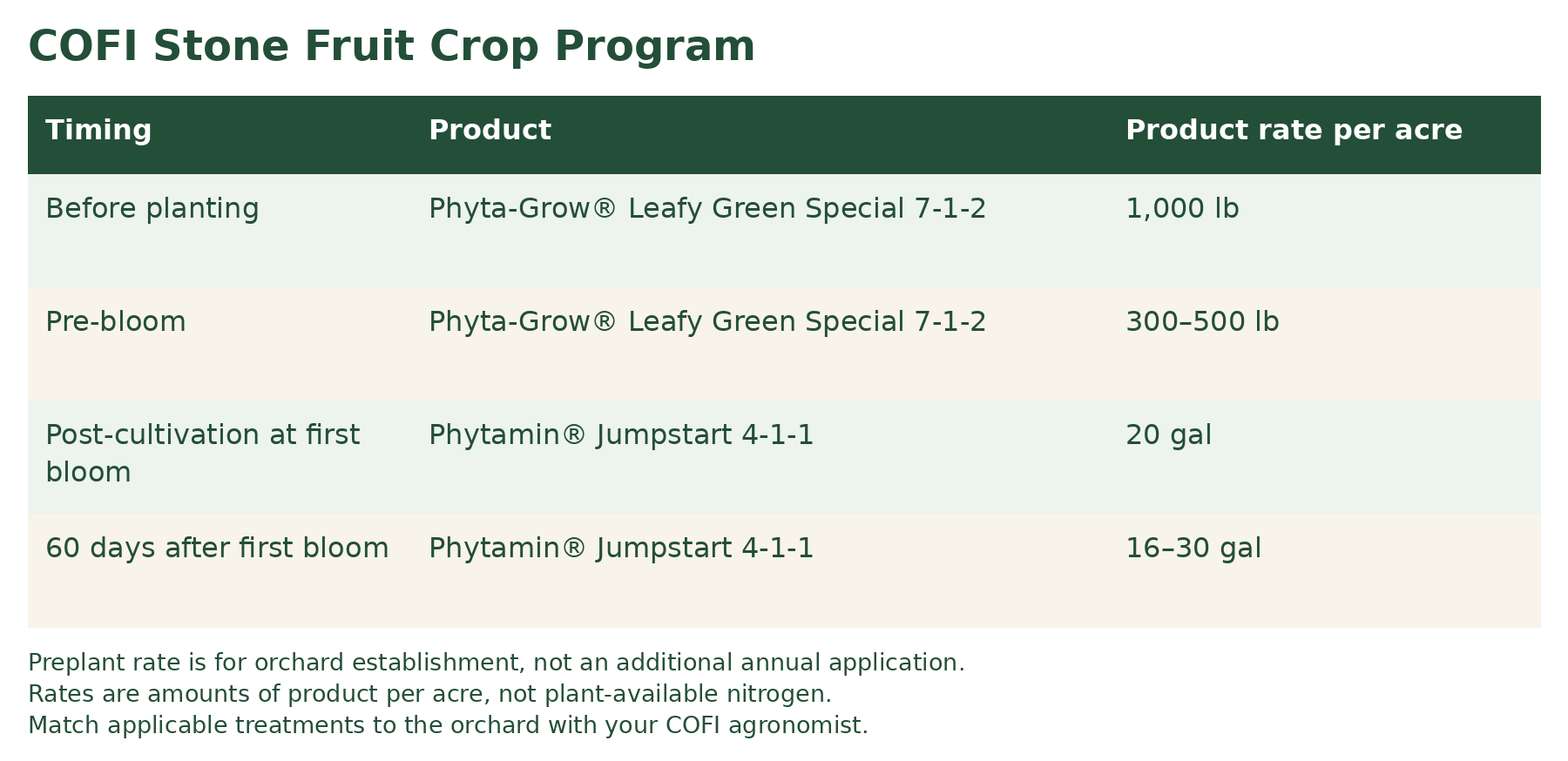
COFI stone fruit fertilizer program showing Leafy Green Special rates before planting and pre-bloom, and Jumpstart rates at first bloom and 60 days after first bloom.
Build the program around the block
Use the rate table as a starting point for a conversation about your orchard. Bring your variety and harvest dates, tree age, yield records, leaf analyses, irrigation-water results, and recent fertilizer history. Those details help turn a general schedule into a program matched to the block.
For help adapting the COFI stone fruit program, call 800-269-5690 or visit organicag.com.
References
[1] CDFA FREP and UC Davis — Peach and Nectarine Fertilization Guidelines
https://www.cdfa.ca.gov/is/ffldrs/frep/FertilizationGuidelines/Peach_Nectarine.html
[2] CDFA FREP and UC Davis — Peach and Nectarine Nitrogen Uptake and Partitioning
https://www.cdfa.ca.gov/is/ffldrs/frep/FertilizationGuidelines/N_Peach.html
[3] UC ANR — Organic Nitrogen Availability
https://www.ucanr.edu/site/solution-center-nutrient-management/organic-nitrogen-availability
[4] UC ANR — Nitrogen Budgeting
https://www.ucanr.edu/site/solution-center-nutrient-management/nitrogen-budgeting
[5] UC ANR — Cover Crops
https://www.ucanr.edu/site/solution-center-nutrient-management/cover-crops
[6] CDFA FREP and UC Davis — Prune and Plum Fertilization Guidelines
https://www.cdfa.ca.gov/is/ffldrs/frep/FertilizationGuidelines/Prune_Plum.html
Suggested Citation
The Organic Agronomist. (2026). Growing Organic Stone Fruit: Matching Nitrogen Supply to Crop Demand and Tree Vigor. California Organic Fertilizers, Inc.
Permission to Use
© 2026 California Organic Fertilizers, Inc. All rights reserved. Readers may download, save, and print this publication for personal, educational, or internal business use. Brief excerpts may be quoted with attribution to The Organic Agronomist and a link to the original article. This publication may not be republished, altered, sold, distributed commercially, or presented as another party’s work without prior written permission from California Organic Fertilizers, Inc.
Need help saving a PDF? Click here for instructions.
To save a copy to your computer:
- Right-click the yellow PDF button above.
- Choose Save link as... from the menu.
- Choose where to save the file, such as Downloads.
- Click Save.
Already opened the PDF? Click the printer icon, select Save as PDF as the printer or destination, then click Save.