Published by The Organic Agronomist
Agronomic review: Tim Stemwedel, CCA and COFI Founder
California Organic Fertilizers, Inc.
Executive Summary
An organic rice nitrogen plan should connect fertilizer choice with placement, flooding, and field history. The useful question is whether nitrogen will remain available when the crop needs it. A rate on paper cannot answer that question by itself.
This article focuses on California water-seeded, flooded rice. Research using conventional fertilizers helps explain the underlying soil processes; its application methods and rates are not automatic prescriptions for organic products.
Understand What Flooding Changes
Flooding creates oxygen-limited soil conditions. Ammonium is more stable in the reduced soil layer, while nitrate is vulnerable to denitrification, which converts it to gases. A preplant soil nitrate test is consequently of limited value for predicting rice nitrogen supply. [1]
Rice can take up nitrate before it is lost. The management concern is its unreliable persistence after flooding, rather than an inability of rice to use it. Placement beneath the oxygenated surface and prompt flooding help protect ammonium-based fertilizer nitrogen. [1, 2]
Plan Placement Before Applying Fertilizer
CDFA describes incorporation of aqua ammonia to 3–4 inches in conventional California rice. This illustrates the value of subsurface placement; it does not establish an application method for every organic liquid or dry fertilizer. [1]
Before a COFI application, settle the product, placement equipment, incorporation method, and flooding schedule together. Use the current product label and a field-specific recommendation. Neither fertilizer concentration nor an ammoniacal analysis alone guarantees that nitrogen will be retained.
Allow for Organic Nitrogen Release
Protein-based fertilizer nitrogen must undergo microbial mineralization before that portion becomes mineral nitrogen. Release varies with material characteristics and soil conditions. Total nitrogen applied and nitrogen available during the crop’s demand window are different quantities. [3]
OSU’s vegetable-system guidance explains general release principles. Its release estimates are not rice prescriptions. Ask your adviser how the chosen material is expected to behave in flooded soil.
Treat Drainage as a Nitrogen Decision
California field research found that prolonged early-season drainage allowed nitrate to accumulate. About 60% of that accumulated nitrate was lost after reflooding in the studied conditions. This percentage describes nitrate accumulated during drainage, not 60% of all fertilizer applied. [2]
The research connects nitrogen losses with the length and timing of the drain period. Incorporating fertilizer below the surface reduced exposure to these losses. Its findings support treating planned drainage as part of the nutrient program rather than an unrelated operation. [2]
Record when water leaves the field, how long the soil remains exposed, and when flooding resumes. Bring that history to the agronomic assessment before deciding whether a corrective application is justified.
Check the Crop Before Adding a Midseason Feed
UC rice guidance reports no yield benefit from routinely splitting the total nitrogen rate between preplant aqua ammonia and topdress applications when early flooding is maintained. It recommends monitoring around panicle initiation and using leaf color or plant analysis to identify a need for correction. [4]
Those findings do not prove that every organic material performs like aqua ammonia. For an organic field, combine crop measurements with product release characteristics and the water-management history. A calendar entry alone is a weak reason to add nitrogen.
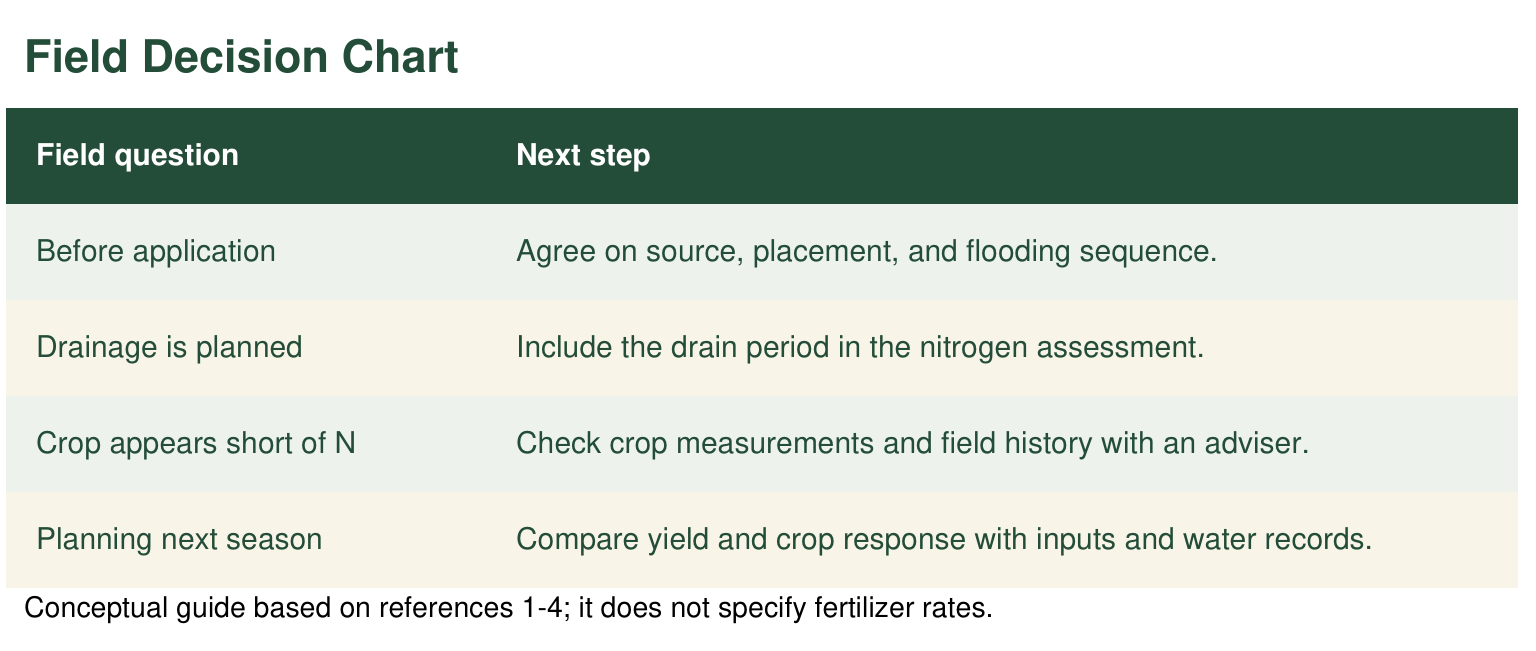
Rice nitrogen decision chart covering fertilizer placement, planned drainage, crop nitrogen assessment, and records for the next season.
Use Field History to Improve the Budget
CDFA notes that consistent straw incorporation and winter flooding can increase soil nitrogen supply over time. UC research also identifies greater nitrogen availability in some rice fields following a fallow year. These are reasons to assess field history rather than automatically repeating last season’s rate. [1, 4]
Keep records of straw handling, winter water, previous crops, fertilizer inputs, and crop response. Separate known inputs from estimates of future mineralization. Where the expected soil contribution is uncertain, document the assumption so it can be checked against the season’s results.
Build a Program That Can Be Reviewed
A useful field plan states the nitrogen source, amount, placement, timing, water sequence, and method for checking the crop. Record those details for each management block, along with changes made during the season.
The plan should also say who will interpret crop measurements and when that review will occur. This makes a possible corrective application a considered decision instead of a routine extra pass.
Conclusion
Protecting nitrogen in organic rice begins with matching the material to the field’s water regime. Plan placement and flooding together, account for release timing and field history, and use crop observations to guide adjustments. The objective is dependable crop nutrition with fewer avoidable losses.
References
CDFA FREP and UC Davis. California Fertilization Guidelines: Water Seeded Rice.
Linquist, B.A., Koffler, K., Hill, J.E., and van Kessel, C. (2011). Rice Field Drainage Affects Nitrogen Dynamics and Management. California Agriculture, 65(2), 80–84.
Oregon State University Extension. Nutrient Management for Sustainable Vegetable Cropping Systems in Western Oregon. EM 9165. General organic nitrogen release principles.
Linquist, B.A. (2026). Where Can You Reduce Fertilizer Input Costs?. UC Rice Blog.
Suggested Citation
The Organic Agronomist. (2026). Growing Organic Rice: Protect Nitrogen with Placement and Water Management. California Organic Fertilizers, Inc.
Permission to Use
© 2026 California Organic Fertilizers, Inc. All rights reserved. Readers may download, save, and print this publication for personal, educational, or internal business use. Brief excerpts may be quoted with attribution to The Organic Agronomist and a link to the original article. This publication may not be republished, altered, sold, distributed commercially, or presented as another party’s work without prior written permission from California Organic Fertilizers, Inc.
Need help saving a PDF? Click here for instructions.
To save a copy to your computer:
- Right-click the yellow PDF button above.
- Choose Save link as... from the menu.
- Choose where to save the file, such as Downloads.
- Click Save.
Already opened the PDF? Click the printer icon, select Save as PDF as the printer or destination, then click Save.