Published by The Organic Agronomist
Written by Tim Stemwedel, CCA and COFI Founder
Published: September 2, 2026
Cucumbers, melons, squash, pumpkins, and watermelons can produce an impressive amount of vine growth in a relatively short period of time. That vigorous growth can make cucurbits look like crops that need large amounts of nitrogen from the beginning.
The physiology tells a more complicated story.
At least in well-documented melon production systems, nitrogen uptake can be surprisingly small during early establishment. Demand increases as the canopy develops, flowering begins, and fruit becomes an increasingly important destination for the carbohydrates and nutrients produced by the plant.
That creates a different fertility problem from the one faced with many leafy vegetables.
The objective is not simply to grow a large plant.
It is to develop enough healthy canopy to support flowering, fruit set, fruit development, and harvest without allowing nitrogen supply to push the crop excessively toward vegetative growth.
In cucurbits, the most vigorous vine is not necessarily the most productive crop
.
Cucurbits Can Need Surprisingly Little Nitrogen Early
California fertilizer guidelines provide an excellent example from hybrid cantaloupes.
In commercial field research, cantaloupe plants took up less than 2 pounds of nitrogen per acre before early bloom. Nitrogen uptake then increased steadily from early bloom through crop maturity. Honeydew melons appear to follow a similar general pattern.
That does not mean cucumbers, pumpkins, squash, watermelons, and every melon variety take up exactly the same amount of nitrogen at exactly the same stage.
They do not.
But the melon research illustrates an important cucurbit-management principle:
A young cucurbit plant may have a much smaller nitrogen requirement than its eventual size suggests.
This matters particularly in organic systems because preplant nitrogen fertilizers may begin mineralizing before crop demand becomes large.
A field can therefore have two biological clocks operating simultaneously:
the crop-development clock; and
the fertilizer-mineralization clock.
Those clocks do not automatically stay synchronized.
Bloom Changes the Nitrogen Demand Curve
Early bloom represents an important transition.
The plant is no longer simply establishing roots and expanding vines. It is entering reproductive growth while continuing to build the photosynthetic canopy needed to support the developing crop.
In cantaloupe, nitrogen uptake begins progressing steadily after early bloom and continues toward maturity.
That gives growers an important management window.
Nitrogen supplied too early may become available before the crop needs much of it.
Nitrogen supplied too late may arrive after flower production, fruit set, or fruit development has already been restricted.
The objective is not a single large nitrogen event.
It is adequate nitrogen availability as crop demand develops.
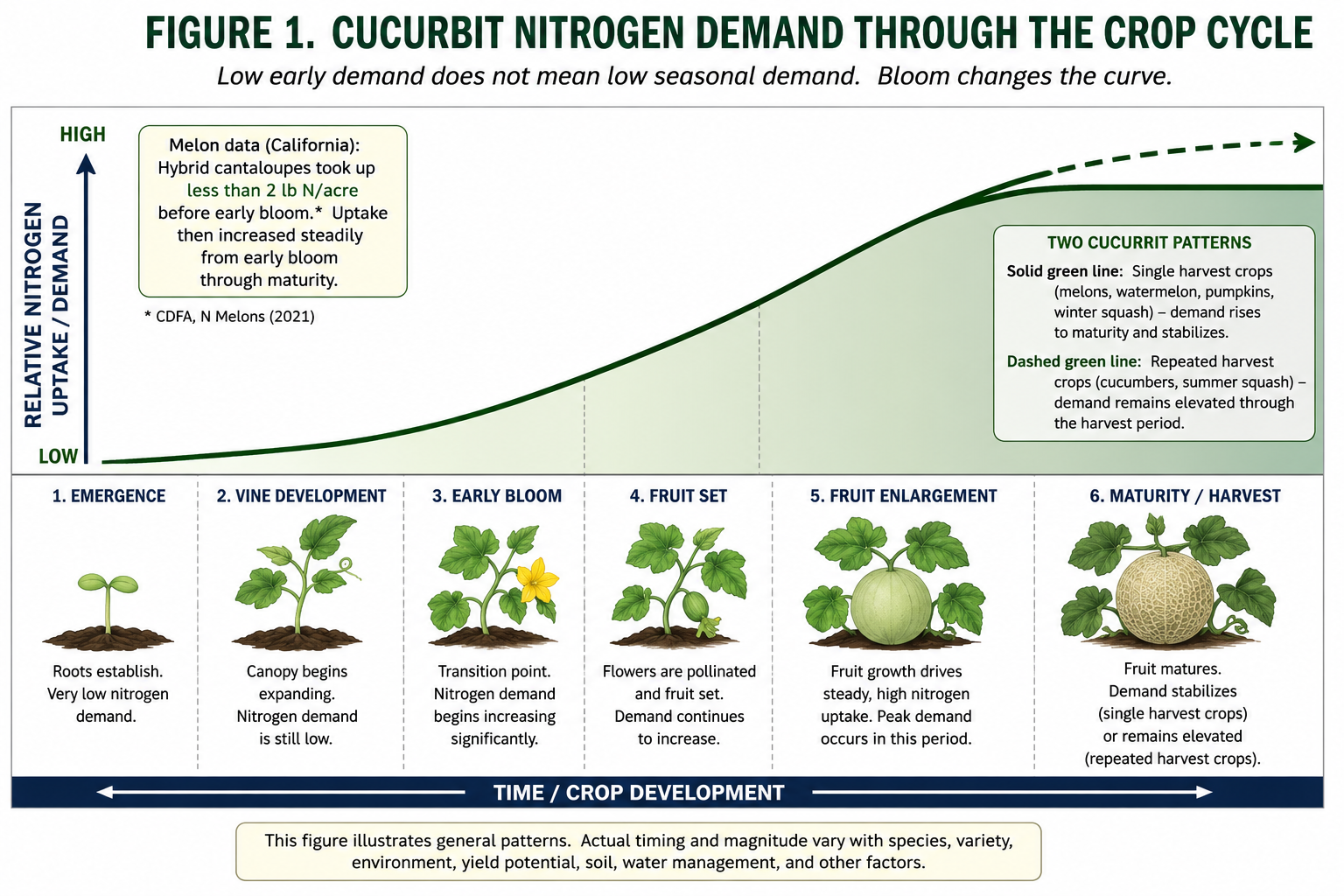
Illustration showing cucurbit nitrogen demand increasing from emergence through bloom, fruit set, fruit enlargement, and harvest, with very low early demand and higher nitrogen uptake after bloom.
Figure 1. Cucurbit Nitrogen Demand Through the Crop Cycle. Nitrogen demand is relatively low during establishment and early vine growth, then increases substantially around bloom, fruit set, and fruit enlargement. Repeated-harvest crops such as cucumbers and summer squash may maintain elevated nitrogen demand later into the harvest period.
Fruit Set Changes What the Plant Is Trying to Accomplish
Vegetative growth is essential.
Leaves capture light. Roots acquire water and nutrients. Vines position leaves and flowers. Without an adequate canopy, the crop cannot support substantial fruit production.
But once flowering and fruiting begin, the plant must support both vegetative and reproductive growth.
Developing fruit becomes a major biological sink—a destination for photosynthate and nutrients.
That means the agronomic objective changes.
Before flowering, vigorous vegetative development may be desirable.
After flowering begins, vine growth alone is no longer an adequate measure of crop performance.
A field can be dark green, vigorous, and visually impressive while producing fewer marketable fruit than expected.
More Vine Is Not Always More Yield
Excessive nitrogen can encourage cucurbits to continue directing resources toward leaves and vines while delaying reproductive development.
That does not mean nitrogen is harmful during flowering and fruit development. The crop still needs nitrogen.
The distinction is between adequate nitrogen and excessive nitrogen.
A productive cucurbit plant needs enough leaf area to intercept sunlight and support photosynthesis, but there is little value in continually expanding vegetative growth if reproductive development is being delayed.
The fertility objective is therefore balance:
Build the canopy. Then feed the crop the canopy is supposed to support.
Not All Cucurbits Follow the Same Harvest Pattern
This distinction is important enough that cucurbits should not be treated as a single crop nutritionally.
Melons, watermelons, pumpkins, and many winter squash generally move toward a defined fruit-development and maturity period.
Cucumbers and summer squash behave differently because harvest commonly occurs repeatedly while plants continue to flower and develop additional fruit.
That creates two broad cucurbit fertility patterns.
Crops moving toward a defined maturity
Examples include:
cantaloupe;
honeydew;
watermelon;
pumpkins; and
many winter squash.
Nitrogen management must support canopy development, flowering, fruit set, and fruit enlargement without unnecessarily prolonging vegetative growth.
Crops producing through repeated harvests
Examples include:
slicing cucumbers;
pickling cucumbers;
zucchini; and
other summer squash.
These plants must continue maintaining productive foliage while repeatedly producing new flowers and fruit.
Their nitrogen requirement may therefore continue later into the production period.
This is one reason a single generic cucurbit fertilizer schedule can be misleading.
When Poor Fruit Set Is Not a Fertility Problem
A vigorous cucurbit crop with poor fruit set often tempts growers to change the fertilizer program.
Sometimes that is the wrong response.
Cucumbers, squash, pumpkins, and many melons depend heavily on successful pollination. Poor pollination can result in flowers producing no fruit at all or developing small, misshapen, unmarketable fruit.
Male and female flowers also do not necessarily appear simultaneously. Male flowers commonly appear before female flowers, and individual flowers may only remain receptive for a limited period.
Weather makes the system even more complicated.
Excessive heat, drought stress, excessive soil moisture, poor pollinator activity, or unfavorable weather during flowering can interfere with fruit set.
That leads to an important diagnostic rule:
Poor fruit set is not automatically a fertility problem.
Before adding nitrogen to a crop with poor fruit set, investigate:
flower production;
male-to-female flower development;
pollinator activity;
heat stress;
irrigation management;
root-zone oxygen;
pest pressure;
disease; and
plant nutrient status.
More fertilizer cannot pollinate a flower.
Yield Changes the Nitrogen Budget
Crop nitrogen demand is partly determined by how much crop is actually produced.
For cantaloupe, California fertilizer guidelines summarize research showing substantial variation in nitrogen removal per ton of harvested fruit, with a weighted average close to 4.9 pounds of nitrogen removed per ton of fresh cantaloupe fruit. Honeydew values are lower, averaging roughly 3 pounds of nitrogen per ton of harvested fruit in the summarized studies.
These values should not be treated as universal cucurbit fertilizer recommendations.
They are useful for a different reason.
They demonstrate that yield matters when building a nitrogen budget.
A field producing 10 tons of fruit does not export the same amount of nitrogen as one producing 30 tons.
And nitrogen removed with fruit is only part of total plant uptake. Nitrogen remaining in vines, leaves, and roots is not necessarily removed from the field.
That nitrogen becomes part of the residue pool after the crop terminates.
Crop Uptake Is Not the Same as Fertilizer Requirement
The plant may obtain nitrogen from:
fertilizer;
residual soil nitrate;
irrigation water;
mineralization of soil organic matter;
crop residues;
cover crops;
compost;
manure or other amendments; and
fertilizer remaining from previous applications.
Therefore:
Crop nitrogen uptake is not the same as fertilizer nitrogen requirement.
The fertilizer program only needs to supply the portion of crop demand that cannot reasonably be supplied by the other available nitrogen sources.
Ignoring those sources can result in applying nitrogen the crop did not need.
Account for Nitrogen Already in the Field
Melons can develop extensive root systems capable of using residual soil nitrogen efficiently.
That makes soil testing especially important.
California fertilizer guidelines recommend measuring soil nitrate before major nitrogen applications and specifically identify the pre-sidedress nitrate test as useful because it measures available nitrogen immediately before the period of strong crop uptake.
This timing has another advantage.
A preplant soil test measures nitrate present before much of the season has occurred.
A pre-sidedress test can capture additional nitrogen that has mineralized from:
soil organic matter;
previous crop residues;
organic amendments; and
other biologically active nitrogen pools.
That information is particularly valuable in organic systems.
Irrigation Water Can Be Fertilizer Too
Nitrogen arriving through irrigation water is easy to overlook because growers did not intentionally purchase it as fertilizer.
The plant does not care where it came from.
California fertilizer guidelines note that well water containing nitrate can contribute meaningful quantities of nitrogen over an irrigation season.
That nitrogen belongs in the crop budget.
A grower accounting for fertilizer nitrogen but ignoring nitrate-nitrogen in irrigation water can underestimate the amount of nitrogen entering the root zone.
Why a Large Organic Preplant Can Get Ahead of the Crop
Suppose a grower applies a substantial amount of concentrated organic nitrogen before planting.
The crop emerges.
Roots develop.
Vines begin expanding.
But nitrogen demand remains relatively low.
Meanwhile, microorganisms are already decomposing the fertilizer and converting organic nitrogen into plant-available forms.
By early bloom, the crop’s nitrogen demand begins increasing.
The question is:
How much of the preplant nitrogen is still becoming available when demand accelerates?
That answer depends on:
fertilizer material;
soil temperature;
moisture;
incorporation;
particle size;
microbial activity;
irrigation; and
time.
Feather meal 12-0-0, meat & bone meal 8-5-1, soybean meal 7-1-2, and chicken litter-based 4-4-2 should therefore not be assumed to produce identical nitrogen-release patterns simply because their application rates have been adjusted to provide the same pounds of total N.
The fertilizer has a release curve.
The crop has a demand curve.
Successful fertility management tries to make those curves overlap.
Test Before You Sidedress
The pre-sidedress nitrate test is particularly well suited to this crop-development pattern.
The young crop has already experienced several weeks of soil biological activity.
Some organic nitrogen has mineralized.
Some residual nitrate may have been used.
Some may have moved.
Irrigation water may have contributed additional nitrogen.
And the crop is approaching the period when demand is becoming significantly larger.
Testing at that point provides information that a fertilizer calculation made weeks earlier simply could not know.
That changes sidedressing from:
“This crop normally gets another application now.”
to:
“Does this crop actually need more nitrogen now?”
That is a much stronger agronomic question.
When the Program Falls Behind
Organic fertility programs do not always mineralize according to plan.
Cool soil, unusual irrigation conditions, changes in microbial activity, rapid crop growth, unexpectedly high yield potential, or other factors can create a short-term nitrogen availability gap.
If testing and crop observations indicate that the crop is genuinely short of available nitrogen during an important growth period, the corrective source should match the timing of the problem.
Adding another material that requires several weeks of mineralization may not solve an immediate deficiency.
This is where rapidly available liquid organic nitrogen can serve a legitimate agronomic purpose.
California Organic Fertilizers’ Phytamin Pure and Phytamin Jumpstart are examples of rapidly available organic nitrogen fertilizers that can be used when an established fertility program needs in-season supplementation.
But the sequence matters:
Diagnose first. Correct second.
The product should follow the agronomic decision—not determine it.
More Nitrogen Is Not Insurance
There is an understandable temptation to add extra nitrogen because running short seems more dangerous than supplying too much.
Cucurbits demonstrate why that reasoning can fail.
Excess nitrogen can promote vegetative growth, delay fruiting, increase the amount of nitrogen vulnerable to loss, and increase fertilizer expense without necessarily increasing marketable yield.
A large, dark-green canopy can look reassuring.
But growers are not paid for vine weight.
They are paid for marketable cucumbers, melons, squash, pumpkins, or watermelons.
The relevant question is therefore not:
How much nitrogen can I give this crop?
It is:
How much plant-available nitrogen does this crop need at this stage to support the yield I am trying to produce?
Management Priorities for Organic Cucurbits
Know the nitrogen already available
Consider residual soil nitrate, irrigation-water nitrate, previous crops, organic amendments, cover crops, and mineralization.
Avoid assuming high early demand
Young cucurbit plants can eventually become enormous without requiring enormous amounts of nitrogen during establishment.
Watch the transition into bloom
Flowering marks an important change in crop physiology and, in melons, the beginning of substantially greater nitrogen uptake.
Maintain productive canopy rather than maximum canopy
Leaves are essential to yield. Uncontrolled vegetative growth is not the objective.
Distinguish fertility problems from fruit-set problems
Investigate pollination, temperature, irrigation, and crop stress before assuming additional nitrogen will correct poor fruit development.
Recognize the harvest pattern
A watermelon field approaching maturity and a zucchini field entering weeks of repeated harvest should not automatically receive identical late-season fertility management.
Test before making major corrections
Soil nitrate testing near sidedress timing can reveal how much nitrogen is actually available after early-season mineralization has occurred.
Match the corrective source to the required response time
If the crop needs nitrogen immediately, choose a source capable of addressing an immediate shortage.
Conclusion
Cucurbits are vigorous crops, but vigorous growth does not mean they need maximum nitrogen from planting through harvest.
The crop’s nutritional objective changes through the season.
Early growth establishes roots and canopy.
Bloom begins the transition toward reproduction.
Fruit set creates new nutrient and carbohydrate demands.
Fruit enlargement and repeated harvest can sustain nitrogen demand later in the crop.
Organic fertility management must follow those changes.
That means accounting for nitrogen already present in the field, understanding when preplant fertilizers are likely to mineralize, testing before additional applications, and resisting the assumption that more vegetative growth automatically means greater yield.
The goal is not to grow the largest vine.
The goal is to maintain enough productive canopy to support flowering, fruit set, fruit development, and harvest—and to have nitrogen available when the crop actually needs it.
Key Takeaways
Cucurbit nitrogen demand changes substantially during crop development.
California melon research found less than 2 lb N/acre uptake before early bloom, followed by steadily increasing uptake toward maturity.
Melon data should not be assumed to describe every cucumber, squash, pumpkin, or watermelon crop precisely.
Excess nitrogen can promote vine and leaf growth while delaying fruiting.
A large, dark-green canopy does not necessarily indicate maximum yield potential.
Cucumbers and summer squash can maintain reproductive demand through repeated harvest, while pumpkins, melons, and winter squash generally move toward a more defined maturity period.
Poor fruit set may result from pollination, heat, irrigation, or other stresses rather than nitrogen deficiency.
Crop nitrogen uptake is not the same as fertilizer nitrogen requirement.
Residual soil nitrate, irrigation-water nitrogen, mineralization, residues, and amendments should be credited before additional fertilizer is applied.
A pre-sidedress nitrate test can provide valuable information just before strong crop demand develops.
Organic fertilizer release must be matched to crop demand.
When an immediate nitrogen shortage is confirmed, the corrective fertilizer should be capable of supplying nitrogen within the required time.
Feed the crop—not just the vine.
References
California Department of Food and Agriculture, Fertilizer Research and Education Program. Melon Nitrogen Uptake and Partitioning.
California Department of Food and Agriculture, Fertilizer Research and Education Program. California Fertilization Guidelines: Melons.
University of Minnesota Extension. Flower and Fruit Set in Cucurbits.
University of Minnesota Extension. Fruits and Vegetables That Require Pollination.
University of Georgia Cooperative Extension. Growing Cucumbers in the Home Garden.
University of Georgia Cooperative Extension. Commercial Squash Production.
University of Georgia Cooperative Extension. Commercial Production and Management of Pumpkins and Gourds.
Suggested Citation
Stemwedel, T. (2026). Organic Cucurbits: Matching Nitrogen to Bloom, Fruit Set, and Harvest. The Organic Agronomist. California Organic Fertilizers, Inc.
© 2026 California Organic Fertilizers, Inc. All rights reserved.
Published by The Organic Agronomist.
Linking directly to the original article is encouraged.
Permission is granted to quote brief excerpts with proper attribution and a link to the original article when practical.
Reproduction of complete articles or substantial portions without written permission is prohibited.
Need help saving a PDF? Click here for instructions.
To save a copy to your computer:
- Right-click the yellow PDF button above.
- Choose Save link as... from the menu.
- Choose where to save the file, such as Downloads.
- Click Save.
Already opened the PDF? Click the printer icon, select Save as PDF as the printer or destination, then click Save.