Published by The Organic Agronomist
Agronomic Review by Tim Stemwedel, CCA and COFI Founder
Published: August 10, 2026
Organic carrot production depends on root-zone conditions, stand establishment, nitrogen timing, irrigation, weed control, and disease prevention.
Executive Summary
Carrots are different from many vegetable crops because the harvested product develops almost entirely below the soil surface. A field can produce vigorous tops and substantial plant biomass while still producing disappointing marketable yield if roots are forked, stubbed, cracked, diseased, undersized, or otherwise unmarketable.
Successful organic carrot production therefore depends on more than supplying nutrients and water. Soil physical condition, early taproot development, irrigation uniformity, nutrient timing, weed competition, nematodes, and soilborne diseases all influence the root that ultimately goes through the packing shed.
Growing carrots is not just about producing yield. It is about producing straight, uniform, healthy roots that can be harvested and sold.
Successful organic carrot production depends on more than supplying nutrients and water. Soil physical condition, early taproot development, irrigation uniformity, nutrient timing, weed competition, nematodes, and soilborne diseases all influence the root that ultimately goes through the packing shed.
The Carrot Is the Crop
In a lettuce field, much of the crop condition can be evaluated by looking across the field. Carrots are different. The leaves provide clues about plant health, but much of the economic outcome remains hidden underground until harvest.
That makes marketable yield especially important. A carrot that forks, becomes severely misshapen, develops disease lesions, or suffers other root defects may have consumed water, nutrients, land, and management costs for an entire season without contributing fully to final packout.
The objective is therefore not maximum vegetative growth or simply the largest possible biological yield. The objective is to protect the developing taproot from emergence through harvest.
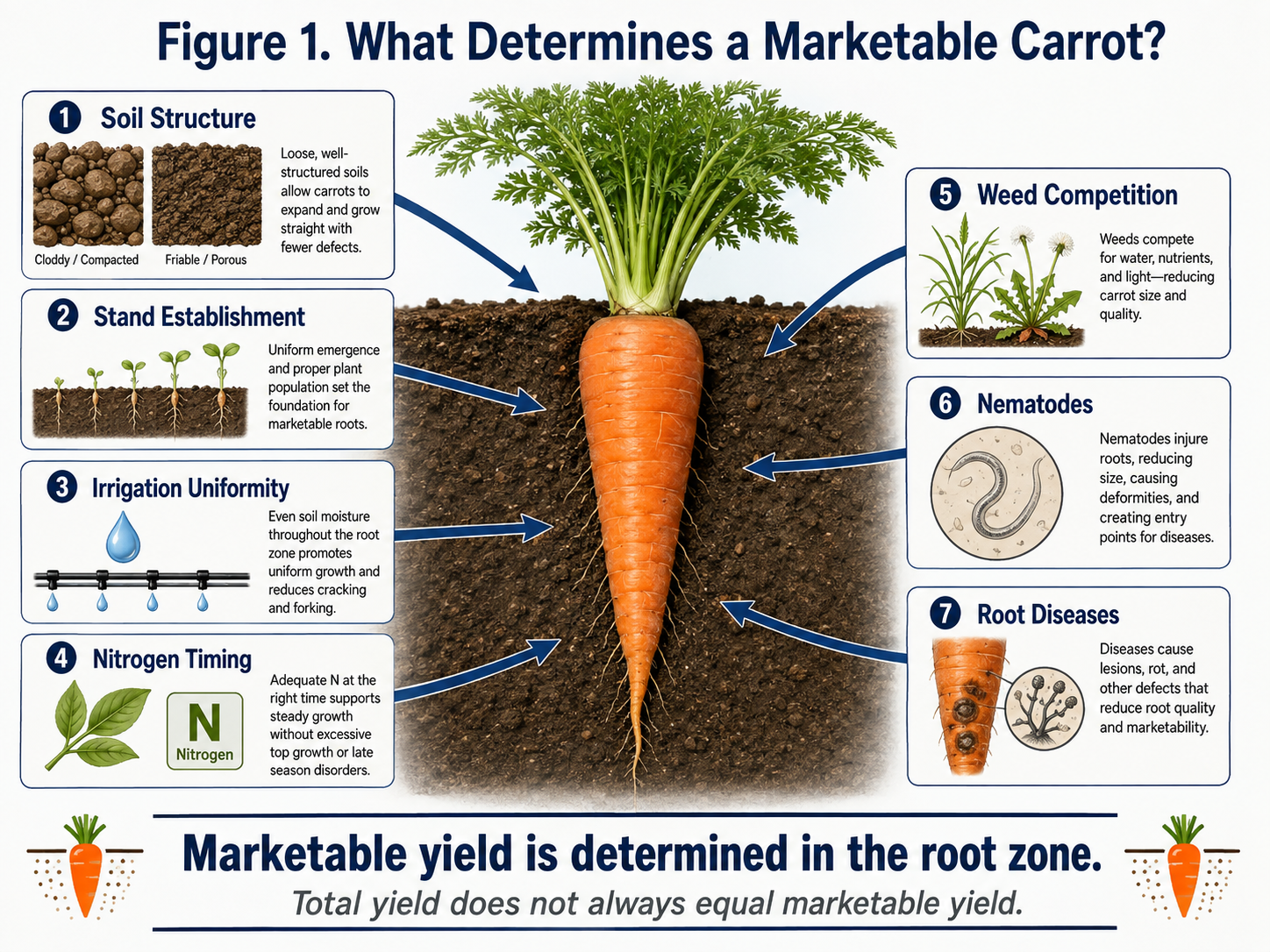
Diagram showing seven factors that determine marketable carrot yield: soil structure, stand establishment, irrigation uniformity, nitrogen timing, weed competition, nematodes, and root diseases.
Stand Establishment Sets the Foundation
Carrots are especially sensitive to conditions during emergence because the harvested product is the root itself. Uneven emergence, crusted soil, poor seed-to-soil contact, excess moisture, or early stress can reduce stand uniformity and affect root shape before the crop has much opportunity to recover.
A uniform stand also improves the efficiency of irrigation, fertility, weed management, and harvest. When plants emerge at different times, they compete unevenly and develop at different rates, making it harder to produce a consistent marketable crop.
The goal is not simply to achieve a high plant population. It is to establish a uniform population of healthy seedlings with unrestricted early root growth.
That keeps the article moving logically from the root-zone graphic into the first major management factor.
Soil Structure and Root Shape
.Carrot roots need a loose, friable soil profile that allows the taproot to expand downward without obstruction. Compaction, clods, stones, or abrupt changes in soil density can cause roots to fork, curve, or become misshapen.
These defects matter because carrot profitability depends heavily on marketable quality. A field can produce substantial biological yield and still suffer poor packout if too many roots are deformed.
Good carrot ground should therefore provide:
Adequate tilth through the root zone
Minimal compaction
Good drainage
Uniform moisture
A seedbed fine enough for consistent emergence without becoming crusted
Deep tillage can help where compaction is present, but tillage alone does not guarantee good root development. Soil moisture at planting, irrigation management, and soil structural stability remain important throughout the season.
Irrigation Uniformity
Carrots require consistent soil moisture because the developing taproot responds directly to changes in the root-zone environment. Large swings between wet and dry conditions can contribute to irregular growth, cracking, and uneven root development.
Uniform irrigation is especially important during germination and early establishment, when the seed and young root system occupy only a shallow portion of the soil profile. If portions of the field dry out while others remain wet, emergence becomes uneven and plant development quickly loses uniformity.
As the crop develops, irrigation should wet the active root zone without creating prolonged saturation. Excess water can reduce soil oxygen, encourage disease, and restrict root growth, while insufficient water can slow expansion and increase plant stress.
The practical objective is simple: keep moisture as uniform as possible across both the field and the season.
Nitrogen Timing Matters More Than Total Nitrogen
Carrots need enough available nitrogen to establish a healthy canopy and support root development, but the timing of that nitrogen matters as much as the total amount applied.
In organic production, much of the nitrogen supplied by preplant fertilizers must first be mineralized by soil microorganisms before the crop can use it. That means a fertilizer may contain plenty of total nitrogen while still releasing too little plant-available nitrogen during the period when the crop needs it most.
This creates a particular challenge in carrots. If early nitrogen availability is too low, canopy development can lag and yield potential may be reduced. If too much nitrogen becomes available late in the season, it may encourage continued top growth without providing the same benefit to marketable root yield.
The practical goal is therefore to match plant-available nitrogen with crop demand rather than simply applying a target number of pounds of total nitrogen.
Common Organic Preplant Nitrogen Sources
Organic carrot programs often rely on preplant fertilizers to supply most of the crop’s nitrogen. The challenge is that these materials differ substantially in how quickly their nitrogen becomes plant available.
Feather meal 12-0-0 is concentrated in nitrogen, but its release depends heavily on microbial decomposition. It can provide useful nitrogen over time, but release may lag when soils are cool or biological activity is limited.
Meat and bone meal 8-5-1 supplies both nitrogen and phosphorus. It generally provides a broader nutrient contribution than feather meal, but its nitrogen still depends on mineralization before becoming available to the crop.
Heat-treated chicken litter 4-4-2 contributes nitrogen, phosphorus, and potassium, but its nutrient ratio does not necessarily match carrot uptake. Its relatively low nitrogen concentration also means that supplying large amounts of nitrogen can bring substantial phosphorus with it.
Soy meal 7-1-2 is a plant-based nitrogen source that can mineralize more rapidly than some animal-protein meals under favorable soil conditions, although release still depends on temperature, moisture, and microbial activity.
The important distinction is that fertilizer analysis tells us how much nitrogen is present, not when that nitrogen will become available to the carrot crop.
When Preplant Nitrogen Arrives Too Late
A preplant fertilizer can contain enough total nitrogen on paper and still fail to meet crop demand at the right time.
In carrots, that timing gap matters because early canopy development supports photosynthesis and root growth. If mineralization is too slow during the period of greatest crop demand, the plant may experience a temporary nitrogen shortage even though substantial organic nitrogen remains in the soil.
Later in the season, that same fertilizer may continue releasing nitrogen after much of the crop’s yield potential has already been established. At that point, additional nitrogen may contribute more to continued vegetative growth than to increased marketable root yield.
This is why organic fertility programs should be evaluated by nitrogen availability over time, not simply by the total pounds of nitrogen applied
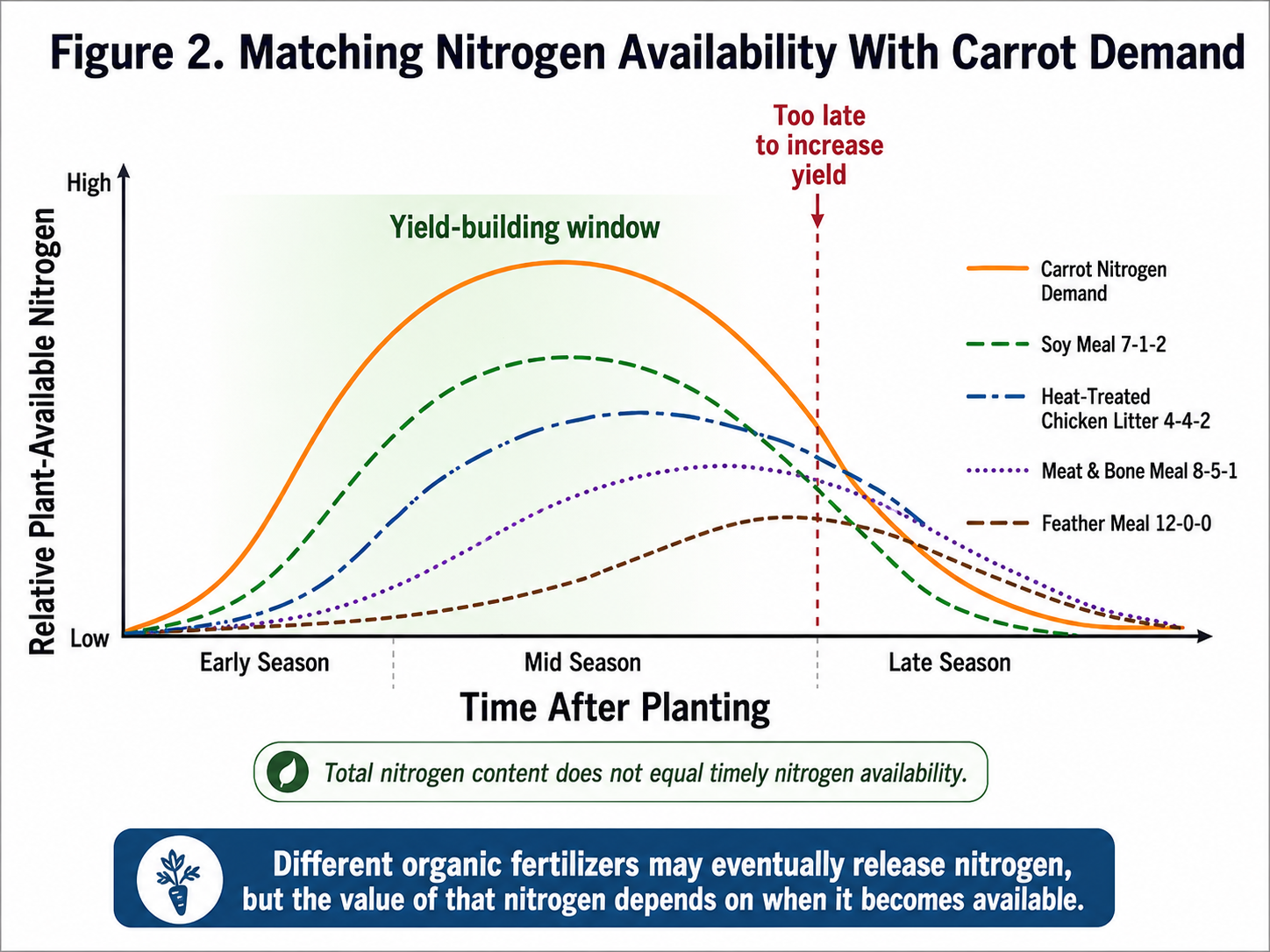
Chart comparing carrot nitrogen demand with nitrogen release from soy meal 7-1-2, heat-treated chicken litter 4-4-2, meat and bone meal 8-5-1, and feather meal 12-0-0, showing the yield-building window and how nitrogen released too late may not increase marketable yield.
When Supplemental Nitrogen Is Justified
Supplemental nitrogen is most useful when there is evidence that crop demand is outpacing nitrogen availability. Pale foliage, weak canopy development, tissue analysis, soil nitrate testing, field history, and known delays in mineralization can all help identify a developing shortfall.
The key is timing. A corrective application made while the crop is still building yield can be valuable. The same application made after most yield potential has already been established may provide little economic return.
Supplemental nitrogen should therefore be used to solve a diagnosed timing problem, not simply added as insurance.
Correcting an Early Nitrogen Shortfall
Even with a well-designed preplant program, carrots can sometimes experience a temporary nitrogen shortfall. Cool soil, excessive moisture, dry conditions, or slower-than-expected mineralization can all reduce the rate at which organic nitrogen becomes plant available.
When this happens, waiting for the preplant fertilizer to mineralize may allow the crop to remain deficient during an important growth period. A supplemental nitrogen application can be useful when it supplies nitrogen in a form that becomes available quickly enough to correct the shortfall.
The objective is not to replace the preplant program. It is to provide additional plant-available nitrogen when biological release is not keeping pace with crop demand.
Weed Competition and Early Crop Growth
Carrots are poor early competitors with weeds. Their seedlings emerge slowly, develop a relatively small canopy at first, and leave much of the soil surface exposed during establishment.
That makes early weed control especially important. Weeds that emerge with or ahead of the crop can compete for light, water, and nutrients during the same period when carrots are establishing stand and developing their root systems.
The effect is not limited to reduced plant growth. Heavy early competition can also make irrigation and harvest less uniform and can increase the risk that otherwise healthy roots fail to reach marketable size.
The practical goal is to keep the field as weed-free as possible during the early growth period, when carrot seedlings are least able to compete.
Nematodes and Root Quality
Plant-parasitic nematodes can be especially damaging in carrots because even modest root injury can reduce marketable quality. Feeding on developing roots may cause forking, stunting, galling, or irregular root shape, depending on the nematode species involved.
Root-knot nematodes are among the most important concerns because they can distort the taproot and create visible defects that directly reduce packout.
Good nematode management begins before planting. Field history, soil sampling, crop rotation, resistant rotational crops where available, and sanitation all help reduce risk. Once a susceptible carrot crop is established in a heavily infested field, corrective options are limited.
For carrots, nematode management is therefore less about rescuing a damaged crop and more about avoiding serious root injury before it occurs.
Root Diseases and Soil Conditions
Carrot root diseases are strongly influenced by the conditions surrounding the developing taproot. Poor drainage, prolonged soil saturation, compaction, and damaged roots can all increase the risk of disease and reduce marketable quality.
Several soilborne pathogens can cause root rots, lesions, discoloration, or decay. Because the harvested portion of the crop is underground, even limited disease can turn an otherwise productive plant into an unmarketable root.
Management therefore depends heavily on prevention. Well-drained fields, careful irrigation, crop rotation, sanitation, and avoiding unnecessary root injury all help reduce disease pressure.
The practical lesson is that carrot disease management begins with the root-zone environment. Healthy roots are easier to protect than damaged roots are to rescue.
Conclusion
Producing high-quality organic carrots depends on managing several interacting factors well before harvest. Soil structure influences root shape. Stand establishment determines uniformity. Irrigation affects both growth and disease pressure. Weed competition, nematodes, and root diseases can reduce marketable quality even when overall plant growth appears acceptable.
Fertility adds another layer of complexity. In organic systems, the amount of nitrogen applied is only part of the story. The crop also depends on when that nitrogen becomes plant available. A fertilizer program that releases nitrogen too slowly can leave the crop short during critical growth stages, while nitrogen released too late may contribute little to marketable yield.
The most effective carrot programs therefore focus on protecting the developing taproot from planting through harvest and matching nutrient availability as closely as possible with crop demand.
Key Takeaways
Uniform emergence is critical because carrots have limited ability to compensate for a poor stand.
Loose, well-structured soil helps reduce forking and misshapen roots.
Irrigation should keep the root zone consistently moist without prolonged saturation.
Nitrogen timing matters as much as total nitrogen applied.
Organic fertilizers differ widely in how quickly their nitrogen becomes plant available.
Early weed competition can reduce crop uniformity and marketable yield.
Nematodes and root diseases are best managed preventively.
Marketable carrot yield depends on protecting root quality, not simply producing plant biomass.
References
University of California Agriculture and Natural Resources. Carrot Production and Pest Management Resources.
University of California Statewide Integrated Pest Management Program. Carrot Pest Management Guidelines.
USDA Natural Resources Conservation Service. Resources on soil health, nutrient management, and irrigation management.
Hartz, T. K., and related University of California research on nitrogen management and nutrient availability in vegetable crops.
California Department of Food and Agriculture. Resources on organic fertilizer materials and nutrient management.
Suggested Citation
Stemwedel, T. (2026). Growing Organic Carrots: Managing the Root Zone for Marketable Yield. The Organic Agronomist. California Organic Fertilizers, Inc.
Permission to Use
© 2026 California Organic Fertilizers, Inc. All rights reserved.
Readers may download, save, and print this article for personal, educational, or internal business use. Brief excerpts may be quoted with attribution to The Organic Agronomist and a link to the original article.
This article may not be republished, altered, sold, commercially distributed, or presented as another party’s work without prior written permission. Permission requests may be sent to info@organicag.com.
Related Articles
Understanding Plant-Available Nitrogen in Organic Fertilizers
The Difference Between Organic Nitrogen Sources
Feeding the Soil or Feeding the Crop?
Micronutrients: The Quiet Yield Limiters
The Soil Food Web Explained
Need help saving a PDF? Click here for instructions.
To save a copy to your computer:
- Right-click the yellow PDF button above.
- Choose Save link as... from the menu.
- Choose where to save the file, such as Downloads.
- Click Save.
Already opened the PDF? Click the printer icon, select Save as PDF as the printer or destination, then click Save.