Published by The Organic Agronomist
Written by Tim Stemwedel, CCA and COFI Founder
Published: September 2, 2026
Broccoli, cauliflower, and cabbage are often described as heavy-feeding crops. That description is accurate, but incomplete.
The greater challenge—especially in organic production—is not simply supplying enough nitrogen. It is having plant-available nitrogen in the root zone at the same time the crop is capable of using it.
Organic fertilizers do not necessarily release all of their nitrogen when they are applied. Much of their nitrogen must first be converted by soil microorganisms into mineral forms that plant roots can absorb. Meanwhile, the nitrogen demand of a cole crop changes dramatically during the season.
Successful fertility management therefore depends on synchronizing two biological processes: nitrogen release from the soil and fertilizer, and nitrogen uptake by the crop.
When those processes are synchronized, a grower can meet crop demand efficiently. When they are not synchronized, a field can contain substantial total nitrogen while the crop is functionally short of plant-available nitrogen.
That is the nitrogen-timing problem.
Cole Crops Can Take Up a Remarkable Amount of Nitrogen
Research conducted in commercial Salinas Valley fields illustrates how aggressively cole crops can acquire nitrogen. In summer-grown fields, average aboveground nitrogen accumulation was approximately 337 lb N/acre in broccoli, 355 lb N/acre in cauliflower, and 284 lb N/acre in cabbage.
Those numbers are not fertilizer recommendations. The crops obtained substantial nitrogen from sources other than fertilizer applied during the current crop.
Crop nitrogen uptake is not the same thing as fertilizer nitrogen requirement.
The crop does not distinguish among nitrate or ammonium originating from current fertilizer, mineralization of soil organic matter, previous crop residues, irrigation water, or residual nitrate in the soil profile. If roots can acquire the nitrogen, it contributes to crop nutrition.
Cole Crops Can Scavenge Nitrogen from Depth
One reason crop nitrogen uptake and fertilizer requirement can differ is root depth.
The Salinas Valley research found that most cole-crop roots were concentrated in the upper two feet, but broccoli and cauliflower roots sometimes reached 36 to 48 inches, while cabbage roots reached about 31 inches. That deeper rooting gives cole crops access to nitrate that may be below the effective rooting zone of shallower vegetables.
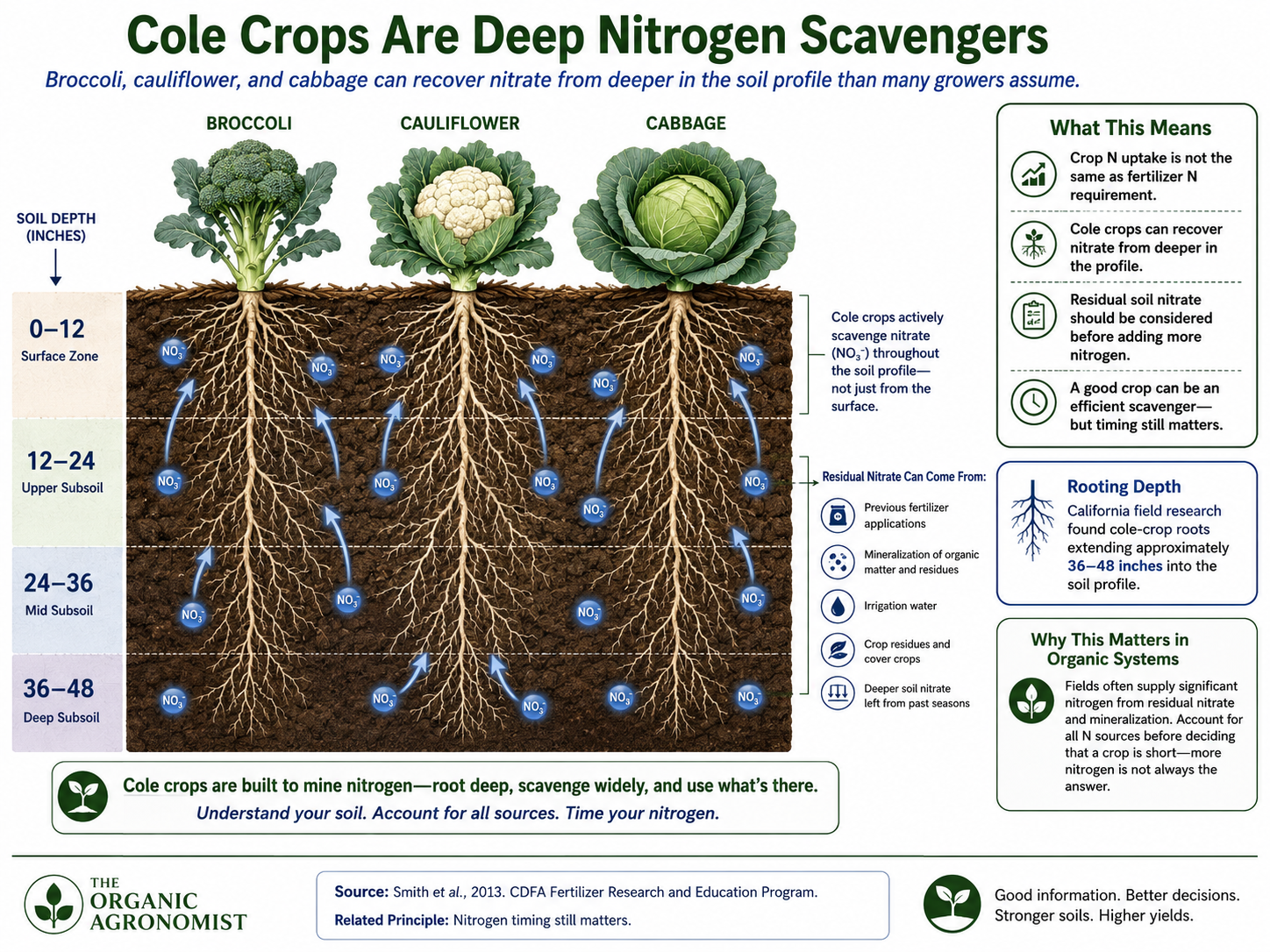
Broccoli, cauliflower, and cabbage root systems extending 36 to 48 inches into the soil profile, illustrating how cole crops can recover residual nitrate from deeper soil layers.
Figure 1. Cole Crops Are Deep Nitrogen Scavengers. Broccoli, cauliflower, and cabbage can recover nitrate from deeper in the soil profile than many growers assume. California field research found cole-crop roots extending approximately 36 to 48 inches into the soil profile, allowing the crop to scavenge residual nitrate below the shallow surface layer.
This has an important practical implication: before adding more nitrogen, consider the entire nitrogen budget, including:
residual soil nitrate;
nitrate deeper in the soil profile;
irrigation-water nitrogen;
mineralization of soil organic matter;
previous crop residues and cover crops;
compost, manure, and other organic amendments; and
current-season fertilizer.
A cole crop can be an effective nitrogen scavenger. But scavenging ability does not eliminate the timing problem.
Nitrogen Demand Is Not Constant
Plants do not absorb nitrogen at an even rate from planting through harvest.
Research on broccoli, cauliflower, and cabbage found that nitrogen accumulation followed a sigmoidal, or S-shaped, pattern. Uptake is modest during early establishment, accelerates as the canopy expands, and can remain substantial late in the crop cycle.
That makes the timing of plant-available nitrogen particularly important.
A program that releases abundant nitrogen before the crop can use it may create unnecessary surplus. A program that releases too little nitrogen during rapid growth can restrict crop development. And nitrogen that mineralizes after the crop’s critical demand period cannot fully restore growth that was lost when nitrogen was unavailable.
Season Can Completely Change the Uptake Curve
The California research found a striking difference between summer and winter cole crops.
Summer crops accumulated approximately 20% of their total nitrogen during the final 20% of the growing season. Winter crops accumulated approximately 70% during that same final portion of the crop cycle.
The researchers attributed the delayed winter uptake pattern to low temperatures and short days that slowed early crop growth, followed by faster uptake as temperature and day length increased.
That finding has major implications for organic fertility.
The same fertilizer program can behave very differently in two planting windows. Crop growth may be slowed by winter conditions while fertilizer mineralization is already occurring. Later, when crop demand accelerates, part of the easily mineralized nitrogen may already have been released.
The crop’s biological clock and the fertilizer’s biological clock do not necessarily run together.
Organic Fertilizer Has Its Own Timing Curve
Most organic nitrogen fertilizers contain nitrogen in organic compounds. Before much of that nitrogen can be absorbed, microorganisms must decompose the material and release ammonium through mineralization. Ammonium may subsequently be converted to nitrate through nitrification.
These are biological processes influenced by temperature, moisture, aeration, fertilizer composition, particle size, incorporation, microbial activity, and other soil conditions.
A UC Davis incubation study illustrates the point. Feather meal and several other concentrated organic nitrogen fertilizers mineralized rapidly under controlled conditions: 47% to 60% of their organic nitrogen mineralized within two weeks. Mineralization continued afterward, but at a slower rate.
That does not mean feather meal will release a fixed percentage on a fixed schedule in every field. Laboratory incubations are designed to compare materials under controlled conditions, not to predict an exact field-release date.
The useful lesson is that organic fertilizers have release curves, not constant release rates.
Placement Changes Nitrogen Release
Field evaluations by UC Cooperative Extension provide another useful example. Researchers compared a 4-4-2 fertilizer containing chicken, meat, and bone ingredients with a 12-0-0 feather meal material. Fertilizer was either placed on the soil surface or buried about three inches deep.
Over the 48-day evaluation, incorporation increased nitrogen release from both materials. The effect was particularly large for the 12-0-0 feather meal. The researchers also cautioned that the pouch method used in the field could overestimate actual release, reinforcing the need to treat release percentages as experimental observations rather than universal guarantees.
A fertilizer analysis therefore tells only part of the story.
A bag marked 12-0-0 tells us how much total nitrogen is present. It does not tell us precisely when the crop will receive that nitrogen.
Common Organic Preplants Do Not Behave Identically
Organic cole-crop programs commonly use several concentrated organic fertilizers, but they should not be expected to release nitrogen at the same rate.
Feather meal 12-0-0
A concentrated organic nitrogen source. Mineralization can be relatively rapid under favorable conditions, and incorporation can increase release.
Meat & bone meal 8-5-1
Supplies nitrogen along with substantial phosphorus. Its nutrient-release pattern depends on the material, soil conditions, and placement.
Soybean meal 7-1-2
A plant-derived nitrogen source that requires biological mineralization. Temperature, moisture, and microbial activity influence how quickly its nitrogen becomes available.
Chicken litter-based fertilizer 4-4-2
Supplies nitrogen, phosphorus, and potassium. Release depends on formulation, processing, placement, and field conditions.
These materials can all have legitimate roles, but equal pounds of total nitrogen do not guarantee equal nitrogen availability over time.
Repeatedly increasing the rate of an N-P-containing fertilizer solely to obtain more nitrogen can also add phosphorus faster than the crop removes it. The fertility program should therefore be built around the crop’s complete nutrient budget rather than nitrogen analysis alone.
The Synchronization Problem
Think of organic cole-crop fertility as two curves.
The first is the crop nitrogen-demand curve.
The second is the plant-available nitrogen-supply curve.
The objective is not to maximize either curve. The objective is to make them overlap.
When nitrogen availability substantially exceeds crop demand, nitrogen may remain in the soil where it is vulnerable to loss or carryover. When crop demand exceeds nitrogen availability, growth can be restricted even though substantial organic nitrogen remains in the field.
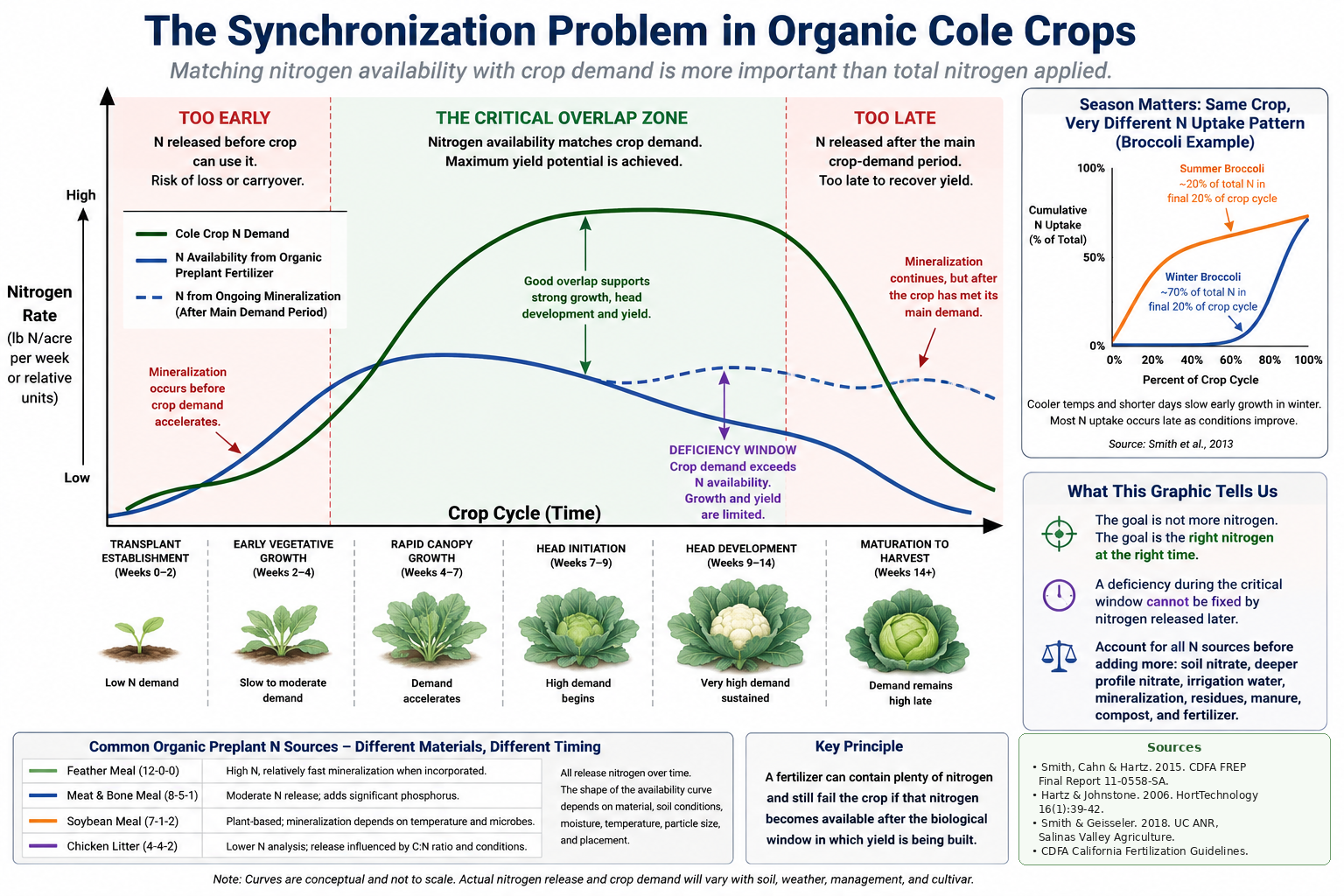
Conceptual graph comparing cole-crop nitrogen demand with plant-available nitrogen supply over the growing season, showing periods when nitrogen is available too early, synchronized with crop demand, or released too late.
Figure 2. The Synchronization Problem in Organic Cole Crops. The goal of organic nitrogen management is to synchronize plant-available nitrogen with changing crop demand. Nitrogen released too early may create surplus, while nitrogen released too late may not support crop growth during the critical yield-building period. Curves are conceptual and not to scale.
When nitrogen becomes available too early
Mineralization runs ahead of crop uptake. The nitrogen may be vulnerable to movement, loss, or carryover before the crop reaches its strongest demand.
When nitrogen availability matches crop demand
This is the target. Residual soil N, irrigation-water N, mineralization, and fertilizer together provide enough plant-available nitrogen as crop uptake accelerates.
When nitrogen becomes available too late
The field may contain nitrogen, but much of it remains in organic forms while the crop is building biomass and yield. Later mineralization does not travel backward in time.
A fertilizer can contain plenty of nitrogen and still fail the crop if that nitrogen becomes available after the biological window in which yield is being built.
When the Preplant Program Falls Behind
A grower may have applied a reasonable amount of preplant fertilizer, yet weather, soil conditions, irrigation, mineralization rate, or unusually rapid crop growth can cause plant-available nitrogen to fall behind crop demand.
The first response should not automatically be another large application of slowly mineralizing fertilizer. First determine whether the crop actually has a short-term availability problem.
Useful information can include:
soil nitrate testing;
crop color and vigor;
plant tissue information where appropriate;
irrigation-water nitrate;
fertilizer history;
previous crop;
amendment history;
rooting depth;
weather; and
expected remaining crop demand.
If a genuine short-term nitrogen deficit exists, the corrective fertilizer should match the timing of the problem.
A crop needing available nitrogen now is fundamentally different from a crop needing nitrogen several weeks from now.
Rapidly available liquid organic nitrogen fertilizers can therefore have an important agronomic role as corrective tools when preplant mineralization does not keep pace with crop demand.
California Organic Fertilizers’ Phytamin Pure and Phytamin Jumpstart are examples of products designed for rapid plant availability. They should be viewed as examples within this fertilizer category, not as substitutes for diagnosing the crop and soil first.
The decision should begin with the crop’s need—not with the product.
More Nitrogen Is Not the Objective
The high nitrogen uptake of cole crops can tempt growers to treat them simply as crops that require aggressive fertilization.
That misses the larger lesson.
The goal is adequate plant-available nitrogen at the right time with as little unnecessary surplus as practical.
Cole crops can recover meaningful residual nitrate from the soil profile. Adding fertilizer without accounting for that nitrogen may increase cost without proportionally increasing yield.
At the same time, relying on nitrogen that is present only in slowly mineralizing organic forms can leave the crop short during a critical growth period.
The best fertility program therefore requires both restraint and responsiveness.
Key Takeaways
Broccoli, cauliflower, and cabbage can accumulate large quantities of nitrogen.
Crop nitrogen uptake is not the same as fertilizer nitrogen requirement.
Cole crops can access residual nitrate below the shallow surface root zone.
Nitrogen uptake changes dramatically through the crop cycle and with season.
Organic fertilizers have release curves; total analysis does not describe the timing of plant availability.
Fertilizer material, placement, soil conditions, weather, and irrigation can change nitrogen release.
Feather meal 12-0-0, meat & bone meal 8-5-1, soybean meal 7-1-2, and chicken litter-based 4-4-2 should not be assumed to behave identically.
When crop demand outruns mineralization, a rapidly available organic nitrogen source may be more appropriate than simply adding more slowly mineralizing material.
Account for residual soil nitrate, deeper-profile nitrate, irrigation water, mineralization, residues, compost, amendments, and fertilizer before deciding the crop needs more nitrogen.
The objective is not maximum nitrogen. It is synchronization.
References
Smith, R., Cahn, M., Hartz, T.K., Love, P., & Farrara, B. (2015). Survey of Nitrogen Uptake and Applied Irrigation Water in Broccoli, Cauliflower and Cabbage Production in the Salinas Valley. California Department of Food and Agriculture, Fertilizer Research and Education Program, Final Report 11-0558-SA.
Smith, R., Cahn, M., Hartz, T.K., Love, P., & Farrara, B. (2016). Nitrogen dynamics of cole crop production: Implications for fertility management and environmental protection. HortScience, 51(12), 1586-1591. https://doi.org/10.21273/HORTSCI11335-16
Hartz, T.K., & Johnstone, P.R. (2006). Nitrogen availability from high-nitrogen-containing organic fertilizers. HortTechnology, 16(1), 39-42. https://doi.org/10.21273/HORTTECH.16.1.0039
Smith, R.F., & Geisseler, D.J. (2018). Release of Mineral Nitrogen from Organic Soils and Fertilizers Investigated. University of California Agriculture and Natural Resources, Salinas Valley Agriculture.
California Department of Food and Agriculture. California Fertilization Guidelines: Broccoli and Cauliflower. Fertilizer Research and Education Program.
Suggested Citation
Stemwedel, T. (2026). Organic Cole Crops: Why Nitrogen Timing Matters More Than Total Nitrogen. The Organic Agronomist. California Organic Fertilizers, Inc.
© 2026 California Organic Fertilizers, Inc. All rights reserved.
Published by The Organic Agronomist.
Linking directly to the original article is encouraged.
Permission is granted to quote brief excerpts with proper attribution and a link to the original article when practical.
Reproduction of complete articles or substantial portions without written permission is prohibited.
That completes the visible article body.
Permission to Use
© 2026 California Organic Fertilizers, Inc. All rights reserved. Readers may download, save,and print this publication for personal, educational, or internal business use. Brief excerptsmay be quoted with attribution to The Organic Agronomist and a link to the original article.This publication may not be republished, altered, sold, distributed commercially, or presented as another party’s work without prior written permission from California Organic Fertilizers, Inc.
Need help saving a PDF? Click here for instructions.
To save a copy to your computer:
- Right-click the yellow PDF button above.
- Choose Save link as... from the menu.
- Choose where to save the file, such as Downloads.
- Click Save.
Already opened the PDF? Click the printer icon, select Save as PDF as the printer or destination, then click Save.