Why short crop cycles make nutrient availability, uniform establishment, and early prevention more important than total fertilizer applied
Published by The Organic Agronomist
Written by Tim Stemwedel, CCA and COFI Founder
Published: August 10, 2026
Executive Summary
Organic baby leafy greens operate on a compressed crop clock. Uniform emergence, early root development, and timely nutrient availability must occur within a short production window. A crop can receive enough total fertilizer and still fall short if nitrogen becomes plant-available after the period when it can influence yield and quality.
This timing challenge becomes more pronounced in cool soils, where biological mineralization may lag behind crop demand. Precise irrigation and early prevention of weeds and disease are equally important because there is little time for a baby-leaf crop to recover from an early setback.
The goal is not simply to apply more fertilizer. It is to align plant-available nutrition and crop management with the brief period when the crop can use them most effectively.
Why Baby Leaf Crops Are Different
Baby spinach, baby lettuce, and other baby leafy greens may be harvested only a few weeks after emergence. Within that short period, the crop must establish a uniform stand, develop an effective root system, build leaf area, and reach marketable size and quality.
That compressed schedule leaves little opportunity to recover from uneven emergence, early nutrient shortages, weed competition, excessive irrigation, or disease pressure. Problems that might be corrected later in a longer-season crop can reduce yield and quality before a baby-leaf crop has time to recover.
Uniform establishment is therefore the first management priority. Seedbed preparation, planting depth, soil moisture, irrigation uniformity, and early root-zone conditions must support rapid, even emergence across the field.
The Nitrogen Timing Problem
Organic fertilizers must usually be broken down by soil biology before much of their nitrogen becomes available to the crop. The fertilizer analysis shows how much nitrogen was applied—not how much will be available when the young plants need it.
Release rates depend on the fertilizer material, soil temperature, moisture, microbial activity, placement, and particle size. Cool soil can slow mineralization just as the rapidly growing crop begins to increase its nitrogen demand.
Nitrogen released after harvest may benefit a later crop or remain in the soil system, but it cannot correct a yield or quality loss that has already occurred. For baby leafy greens, available nitrogen at the right time matters more than total nitrogen applied.
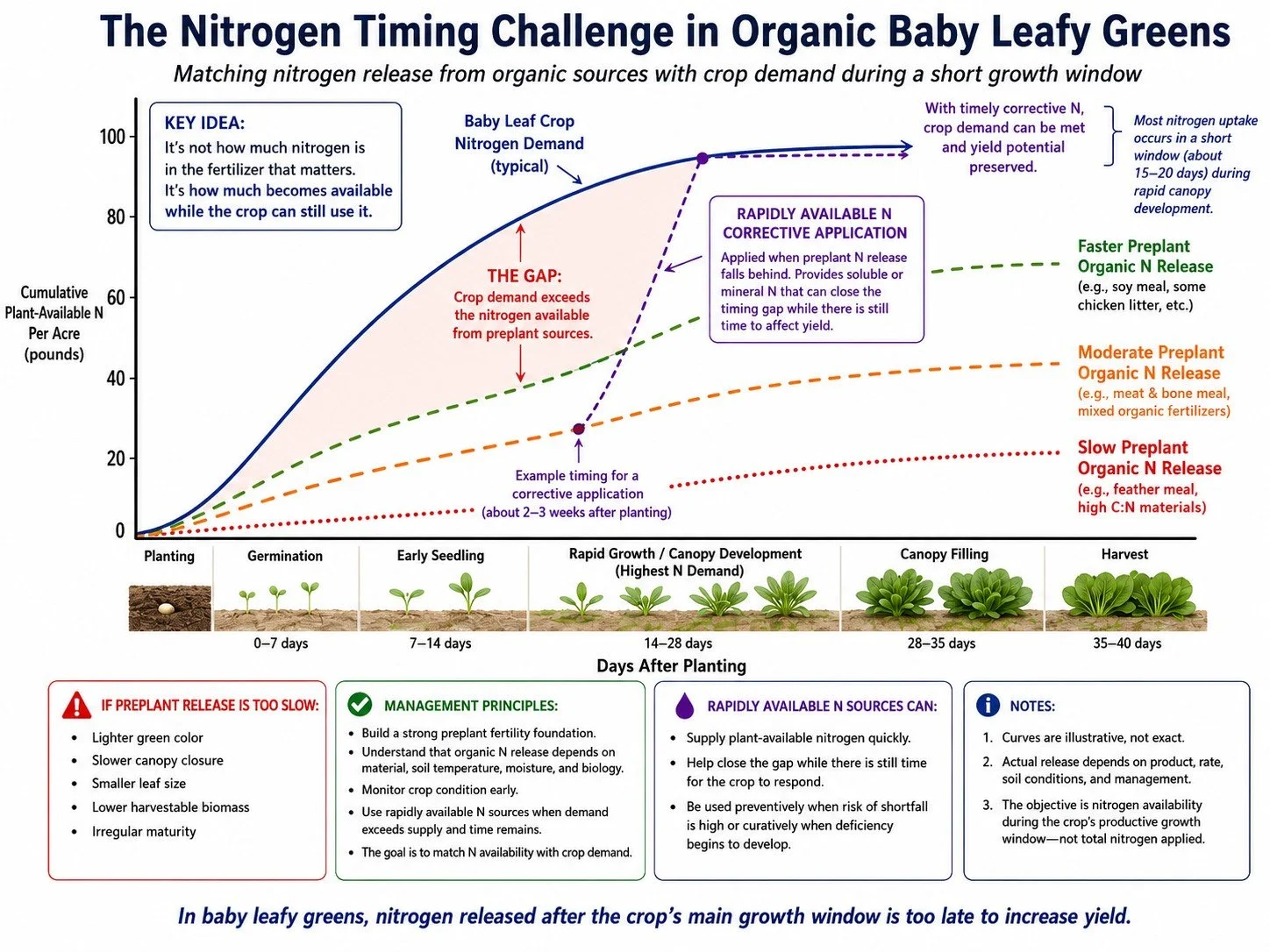
Baby-leaf crop demand can rise faster than nitrogen becomes available from preplant organic sources. A rapidly available corrective source can close the gap only while enough productive growing time remains. Curves are conceptual, not measured release curves.
When Rapidly Available Nitrogen Has a Role
Applying more preplant fertilizer does not necessarily solve a timing mismatch. If its nitrogen mineralizes too slowly, the crop may still experience an early shortage; if it releases after harvest, the remaining nitrogen may increase the risk of loss or complicate fertility planning for the next crop.
A rapidly available nitrogen source can have a role when soil testing, field history, crop appearance, or tissue testing indicates that preplant fertility is not supplying nitrogen quickly enough. Any corrective application must be made early enough for the crop to respond before harvest.
Phytamin Pure™ and Phytamin Jumpstart™ were developed for situations in which preplant fertility is not supplying nitrogen fast enough. Their inclusion here does not mean every baby-leaf crop requires these products; other permitted nitrogen sources may provide a similar function when they deliver plant-available nitrogen with appropriate timing.
Irrigation, Disease, and Weed Timing
Irrigation has two distinct jobs in a baby-leaf crop: establishing a uniform stand and then maintaining sufficient root-zone moisture without creating prolonged leaf wetness or saturated soil. The schedule that supports germination may not be appropriate once the canopy begins to close.
As the canopy becomes denser, air movement declines and leaves may remain wet longer. Irrigation timing and duration should therefore change with crop development to limit conditions that favor disease while continuing to support rapid growth.
Weed control must also begin early. Baby leafy greens have little time to outgrow competition, and late cultivation or hand removal can damage the crop or contaminate harvested leaves. A clean seedbed, uniform emergence, and early intervention are more effective than trying to recover after weeds are established.
Food Safety Is Agronomy
Because the harvested product is a young leaf that may be eaten raw, fertility, irrigation, field sanitation, worker practices, and harvest timing all influence food-safety risk. Inputs should be permitted for organic production and used in accordance with applicable food-safety requirements, label directions, and required preharvest intervals.
Managing moisture, preventing soil or contaminated water from contacting harvestable leaves, maintaining clean equipment, and documenting field practices are not separate from crop management. In baby leafy greens, they are part of the agronomic program.
Manage the Crop Clock
Successful baby-leaf production depends on coordinating every management decision with the crop’s short biological schedule. Uniform emergence must come first, plant-available nitrogen must be present while yield is still being built, and irrigation must evolve as the canopy develops.
The central question is not simply how much fertilizer, water, or crop protection was applied. It is whether each input was available when it could still influence marketable yield, quality, and food safety.
Key Takeaways
Baby leafy greens have little time to recover from early setbacks.
Uniform emergence and early root development are essential.
Total nitrogen applied is not the same as nitrogen available to the crop.
Cool soils can delay nitrogen mineralization.
Corrective nitrogen must be available early enough to affect the crop.
Irrigation should change as the canopy develops.
Weed, disease, and food-safety risks are best managed preventively.
References
Smith, R. Fertilization of Organic Vegetables. UC Cooperative Extension, Monterey County. Baby lettuce and spinach nitrogen uptake guidance. https://ucanr.edu/sites/default/files/2020-12/340390.pdf
UC Cooperative Extension. Crop Growth, Rooting Depth, Nitrogen Uptake and Nitrogen Removal. Peak spinach nitrogen uptake rate and duration. https://ucanr.edu/?legacy-file=188271.pdf&legacy-site=ucceventura
UC Statewide Integrated Pest Management Program. Integrated Weed Management—Spinach.https://ipm.ucanr.edu/agriculture/spinach/integrated-weed-management/
UC Agriculture and Natural Resources. Nitrogen Dynamics in Organic Vegetable Production Project Report. Short crop cycles and lag in mineral nitrogen release from organic fertilizers. https://ucanr.edu/sites/default/files/2021-01/342689.pdf
UC Statewide Integrated Pest Management Program. Cultural Tips for Growing Spinach.https://ipm.ucanr.edu/home-and-landscape/cultural-tips-for-growing-spinach/
UC Statewide Integrated Pest Management Program. Downy Mildew—Spinach.https://ipm.ucanr.edu/agriculture/spinach/downy-mildew/
Montazar, A. Drip Irrigation Shows Promise for Spinach Growers. UC Agriculture and Natural Resources, 2021. https://ucanr.edu/blog/uc-delivers/article/drip-irrigation-shows-promise-spinach-growers
U.S. Food and Drug Administration. FSMA Final Rule on Produce Safety.https://www.fda.gov/food/food-safety-modernization-act-fsma/fsma-final-rule-produce-safety
U.S. Food and Drug Administration. FSMA Final Rule on Pre-Harvest Agricultural Water.https://www.fda.gov/food/food-safety-modernization-act-fsma/fsma-final-rule-pre-harvest-agricultural-water
Suggested Citation
Stemwedel, T. (2026). Growing Organic Baby Leafy Greens: Why Timing Matters More Than Total Fertility. The Organic Agronomist. California Organic Fertilizers, Inc.
Permission to Use
© 2026 California Organic Fertilizers, Inc. All rights reserved.
Published by The Organic Agronomist. Linking directly to the original article is encouraged. Permission is granted to quote brief excerpts with proper attribution and a link to the original article when practical. Reproduction of complete articles or substantial portions without written permission is prohibited.
Need help saving a PDF? Click here for instructions.
To save a copy to your computer:
- Right-click the yellow PDF button above.
- Choose Save link as... from the menu.
- Choose where to save the file, such as Downloads.
- Click Save.
Already opened the PDF? Click the printer icon, select Save as PDF as the printer or destination, then click Save.