Why nutrient timing may matter when a heavy crop competes with the growth needed for the next one.
Published by The Organic Agronomist
Agronomic Review by Tim Stemwedel, CCA and COFI Founder
Published: August 13, 2026
Executive Summary
Alternate bearing is one of the persistent challenges of ‘Hass’ avocado production. A tree carrying a heavy crop in an “on” year may produce a much lighter crop the next year. Heavy fruit load itself is a major driver of the cycle. Recent research shows that fruit load can alter auxin signaling in avocado buds and repress development of the following bloom. Alternate bearing therefore cannot be explained simply as a fertilizer deficiency.
Nutrition still matters. California research demonstrated that nitrogen supplied at particular stages of avocado development can improve yield and, in one four-year study, significantly reduce the severity of alternate bearing. The important lesson was not simply that more nitrogen increased production. When the nitrogen was supplied mattered.
For organic production, that raises a useful question: Is enough plant-available nitrogen present when the tree is simultaneously supporting the current crop and building the shoots and buds needed for the next one?
Why Avocados Alternate Bear
In a heavy crop year, developing fruit become strong sinks for photosynthate and mineral nutrients. At the same time, the tree must continue producing roots, leaves, and new shoots. Those new shoots matter because future flowering depends on vegetative growth capable of developing reproductive buds.
Field studies in California have shown the familiar connection between heavy cropping, flowering behavior, fruit number, and subsequent cropping patterns. Separate work on shoot and root growth also showed that avocado growth is strongly seasonal, with distinct spring and summer shoot flushes.
The cycle is not simply heavy crop → nutrient depletion → light crop. A 2024 study in the Journal of Experimental Botany found that heavy fruit load changed auxin activity in buds and increased expression of a floral repressor, providing direct evidence that the crop itself can send physiological signals associated with reduced return flowering.
A Nitrogen-Timing Experiment Produced an Important Result
Carol Lovatt’s four-year University of California experiment tested additional nitrogen at specific stages of ‘Hass’ avocado development. The fertilizer source was ammonium nitrate. The study found that timing was more important than simply increasing the annual amount of nitrogen.
Additional nitrogen supplied in mid-November and mid-April increased four-year cumulative yield compared with the standard treatment. The April treatment—during flowering, early fruit set, and initiation of the spring vegetative flush—also significantly reduced the severity of alternate bearing.
That result does not mean nitrogen eliminates alternate bearing. It shows that nitrogen availability during a specific physiological window can influence how severely the tree alternates between crops.
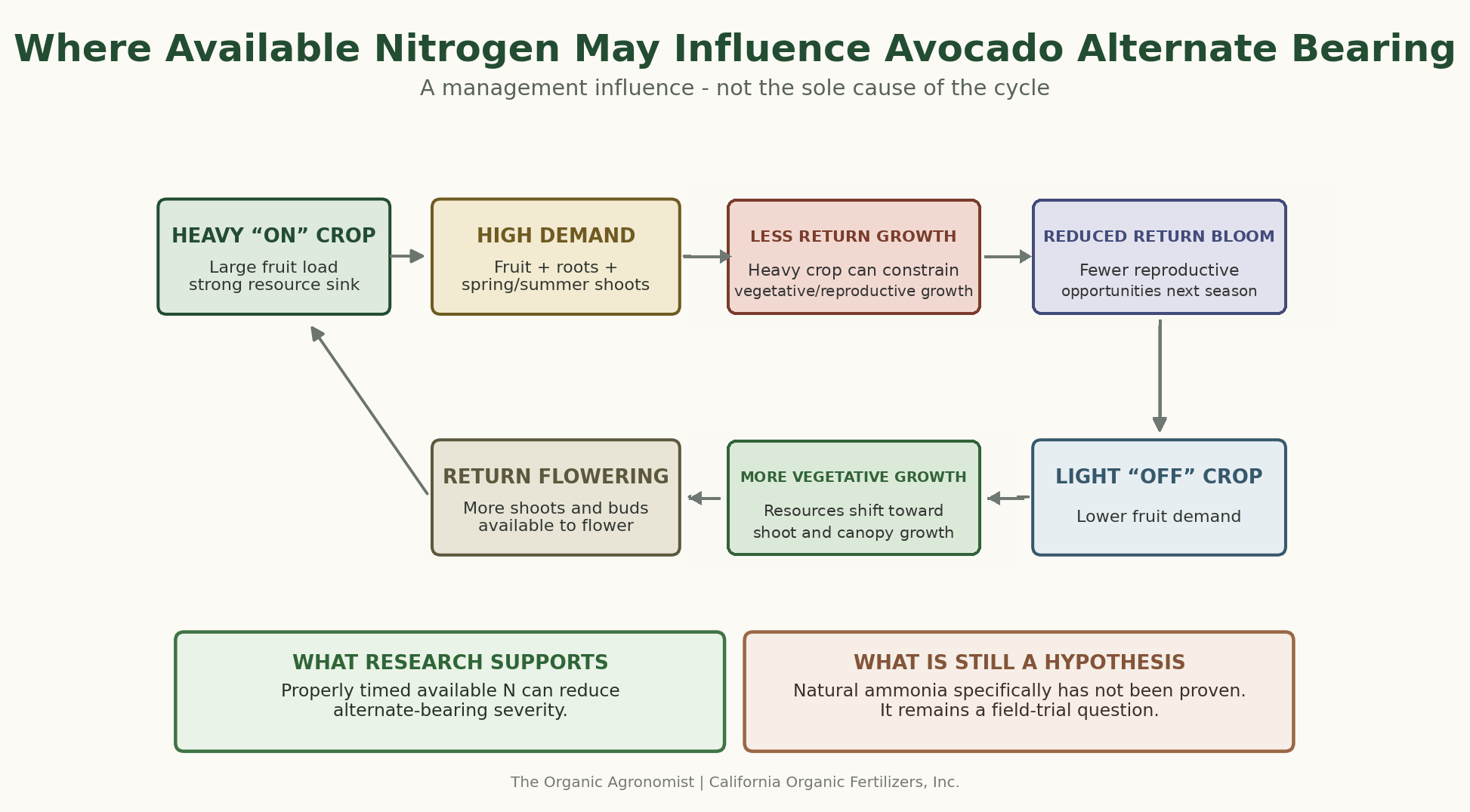
A heavy crop can suppress return flowering through several interacting mechanisms. Properly timed available nitrogen may influence the severity of the cycle, but natural ammonia specifically remains an unproven research question.
Why Would Available Nitrogen at the Right Time Matter?
During bloom and early fruit set, an avocado tree may be flowering, establishing a new crop, and producing a spring vegetative flush at the same time. Later, fruit growth overlaps with summer shoot growth and floral initiation. These are periods when several strong sinks are competing simultaneously.
Later research reinforced the importance of seasonal nitrogen demand. A four-year study showed that application timing affected yield and highlighted the importance of meeting nitrogen demand during summer, when fruit growth, vegetative shoot growth, and floral initiation overlap.
This leads to an important agronomic principle: A tree can receive enough total nitrogen over the course of a year and still experience inadequate nitrogen availability during a critical stage of development.
Why This Matters More in Organic Fertility Programs
In many organic fertilizers, much of the nitrogen is initially contained in proteins and other organic compounds. Before roots can absorb that nitrogen, microorganisms must mineralize a portion of it into plant-available forms.
The rate of release depends on the fertilizer material, temperature, moisture, microbial activity, particle size, and placement. A grower can therefore apply an adequate amount of total organic nitrogen and still miss a short period of high crop demand.
That distinction may become especially important during an “on” year. The more useful fertility question is not only how many pounds of nitrogen were applied, but how much plant-available nitrogen was present while the tree was supporting fruit and producing the growth needed for the next crop.
Could Rapidly Available Nitrogen Help?
The published avocado research supports the importance of properly timed, readily available nitrogen. It does not establish that every nitrogen source will produce the same response.
The field experiments used ammonium nitrate, which supplies both ammonium nitrogen and nitrate nitrogen. The studies therefore do not tell us whether the response came primarily from ammonium, nitrate, or the combination.
For organic agriculture, rapidly available nitrogen sources are scientifically interesting because they may allow growers to target short physiological windows without depending entirely on mineralization of slower organic materials. However, that idea must be tested source by source.
Where Natural Ammonia Fits—and Where the Evidence Stops
Natural ammonia is an interesting research candidate because its nitrogen is already in a rapidly available form. That characteristic could make it useful for targeting periods when crop demand rises quickly.
However, current avocado research does not prove that natural ammonia reduces alternate bearing, nor does it establish an avocado rate or timing recommendation for predominantly ammoniacal nitrogen. Avocado roots are also sensitive to salinity and high localized fertilizer concentrations, so application rate, dilution, irrigation, and root-zone conditions would matter.
The appropriate scientific question is therefore not, “Will natural ammonia stop alternate bearing?” It is, “Can low-rate, phenology-timed ammoniacal nitrogen improve growth, return bloom, or yield consistency without creating root-zone stress?” That is a field-trial question.
More Nitrogen Is Not the Lesson
The most important management lesson from the research is not to simply apply more nitrogen to heavily cropped avocado trees. In the four-year trial, additional nitrogen at some stages did not produce the same benefit as applications at the responsive stages. Timing mattered.
Alternate bearing is a whole-tree problem involving fruit load, vegetative growth, flowering, hormonal signaling, carbohydrate allocation, roots, and nutrition. Nitrogen management may help moderate the cycle, but it cannot be expected to override every effect of a very heavy crop.
For organic growers, the practical question is straightforward: Was sufficient plant-available nitrogen present when the tree was carrying this year’s crop and building the growth required for next year’s crop?
Key Takeaways
Heavy fruit load is a primary driver of alternate bearing in ‘Hass’ avocado.
Hormonal signaling from heavily cropped trees contributes to suppression of return bloom.
Nitrogen nutrition can influence alternate-bearing severity, but nitrogen deficiency is not its sole cause.
A four-year California study found that an April nitrogen treatment increased cumulative yield and significantly reduced alternate-bearing severity.
Additional nitrogen at every growth stage did not produce the same response; timing mattered.
In organic systems, total nitrogen applied and plant-available nitrogen at a critical growth stage can be very different.
Current research does not establish that natural ammonia specifically reduces alternate bearing.
Natural ammonia is a reasonable field-trial hypothesis, not yet an established avocado recommendation.
References
Lovatt, C. J. (2001). Properly Timed Soil-applied Nitrogen Fertilizer Increases Yield and Fruit Size of ‘Hass’ Avocado. Journal of the American Society for Horticultural Science, 126(5), 555–559. https://doi.org/10.21273/JASHS.126.5.555
Salvo, J. E., & Lovatt, C. J. (2016). Nitrogen Fertilization Strategies for the ‘Hass’ Avocado That Increase Total Yield Without Reducing Fruit Size. HortTechnology, 26(4), 426–435. https://doi.org/10.21273/HORTTECH.26.4.426
Mickelbart, M. V., Bender, G. S., Witney, G. W., Adams, C., & Arpaia, M. L. (2012). ‘Hass’ avocado tree growth on four rootstocks in California: Yield and flowering. Scientia Horticulturae, 143, 184–188. https://doi.org/10.1016/j.scienta.2012.06.023
Mickelbart, M. V., Bender, G. S., Witney, G. W., Adams, C., & Arpaia, M. L. (2012). ‘Hass’ avocado tree growth on four rootstocks in California: Shoot and root growth. Scientia Horticulturae, 143, 205–210. https://doi.org/10.1016/j.scienta.2012.06.021
Pochamreddy, M., et al. (2024). Alternate bearing in ‘Hass’ avocado: Fruit load-induced changes in bud auxin homeostasis are associated with flowering repression. Journal of Experimental Botany, 75(18), 5717–5733. https://doi.org/10.1093/jxb/erae305
Suggested Citation
Stemwedel, T. (2026). Can Available Nitrogen Reduce Alternate Bearing in Avocados? The Organic Agronomist. California Organic Fertilizers, Inc.
© 2026 California Organic Fertilizers, Inc. All rights reserved.
Readers may download, save, and print this publication for personal, educational, or internal business use. Brief excerpts may be quoted with attribution to The Organic Agronomist and a link to the original article. This publication may not be republished, altered, sold, distributed commercially, or presented as another party’s work without prior written permission from California Organic Fertilizers, Inc.
For permission requests, contact California Organic Fertilizers, Inc. at info@organicag.com.
Need help saving a PDF? Click here for instructions.
To save a copy to your computer:
- Right-click the yellow PDF button above.
- Choose Save link as... from the menu.
- Choose where to save the file, such as Downloads.
- Click Save.
Already opened the PDF? Click the printer icon, select Save as PDF as the printer or destination, then click Save.