Building an organic fertility program around tree physiology, crop demand, and long-term orchard performance.
Author: The Organic Agronomist Agronomic Review by: Tim Stemwedel, CCA and COFI Founder Published by: The Organic Agronomist California Organic Fertilizers, Inc.
Executive Summary
California almond growers manage a perennial crop with demanding nutritional needs and very little tolerance for poor timing. A successful organic program is not simply a conventional program with different fertilizer labels. It must account for nutrient reserves already stored in the tree, the amount and timing of nutrients removed by the crop, the biological release of organic fertilizers, and the influence of irrigation on nutrient uptake.
Nitrogen deserves special attention, but it is not the only concern. Potassium removal can be substantial, boron is important for reproductive development, zinc shortages can restrict healthy growth, and root-zone problems can limit the uptake of nutrients already present. These nutritional decisions intersect with weed competition, disease management, navel orangeworm prevention, orchard-floor conditions, and harvest timing. Organic growers can succeed by planning these relationships as a year-round system rather than reacting to symptoms after opportunities have passed.
The practical objective is not to apply the most fertilizer. It is to keep enough plant-available nutrition in the active root zone at the times when trees can use it, without encouraging unnecessary vigor, avoidable losses, or excessive expense.
Organic Almonds Are a Timing Challenge
Almond production follows a sequence: dormancy, bloom, leaf expansion, nut set, shell growth, kernel development, hullsplit, harvest, postharvest recovery, and leaf fall. Crop demand for water and nutrients changes across those stages. A fertilizer application that is well timed for active spring growth may be poorly timed after kernel development has passed. A deficiency recognized in midsummer cannot fully replace spring growth or nut development that did not occur.
Pests and diseases also follow seasonal patterns. Navel orangeworm can survive in mummy nuts left after harvest. Brown rot and other diseases are influenced by weather and susceptible tissue at distinct stages. Weeds competing with young trees can reduce permanent orchard growth. The common lesson is that prevention and preparation have greater value than late correction.
How an Almond Tree Uses Nutrients Throughout the Season
Dormancy and bloom: the role of stored reserves
Almond trees begin spring growth before their root systems have reached peak nutrient uptake. Nitrogen and other resources stored in perennial tissues help support bloom and initial leaf development. That does not mean all spring nutrition comes from reserves or that trees should be fertilized heavily in winter. It means the condition of the tree entering dormancy affects how spring begins, and it explains why fertilizing at bloom cannot instantly substitute for reserves accumulated the previous season.
Leaf expansion and nut growth: rising nutrient demand
Once leaves develop and roots become active, nitrogen uptake accelerates. Research from California almond orchards shows that much of the annual nitrogen uptake is concentrated from leaf-out through spring and early summer, particularly as the crop develops. The exact calendar dates shift with weather, variety, location, and tree condition. A grower should therefore build the nitrogen schedule around orchard growth stage, not a fixed date copied from another operation. [1, 2]
Hullsplit and harvest: a different priority
As the season progresses, the need to protect crop quality and prepare for harvest becomes increasingly important. Excessive late nitrogen and poorly managed irrigation can favor hull rot. Late-season fertilizer is not automatically wasted: some nutrients may support tree reserves where a real deficiency exists. But applying nutrients without evidence of need raises cost and may increase risk. [3]
Postharvest: prepare next year's productive tree
Leaves continue photosynthesis while healthy and functional after harvest. Orchard managers should assess crop removal, leaf nutrient status, irrigation conditions, canopy health, and the remaining time before leaf fall. Whether postharvest fertilization is justified depends on demonstrated need, rather than a blanket assumption that every orchard requires a final application.
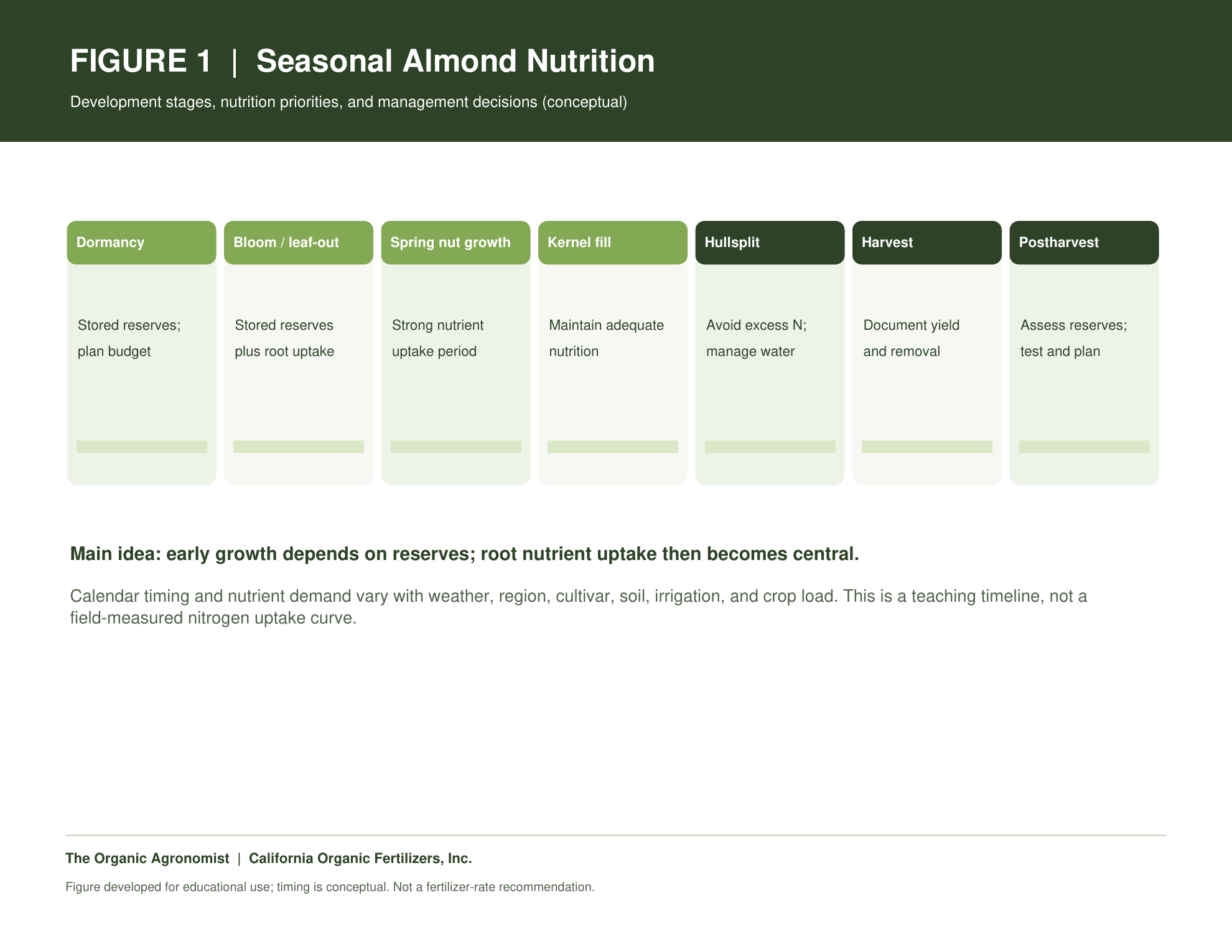
Seasonal almond nutrition timeline showing seven growth stages from dormancy through postharvest. Early growth relies on stored nutrient reserves, followed by increased root nutrient uptake during spring growth. Nutrition, irrigation, and nitrogen management priorities change through kernel fill, hullsplit, harvest, and postharvest.
A conceptual phenology timeline identifies nutrient-management priorities from stored reserves and spring uptake through hullsplit, harvest, and postharvest assessment. The diagram does not represent measured monthly uptake percentages.
Nitrogen: Applying It Is Not the Same as Supplying It
Fertilizer analysis describes total nitrogen contained in a material; it does not say how much will be accessible to the tree during a particular week. Roots take up nitrogen mainly as ammonium and nitrate. Organic nitrogen held in complex compounds must first undergo mineralization—microbial conversion into plant-available inorganic forms—before the tree can absorb that portion. Mineralization varies with temperature, water, soil oxygen, particle size, material composition, and placement.
That is why applying 100 pounds of organic nitrogen per acre does not mean 100 pounds became available during the critical spring uptake period. This is a particular concern when slow-releasing sources are spread on dry soil, left away from active roots, or applied shortly before a cool spell.
Build a nitrogen budget before choosing the fertilizer
UC research reports roughly 68 pounds of nitrogen in harvested fruit per 1,000 pounds of kernel yield in productive almond orchards. It also identifies a smaller but meaningful demand for perennial and vegetative growth. This crop-removal figure is a starting point for estimating tree demand, not a universal fertilizer rate. [1]
Consider an illustrative block expected to produce 3,000 pounds of kernels per acre:
Estimated nitrogen in harvested fruit: 3 × 68 = 204 pounds N per acre.
Additional vegetative and perennial growth demand must be considered according to orchard age and condition.
Subtract nitrogen supplied by existing soil reserves, irrigation water, mineralization of previous amendments, and other measured or defensible sources.
Adjust fertilizer calculations for realistic recovery efficiency and timing, rather than treating the difference as an automatic application rate.
An underperforming orchard should not simply receive a fertilizer rate calculated from an aspirational crop yield. Estimate a realistic crop load, use tissue tests and historical performance, and revise the budget as the season progresses.
Why an organic fertilizer's label does not tell its release curve
Common organic fertilizers offer different combinations of nutrients and release characteristics:
Feather meal (often approximately 12-0-0): concentrated organic nitrogen, but nitrogen release depends on microbial breakdown and adequate soil conditions.
Soybean meal (approximately 7-1-2): an organic nitrogen source with accompanying phosphorus and potassium; availability is still biologically mediated.
Meat and bone meal (approximately 8-5-1): supplies nitrogen and appreciable phosphorus; repeating it as a nitrogen source can increase phosphorus where the orchard does not need more.
Heat-treated poultry-based 4-4-2 fertilizer: offers nitrogen together with phosphorus and potassium; it should not automatically be described as composted, and release depends on processing and material characteristics.
Compost: valuable for organic matter and nutrient cycling, but total nitrogen in compost can greatly exceed the nitrogen mineralized in a single growing season.
Approved soluble nitrogen sources: may provide ammonium or other readily available forms without requiring all the nitrogen to mineralize first; actual uptake still depends on irrigation management, placement, soil conditions, and root activity.
No ranking of these materials is universally correct. A suitable program often combines a baseline source with properly timed supplemental nutrition, guided by testing and an understanding of what is already available. Every input must be verified for compatibility with the grower's organic certifier and its intended use.
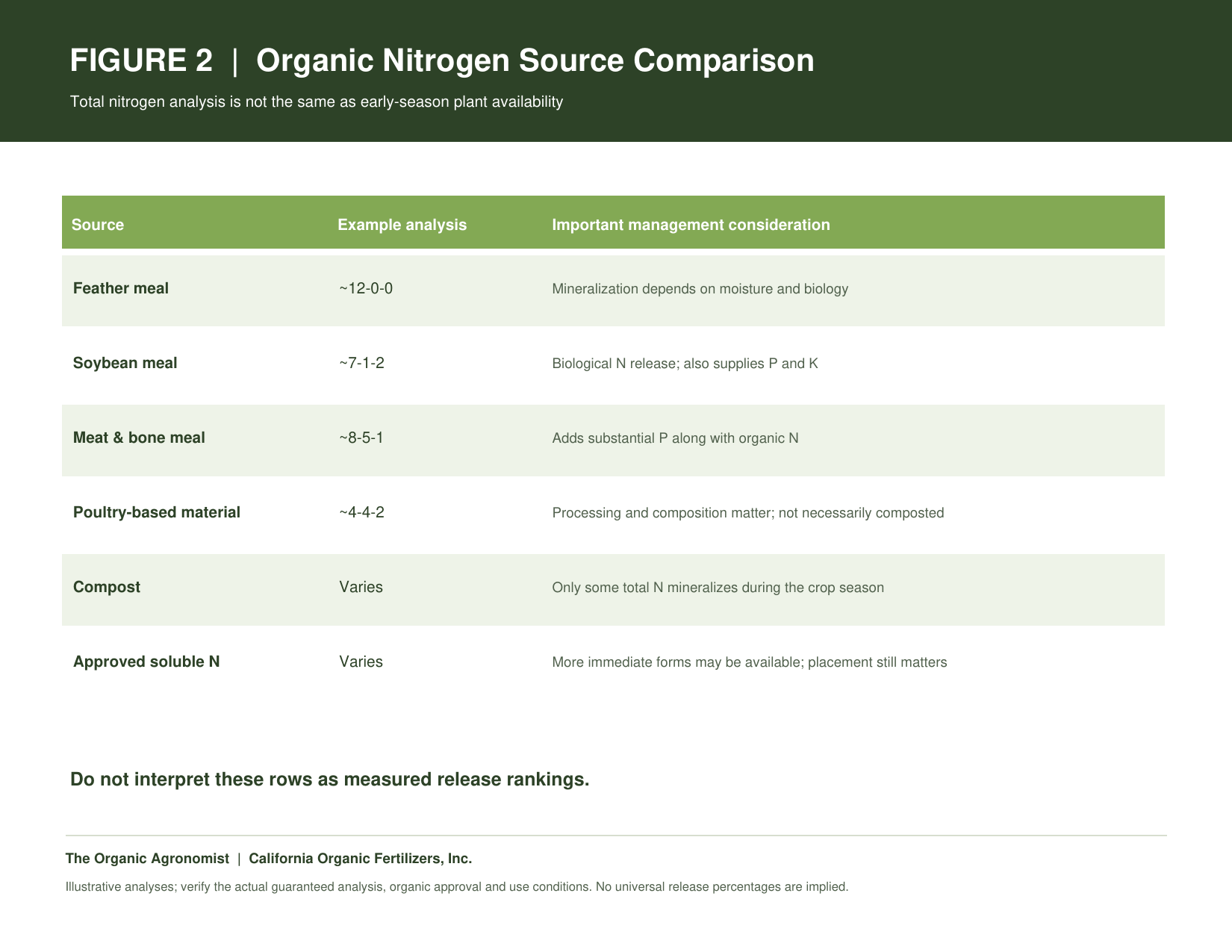
Comparison of organic nitrogen sources used in almond orchards, including feather meal, soybean meal, meat and bone meal, poultry-based fertilizers, compost, and soluble nitrogen. The chart explains differences in nitrogen availability, the need for microbial mineralization, and how release timing affects nutrient management.
Placement and irrigation can determine whether nitrogen reaches roots
Broadcasting dry fertilizer over an unirrigated orchard floor can leave nutrients outside the most active root zone. A source that requires microbial activity needs water and appropriate temperature to mineralize. Fertigation can distribute soluble inputs through the wetted area, but uniformity, filtration, compatibility, and emitter performance still matter. Excess water can move nitrate below effective roots; excessive saturation can reduce oxygen supply and impair root function.
For every fertilizer application, ask four questions: What form is the nutrient in? Where is it placed? What conditions activate its release? When will the tree need it?
Check the crop's response instead of relying on application records alone
Tissue sampling and yield estimates make the nutrient budget more useful. UC investigators have developed early-season almond leaf sampling methods to estimate later nutrient status and support in-season decisions. Conventional midseason leaf analysis remains valuable for diagnosis and documenting trends. Follow a laboratory's validated sampling protocol consistently, and sample weak and strong orchard zones separately when conditions differ. [2]
A change in leaf color alone does not prove nitrogen deficiency. Root injury, irrigation problems, salinity, pests, and nutrient imbalance may produce similar symptoms. Diagnose the cause before adding fertilizer.
Beyond Nitrogen: Nutrients That Protect Productivity
Potassium and the cost of crop removal
Almond crops remove substantial potassium with harvested fruit. Productive orchards can therefore develop meaningful potassium requirements even when leaf nitrogen looks adequate. Potassium helps regulate plant water relations and is important to normal physiological function. Potassium management should consider harvest removal, soil supply, leaf analysis, irrigation water, and the availability of organically permitted materials. Do not interpret a generic N-P-K ratio as proof that the fertilizer matches almond nutrient demand. [4]
Boron: important, but easy to overapply
Boron has important functions in reproduction and cell development. Deficiency can affect production, while overapplication can damage trees. Almond hull analysis at harvest can provide useful information about boron status and complement soil and leaf testing. Growers should not make precautionary boron applications without evidence of need, because the margin between insufficient and excessive supply can be narrow. [5]
Zinc, phosphorus, calcium, magnesium, and sulfur
Zinc supports normal shoot and leaf development; low zinc availability can occur in alkaline or high-pH soils. Phosphorus is essential but should not be added routinely simply because an organic nitrogen source contains it. Calcium and magnesium influence plant structure and physiology, but their soil presence does not guarantee uptake under poor root-zone conditions. Sulfur is essential to protein formation. Soil tests, leaf analysis, visual symptoms, irrigation water quality, and site history should be interpreted together before selecting corrections.
A practical rule: when one nutrient appears low, investigate why it is low before adding several products. The limiting factor may be roots, soil moisture, pH, salt accumulation, or nutrient interactions rather than the total nutrient supply.
Irrigation Is Part of the Fertility Program
Water supplies nutrients to roots and helps determine how effectively roots absorb them. Uneven irrigation can cause one part of an orchard to receive more water and dissolved nutrients while another part remains chronically under-supplied. A saturated root zone may reduce oxygen availability; a very dry root zone may limit nutrient movement and microbial mineralization. Testing irrigation water is also important because nitrate in water contributes to the nitrogen budget.
At hullsplit, irrigation management needs particular care. UC IPM identifies excessive nitrogen and poorly managed irrigation as contributors to hull rot risk; regulated deficit irrigation may be appropriate in some situations when managed carefully, but severe or unplanned stress can harm trees. Use orchard-specific irrigation advice, moisture monitoring, and crop condition rather than a fixed one-size-fits-all cutoff. [3]
Weed Control: Competition You Cannot Get Back
In new orchards, weeds compete with young trees for water, nitrogen, and light while the permanent root and canopy systems are forming. The first several establishment years are particularly sensitive. Growth lost to uncontrolled competition can delay the orchard's productive development even after weeds are removed.
Successful organic weed management starts before planting. Identify persistent perennials such as bermudagrass, nutsedge, bindweed, and johnsongrass early. Where appropriate, reduce populations with preplant cultivation, stale seedbeds, cover management, or other site-specific methods. After planting, use a combination of mowing, shallow cultivation, mulches, hand removal, and approved organic products while avoiding trunk, root, and irrigation-system injury.
The tree row and row middle have different purposes. Keeping competition down near young tree roots is a high priority; well-managed row middles may protect trafficability and support beneficial ecological functions. Cover crops can also compete for water and nutrients if their termination is mistimed, so their benefit must be weighed against the tree's demand.
Navel Orangeworm: Prevention Begins Long Before Hullsplit
Navel orangeworm (NOW) is among the most consequential insect risks in California almonds. Larvae can overwinter inside mummy nuts left on trees or the ground. If that source is not reduced, the pest population has a head start before the new crop becomes susceptible at hullsplit.
UC IPM identifies winter sanitation and early, timely harvest as two essential foundations of control. Monitor mummy nuts, remove and destroy them according to locally appropriate recommendations, and monitor pest activity using traps, degree-day information, and crop development. Organic-compatible mating disruption and other approved methods may contribute, but are not substitutes for sanitation. [6]
Harvest timing is also preventive management. Nuts left exposed at hullsplit are vulnerable to NOW, and high populations can contribute to kernel damage and associated quality losses. After harvest, review reject and damage reports so the next year's program addresses the actual causes.
Diseases: Manage Infection Risk Before Symptoms Appear
Fungal disease protection works best when it reflects pathogen biology and weather, rather than waiting for extensive symptoms. Brown rot blossom blight, shot hole, anthracnose, scab, Alternaria leaf spot, and other diseases differ in their infection conditions and susceptible growth stages. Use UC IPM guidance, orchard history, cultivar susceptibility, and forecast conditions to decide when monitoring and certified-organic-compatible protection are warranted. [7]
Red leaf blotch is an especially useful lesson in timing. Its visible symptoms may appear weeks after infection. When symptoms become conspicuous, much of the opportunity for preventive action has already passed. Because organic-compatible disease-control options may offer limited efficacy under severe pressure, sanitation where relevant, canopy management, monitoring, and timely disease-specific decisions matter. Avoid implying that nutrition alone controls infectious diseases.
Hull rot connects nutrition, water, and tree vigor
Hull rot deserves particular attention in a nutrition-focused article. Excess nitrogen can sustain vigorous conditions that favor the problem, and irrigation practices around hullsplit influence risk. UC IPM advises avoiding excessive nitrogen near hullsplit and evaluating midsummer leaf nitrogen status. This is not an argument for starving trees early in the year; it is an argument for meeting demand during the appropriate period instead of creating a late surplus. [3]
Orchard Floor Management and Harvest Timing
An organic orchard floor must serve several functions: support irrigation management, permit weed control, reduce pest carryover, allow machinery to operate, and provide a clean surface for harvest. Practices that make sense for spring cover management may require adjustment as harvest approaches.
Prepare early enough that mowing, ground leveling, debris removal, and other operations do not delay the harvest window. Evaluate traffic, dust, ant pressure, irrigation hardware, and whether crop debris or vegetation might interfere with equipment. Nut drying, pick-up, and removal should occur as promptly as conditions safely permit. Monitor moisture and processor specifications rather than using a universal dry-down assumption.
Organic Transition and Economic Risk
Organic transition brings agronomic and financial challenges at the same time. Fertility materials may cost more per pound of promptly available nitrogen; weed control may require more labor or repeated operations; and pest and disease management may depend heavily on preventive work. Organic premiums do not eliminate the consequences of low yields or crop-quality losses.
A sound transition plan should establish yield expectations, soil and irrigation baselines, expected fertilizer availability, equipment needs, labor capacity, pest pressure, transition timelines, and cash-flow reserves. Start with a realistic budget for each orchard block, and compare the expense of planned prevention with the expense of crop losses and emergency response.
A Seasonal Decision Guide for Organic Almond Growers
Successful organic almond management requires attention throughout the growing season. Use this guide to connect nutrient availability, irrigation, and orchard management with the changing needs of the crop.
| Orchard Period | Nutrition and Water Priority | Other Management Priority |
|---|---|---|
| Dormancy to Bloom | Review previous tissue results, crop removal, water and soil tests; assess reserves and planned early supply. | Remove mummy nuts; review weeds and bloom disease history. |
| Leaf-Out Through Spring | Estimate crop load; confirm nitrogen availability and irrigation distribution; monitor emerging shortages. | Protect young trees from weed competition; monitor disease and insect conditions. |
| Nut Growth and Kernel Fill | Adjust nitrogen and potassium budgets using realistic yield and tissue information. | Keep canopy functional; review water uniformity and disease monitoring. |
| Hullsplit | Avoid excessive late nitrogen; manage irrigation carefully. | NOW monitoring, hull rot prevention, harvest readiness. |
| Harvest | Record yield and nutrient removal; collect hull samples where appropriate. | Prompt harvest and removal; assess nut damage and orchard-floor performance. |
| Postharvest | Evaluate leaf condition and whether additional nutrition is genuinely needed. | Review sanitation, weed control, soil management, and next year's plan. |
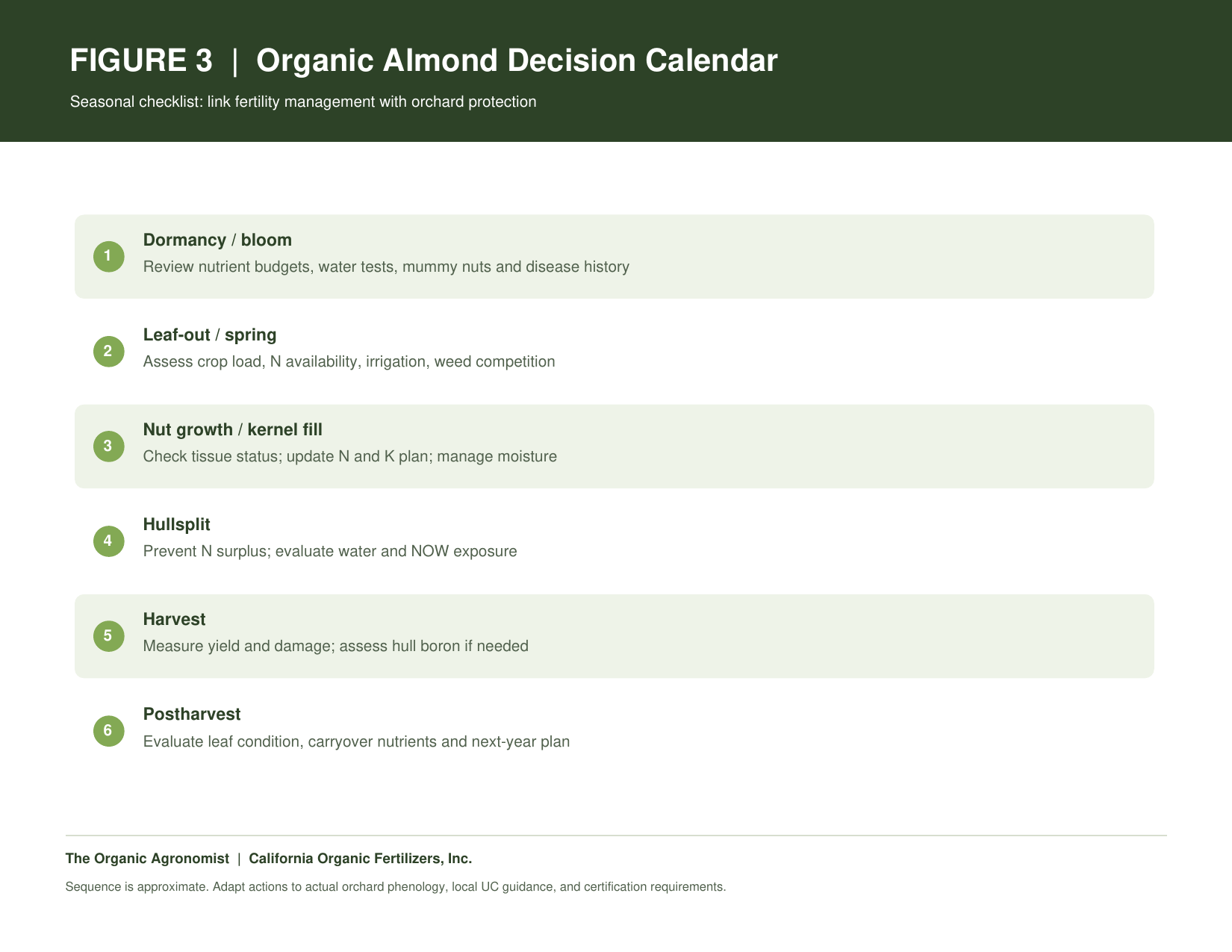
Seasonal organic almond management calendar showing nutrition, irrigation, and orchard management priorities from dormancy through postharvest. The chart connects nitrogen and potassium planning, tissue testing, weed management, disease prevention, navel orangeworm monitoring, hullsplit, and harvest preparation.
A field-use checklist links nutrient budgeting and tissue diagnostics to pest prevention and harvest preparation. Calendar timing varies among California growing regions and varieties.
Management Priorities
Budget from realistic crop demand, accounting for nitrogen and potassium removal rather than copying last year's fertilizer tonnage.
Distinguish total nutrients from plant-available nutrients, especially for biologically mineralized organic sources.
Test the orchard, not just the fertilizer. Combine soil, irrigation-water, tissue, yield, and field observations.
Protect the active root zone. Check irrigation distribution, oxygen, salinity, placement, and root health.
Use prevention as an operational calendar. Weed competition, diseases, NOW, hull rot, and harvest all have critical timing windows.
Review results after harvest. Yield, rejection reports, nutrient status, and costs should inform the next season's plan.
Questions Worth More Field Research
California research provides strong information about almond nutrient uptake and conventional nutrient budgeting, but comparative field measurements of plant-available nitrogen release from commonly used organic materials in almond orchards remain a valuable research opportunity. Trials should compare source, placement, irrigation method, soil temperature, mineralization, actual tree uptake, and yield—not just total fertilizer nitrogen applied. Multi-year trials should also evaluate whether nutrient programs alter tree reserves, canopy vigor, crop quality, and hull rot risk.
Conclusion
Organic almond production is demanding, but it is manageable when the orchard is treated as a connected biological and economic system. The most effective program supplies nutrients when roots can use them, avoids unnecessary additions, protects tree growth against preventable competition and infection, and prepares early for harvest. Well-timed nutrition is not a substitute for good pest or water management; it is one part of the same coordinated plan.
Key Takeaways
Almond trees draw on stored nutrient reserves early, then take up much of the season's nitrogen during spring and early summer.
Nitrogen applied is not the same as nitrogen made available, especially when organic materials require microbial mineralization.
Crop yield, potassium removal, tissue testing, irrigation water, and nutrient recovery matter more than a generic N-P-K recipe.
Nutrient deficiencies and excesses can both reduce performance; unnecessary late nitrogen can increase hull rot risk.
Winter NOW sanitation, timely disease prevention, effective weed control, and prompt harvest remain essential.
A seasonal decision calendar helps growers connect nutrition with everything else that makes an organic almond orchard productive.
Related Reading
The Difference Between Organic Nitrogen Sources — The Organic Agronomist
How Nitrogen Becomes Plant-Available — The Organic Agronomist
UC Davis Almond Nutrition Information and Nitrogen/Potassium Calculator [8]
References
UC Agriculture and Natural Resources. Nitrogen Management in Nut Crops. https://ucanr.edu/sites/default/files/2020-01/318120.pdf
UC ANR. Development of Leaf Sampling & Interpretive Methods for Almond. https://www.ucanr.edu/site/advanced-sensing-management-technology-specialty-crops/update-2012-development-leaf-sampling
UC Statewide IPM Program. Hull Rot—Almond. https://ipm.ucanr.edu/agriculture/almond/hull-rot/
UC Davis Fruit & Nut Research and Information Center. Almond Nutrition Information. https://fruitsandnuts.ucdavis.edu/nutrition-landing-page/almond-nutrition-information
UC Cooperative Extension, Northern Sacramento Valley Orchards. Orchard guidance on almond hull boron samples. https://ucanr.edu/sites/default/files/2023-07/Northern_Sacramento_Valley_Orchards_Newsletter98576.pdf
UC Statewide IPM Program. Navel Orangeworm—Almond. https://ipm.ucanr.edu/agriculture/almond/navel-orangeworm/
UC Statewide IPM Program. Almond Pest Management Guidelines. https://ipm.ucanr.edu/agriculture/almond/
UC Davis Fruit & Nut Research and Information Center. New Nitrogen and Potassium Calculator for Almond (March 2, 2026). https://fruitsandnuts.ucdavis.edu/news/new-nitrogen-and-potassium-calculator-almond
Suggested Citation
The Organic Agronomist. (2026). Growing Organic Almonds: Why Timing and Prevention Matter. California Organic Fertilizers, Inc.
Permission to Use
© 2026 California Organic Fertilizers, Inc. All rights reserved. Readers may download, save, and print this publication for personal, educational, or internal business use. Brief excerpts may be quoted with attribution to The Organic Agronomist and a link to the original article. This publication may not be republished, altered, sold, distributed commercially, or presented as another party’s work without prior written permission from California Organic Fertilizers, Inc.
Need help saving a PDF? Click here for instructions.
To save a copy to your computer:
- Right-click the yellow PDF button above.
- Choose Save link as... from the menu.
- Choose where to save the file, such as Downloads.
- Click Save.
Already opened the PDF? Click the printer icon, select Save as PDF as the printer or destination, then click Save.