Cane berries create an unusual fertility challenge. In many raspberry and blackberry production systems, a plant supports this year’s fruit while simultaneously developing the canes that will carry much of next year’s crop.
Published by The Organic Agronomist
Agronomic Review by Tim Stemwedel, CCA and COFI Founder
Published: August 28, 2026
Executive Summary
Fertility decisions cannot be judged only by the berries being harvested today. Nutrient availability also affects primocane development, root and crown health, nutrient storage, and future production. For organic growers, where much of the nitrogen supply depends on biological mineralization, timing can matter as much as total nutrient rate.
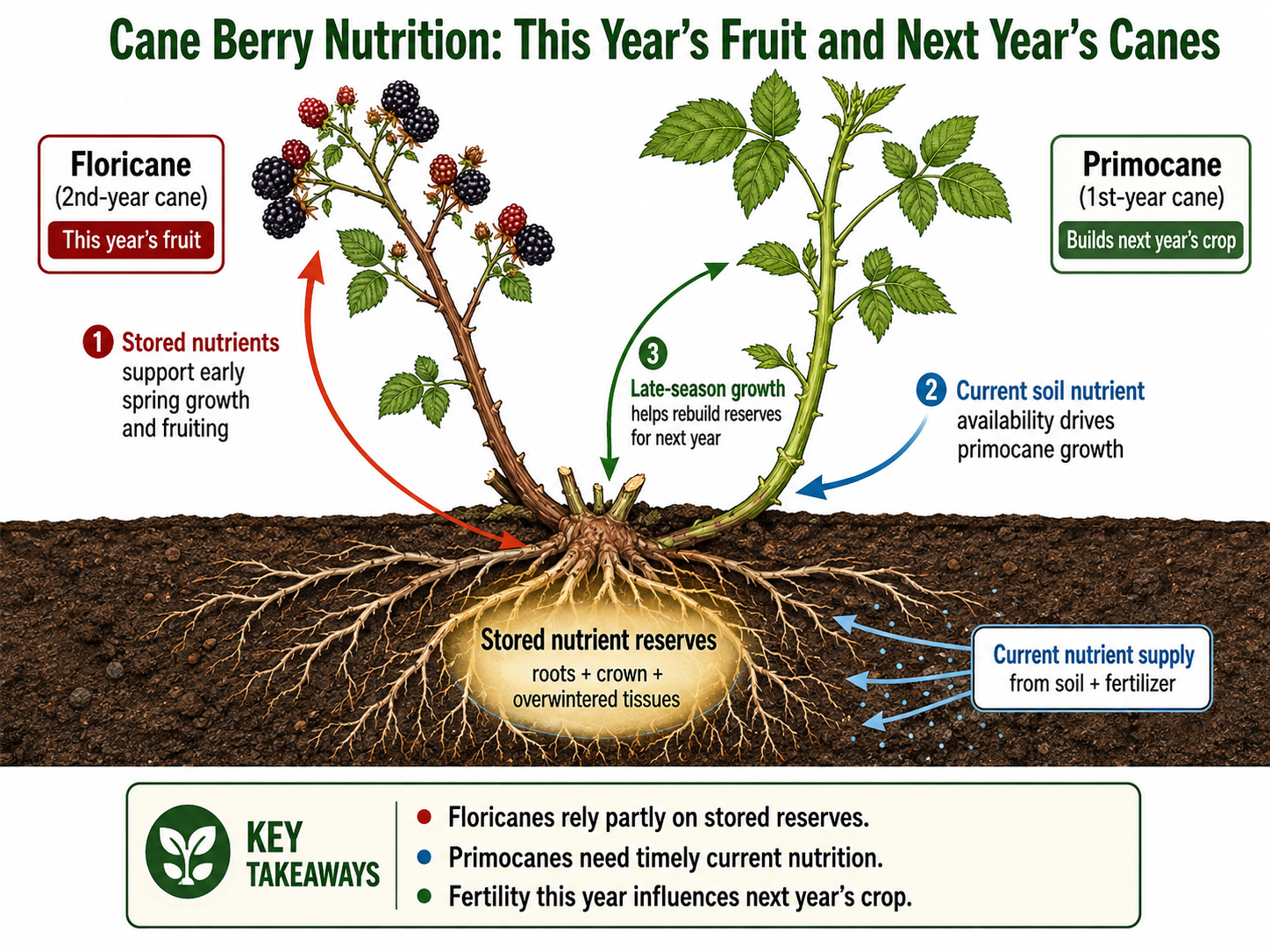
Diagram of a cane berry plant showing fruiting floricanes for this year’s crop, developing primocanes for next year, stored nutrients in the roots and crown, and current nutrient uptake from the soil.
Two Cane Generations, Two Nutrient Demands
Most traditional cane berries have perennial roots and crowns but biennial canes. A primocane is a first-year cane. In floricane-fruiting cultivars, it grows vegetatively during its first season and becomes part of the fruiting structure for the following year. A floricane is a second-year cane that flowers and fruits and then dies after harvest.
Research on raspberry and blackberry nutrient partitioning shows that these cane generations do not depend on nutrient sources in exactly the same way. Fruiting laterals and fruit can draw substantially on nutrients stored over winter in canes, crowns, and roots, while new primocane growth depends much more heavily on nutrients available from the soil and current fertilizer applications [1,2].
Nitrogen Is a Timing Problem
Nitrogen is essential for cane growth, leaf area, photosynthesis, and fruit production. But more nitrogen does not automatically mean more fruit. Excess nitrogen can encourage long internodes and excessive vegetative growth while reducing fruiting laterals, so visual vigor by itself is not a reliable measure of a good fertility program [1,3].
The more useful question is not simply how much nitrogen was applied. It is whether enough plant-available nitrogen was present when the crop needed it.
Organic Fertilizers Do Not All Release Nitrogen at the Same Rate
Much of the nitrogen in solid organic fertilizers is contained in organic compounds that roots cannot absorb directly. Soil microorganisms must decompose those materials and convert a portion of their nitrogen into plant-available forms. This process, mineralization, is influenced by fertilizer composition, temperature, moisture, aeration, particle characteristics, placement, and biological activity.
A fertilizer can therefore contain enough total nitrogen on paper and still release too little during an important period of crop demand. Pacific Northwest cane-berry guidance recommends applying dry or granular organic nitrogen sources earlier than more rapidly available fertilizers because those materials require time to break down and release nutrients [1].
This becomes especially important in cool spring soils. If mineralization lags behind primocane demand, the plant can experience a temporary nitrogen shortage even though substantial organic nitrogen is already in the field. Nitrogen released later cannot completely restore growth that was limited during an earlier developmental window.
Nutrient content and nutrient availability are not the same thing.
Rapidly Available Nutrition Has a Different Role
Research in certified-organic blackberry systems has shown that liquid organic fertilizers can successfully supply nitrogen through fertigation when properly managed. Studies using organically approved liquid sources, including corn- and fish-derived fertilizers, supported commercially useful growth and production [4].
This does not make liquid fertilizer inherently better than dry fertilizer. The two can serve different agronomic roles. A slower-mineralizing fertilizer can provide part of the underlying seasonal nutrient program, while a more rapidly available source can provide greater control when current plant demand exceeds nutrient release from the soil and existing fertilizer materials.
That distinction matters in perennial crops because a temporary shortage is not always best corrected by adding a large amount of additional slow-release fertility that may continue releasing nutrients after the shortage has passed. The objective is not maximum fertilizer. The objective is sufficient plant-available nutrition at the correct time.
Root Health Comes Before Fertilizer
Cane berries also show why fertility cannot be separated from root-zone management. Raspberry roots are sensitive to prolonged saturated soil. Waterlogging restricts oxygen supply to roots and also favors Phytophthora root and crown rot. UC IPM notes that affected plants can develop weak primocanes, weak floricane laterals, yellowing, wilting, root loss, and dieback [5].
Several of those symptoms can resemble nutrient deficiency. That creates an easy management mistake: weak growth is diagnosed as inadequate fertility when the underlying problem is a damaged root system.
No fertilizer can fully compensate for roots that cannot function. Drainage, soil structure, irrigation management, and root health belong at the beginning of a cane-berry fertility program. In California, the solution also depends on location: poorly drained coastal soils may benefit from raised beds, while rapidly drying Central Valley soils require careful moisture management [6].
The target is a root zone that stays moist enough for active growth but remains well aerated.
Irrigation Is Part of Nutrient Management
Water and fertility are inseparable in cane berries. Moisture is especially important during fruit ripening and while flower buds and replacement canes are developing. UC guidance also recommends continuing irrigation after harvest to support new cane development [6].
Too little water restricts nutrient movement and uptake. Too much water reduces aeration and can move soluble nutrients below the most active roots. In fertigated systems, irrigation duration and uniformity determine where the fertilizer actually travels.
Good nutrient management therefore considers irrigation uniformity, soil texture, effective rooting depth, application frequency, fertilizer concentration, and the amount of water applied after nutrient injection.
Tissue Testing Helps Separate Appearance From Reality
A weak cane may result from inadequate nitrogen, damaged roots, poor irrigation, unsuitable pH, salinity, disease, competition, or several stresses at once. Plant tissue analysis adds another piece of evidence because it measures nutrients that actually reached the plant.
Current extension guidance recommends combining soil testing with plant tissue analysis and sampling comparable primocane leaves at a consistent developmental stage. Consistent sampling makes year-to-year trends more useful and reduces the chance that normal seasonal changes in tissue concentration will be mistaken for a fertility problem [1,3].
A strong monitoring program combines soil analysis, tissue analysis, cane growth, yield, irrigation history, and fertilizer history. No single measurement tells the entire story.
Do Not Confuse Vigor With Productivity
One of the easiest mistakes in cane berries is assuming that the most vigorous planting must also be the most productive. Large nitrogen inputs can create impressive vegetative growth, but commercial production depends on balanced canopy development, fruiting laterals, berry quality, healthy replacement canes, and a sustainable root system.
Organic blackberry establishment trials reinforce the larger point. Different approved fertilizer sources were capable of supporting crop establishment when nutrient supply was adequate; cultivar and management effects were often more important than the fertilizer source itself [7].
The useful questions are therefore practical: What does the crop need? When does it need it? How quickly will the selected fertilizer release it? Will irrigation place those nutrients where active roots can reach them? And what do the soil, tissue, and canes say about the result?
Managing the Whole Production Cycle
A sound organic cane-berry fertility program begins before a fertilizer is selected.
Protect the root system. Choose well-drained sites, correct major soil problems before planting when possible, and manage irrigation so roots receive both water and oxygen.
Understand the fruiting system. Know whether the cultivar fruits primarily on floricanes, primocanes, or both. Nutrient demand and timing are not identical among these systems.
Anticipate nutrient release. Apply slower-mineralizing organic fertilizers early enough for nutrient release to overlap plant demand.
Monitor the crop. Use soil analysis, tissue analysis, cane growth, irrigation records, and yield history together.
Correct timing problems with timing solutions. When crop demand temporarily exceeds nutrient mineralization, a more rapidly available organic nutrient source may be more appropriate than simply increasing the entire seasonal fertilizer program.
Remember next year. After harvest, the crop is not finished. Developing canes, roots, crowns, and stored nutrient reserves are already influencing future production.
Key Takeaways
Cane berries can support fruiting floricanes and developing primocanes at the same time.
Floricanes can rely substantially on stored nutrient reserves, while new primocanes depend more heavily on current soil and fertilizer availability.
Organic fertilizer performance depends on when nutrients become plant available, not only on guaranteed analysis.
Excess nitrogen can increase vegetative growth without increasing fruit production.
Rapidly available fertility can be useful when crop demand temporarily exceeds nutrient mineralization.
Root health, drainage, and irrigation determine whether available nutrients can actually be absorbed.
Soil analysis, tissue analysis, plant growth, and yield history should be interpreted together.
Fertility decisions made this season can influence next year’s crop.
References
Davis, A., Lukas, S., Strik, B.C., Moore, A., Wasko DeVetter, L., Bryla, D.R., & Dixon, E. (2024). Nutrient Management of Raspberries and Blackberries in Oregon and Washington. PNW 780. Pacific Northwest Extension. https://extension.oregonstate.edu/catalog/pnw-780-nutrient-management-raspberries-blackberries-oregon-washington
Strik, B.C., & Bryla, D.R. (2015). Uptake and partitioning of nutrients in blackberry and raspberry and evaluating plant nutrient status for accurate assessment of fertilizer requirements. HortTechnology, 25(4), 452–459. https://doi.org/10.21273/HORTTECH.25.4.452
Klodd, A. (reviewed 2026). Irrigation and Nutrient Management for Raspberries. University of Minnesota Extension. https://extension.umn.edu/raspberry-farming/irrigation-and-nutrient-management-raspberries
Fernandez-Salvador, J., Strik, B.C., & Bryla, D.R. (2015). Liquid corn and fish fertilizers are good options for fertigation in blackberry cultivars grown in an organic production system. HortScience, 50(2), 225–233. https://doi.org/10.21273/HORTSCI.50.2.225
University of California Statewide Integrated Pest Management Program. Phytophthora Root Rot—Caneberries. UC Agriculture and Natural Resources. https://ipm.ucanr.edu/agriculture/caneberries/phytophthora-root-rot/
University of California Statewide Integrated Pest Management Program. Cultural Tips for Growing Blackberry and Raspberry. UC Agriculture and Natural Resources. https://ipm.ucanr.edu/home-and-landscape/cultural-tips-for-growing-blackberry-and-raspberry/
Fernandez-Salvador, J., Strik, B.C., & Bryla, D.R. (2015). Response of blackberry cultivars to fertilizer source during establishment in an organic fresh market production system. HortTechnology, 25(3), 277–292. https://doi.org/10.21273/HORTTECH.25.3.277
Related Articles
Nutrient Availability vs. Nutrient Content
Understanding Salt Index in Organic Fertilizers
Root Development
Organic Nitrogen Source
Conclusion
Cane berries make one lesson especially clear: good fertility management is not simply about how much fertilizer enters the field. It is about whether nutrients become available at the right place and the right time.
A floricane-fruiting plant can be harvesting one crop while constructing another. Stored nutrients help support current fruiting, while current nutrient availability strongly influences developing primocanes and the reserves that carry the plant into its next production cycle [1,2].
For organic growers, nutrient mineralization adds another layer of uncertainty. The strongest programs combine healthy roots, sound irrigation, appropriate fertilizer sources, realistic release timing, tissue analysis, and observation of plant response. Fertility then becomes more than feeding this year’s berries—it becomes management of the entire production cycle.
Suggested Citation
Stemwedel, T. (2026). Growing Organic Cane Berries: Managing Nutrition for This Year’s Fruit and Next Year’s Canes. The Organic Agronomist, California Organic Fertilizers, Inc.
Permission to Use
© 2026 California Organic Fertilizers, Inc. All rights reserved.
Readers may download, save, and print this article for personal, educational, or internal business use. Brief excerpts may be quoted with attribution to The Organic Agronomist and a link to the original article.
This article may not be republished, altered, sold, commercially distributed, or presented as another party’s work without prior written permission. Permission requests may be sent to info@organicag.com.
Need help saving a PDF? Click here for instructions.
To save a copy to your computer:
- Right-click the yellow PDF button above.
- Choose Save link as... from the menu.
- Choose where to save the file, such as Downloads.
- Click Save.
Already opened the PDF? Click the printer icon, select Save as PDF as the printer or destination, then click Save.