Nitrogen concentration tells only part of the story. Release pathway, timing, and field conditions determine when nitrogen can actually reach the crop.
Published by The Organic Agronomist Reviewed and verified by Tim Stemwedel, CCA and COFI Founder
Executive Summary
Two organic fertilizers can carry the same nitrogen anaylsis and still perform very differently in the field. The reason is that fertilizer analysis describes how much nitrogen a material contains, not how quickly that nitrogen will become avialable to a crop.
Plants take up most nitrogen as ammonium (NH₄⁺) and nitrate (NO₃⁻). Nitrogen contained in proteins and other organic compoiunds must usually be released through microbial decomposition before roots can absorb it. The rate of that conversion depends on the source material, how it was processed, soil temperature, moisture, aeration, microbial activity, placement, and crop demand.
The prictical lessonis straightforward: growers should select nitrogen sources by both total citrogen content and expected timing of plant availability. The best program often combines sources rather than relying on a single material.
Why the Nitrogen Source Matters
Nitrogen supports chlorophyll formation, photosynthesis, enzymes, proteins and new plant tissue. A crop can therefore suffer even when adequate total nitrogen hs ben applied if that nitrogen is not available during a critical growth stage.
This mismatch is common in organic production. A fertilizer may contain substantial nitrogen, but much of it can remain temporarily tied up in complex proteins or stable organic matter. Conversely, another source may supply ammonium soon after application.
The important question is not merely:
How much nitrogen was applied?
It is also:
In what form is the nitrogen, and when is the crop likely to receive it?
The Forms of Nitrogen Plants Use
Plant roots absorb nitrogen primarily as:
Ammonium (NH₄⁺): a positively charged form that can be retianed on soil exchange sites. Nitrate (NO₃⁻): a negatively charged, mobile form that moves readily with soil water.
Some plants can also absorb limited quantities of small organic nitrogen compounds, but ammonium and nitrate remian the principal forms used in crop nutrition.
When nitrogen begins in proteins, peptides, amino acids, or stable organic matter, soil organisms generally must convert it into ammonium. This biological release is called mineralization. Ammonium may then be converted into nitrate through nitrification.
Mineralization: The Biological Gatekeeper
Mineralization is the microbial conversion of organic nitrogen into plant-available mineral nitrogen. It is not a fixed-rate process.
The principal controls include:
Soil temperature: biological activity generally slows in cold soil.
Soil moisture: very dry soil limits microbial activity, while saturated soil restricts oxygen.
Aeration: many decomposers and nitrifying organisms require oxygen.
Particle size and processing: finely ground or hydrolyzed materials may expose more surface area to decomposition.
Carbon-to-nitrogen ratio: carbon-rich materials may temporarily encourage microorganisms to retain available nitrogen in their cells.
Placement: incorporation, banding, surface application, and irrigation can alter fertilizer contact with soil and roots.
Soil biological activity: microbial communities differ among soils and management systems.
This is why published release estimates should be treated as planning ranges, not guarantees.
Major Categories of Organic Nitrogen Sources
Natural Ammonia
Natural ammonia supplies nitrogen in an ammoniacal form rather than locking it inside a protein matrix. Once placed in moist soil, ammonia reacts with water and is present largely as ammonium, depending on pH and other conditions.
Primary agronomic characteristic: immediate plant-available nitrogen.
Potential uses:
Early crop establishment
In-season nitrogen delivery
Situations in which crop demand cannot wait for substantial mineralization
Management considerations:
Placement and irrigation management matter. Ammonia loss can occur if ammoniacal material remains exposed under conditions favorable to volatilization. The specific product must be allowed by the grower’s organic certifier and used according to its label and organic system plan.
Blood Meal
Blood meal is an animal-protein fertilizer commonly valued for its high nitrogen concentration. Its nitrogen must still be mineralized, but it is generally considered a relatively available dry organic source.
Primary agronomic characteristic: concentrated organic nitrogen with comparatively rapid biological release under favorable conditions.
Management considerations:
Release slows in cold or biologically inactive soil. Concentrated placement can create a strong localized nutrient effect. Product processing can influence performance.
Fish-Based Fertilizers
Fish fertilizers include hydrolysates, emulsions, meals, and other processed products. They are not agronomically interchangeable.
Hydrolyzed liquids may contain soluble proteins, peptides, amino acids, ammonium, and fine organic particles. Fish meals contain a larger dry particulate fraction and commonly require more decomposition.
Primary agronomic characteristic: potentially rapid-to-moderate availability, depending strongly on product type and processing.
Management considerations:
Compare the actual label, soluble fraction, and physical form. Do not assume all fish products release nitrogen at the same rate. Fish-derived materials may also contribute phosphorus and other nutrients.
Meat and Bone Meal
Meat and bone meal combines protein-rich animal tissue with a mineral bone fraction. The protein fraction supplies organic nitrogen, while the bone fraction contributes phosphorus and calcium.
Primary agronomic characteristic: a multi-nutrient material with moderate nitrogen release and a meaningful phosphorus contribution.
Management considerations:
Account for phosphorus when setting application rates. Repeated use based only on nitrogen demand can overapply phosphorus. Particle size, heat treatment, and composition vary among products.
Poultry Litter
Poultry litter is widely used as a fertilizer because it supplies nitrogen, phosphorus, potassium, and organic matter in one material. Its nitrogen is a mixture of readily available and organic forms, so the guaranteed analysis does not equal the amount of nitrogen a crop can use immediately.
Primary agronomic characteristic: a manure-based, multi-nutrient fertilizer with variable first-season plant-available nitrogen and a substantial phosphorus contribution.
Management considerations:
Plant-available nitrogen varies with litter composition, bedding, moisture, storage, processing, application method, and soil conditions. Surface application can increase ammonia loss; incorporation changes how much nitrogen is retained and how quickly it becomes available. Repeated applications based primarily on nitrogen demand can build soil phosphorus because litter supplies substantial phosphorus along with nitrogen. Food-safety management matters. Raw, uncomposted manure used on organic food crops is subject to USDA National Organic Program preharvest restrictions; properly composted or qualifying processed manure is treated differently. Use a current litter analysis, soil test, and realistic availability estimate when determining application rate, and confirm organic-use requirements with the operation’s certifier.
Plant Protein Meals
Plant protein fertilizers include soybean meal, cottonseed meal, canola meal, alfalfa meal, and other seed or plant meals. Their nitrogen is contained in proteins and must be mineralized.
Plant meals also contain varying amounts of structural carbohydrates and other organic compounds. Their behavior therefore depends on the crop source, processing, oil extraction method, particle size, and soil conditions.
Primary agronomic characteristic: generally moderate biological release with additional organic carbon.
Management considerations:
Nutrient analyses differ substantially among plant meals. Some materials may contain meaningful phosphorus or potassium. Carbon content can affect the timing of net nitrogen release.
Feather Meal
Feather meal is composed largely of keratin, a durable structural protein. Processing is used to make the material more digestible to microorganisms, but release remains dependent on biological decomposition.
Primary agronomic characteristic: concentrated nitrogen with release strongly influenced by processing and soil conditions.
Feather meal is often described as slow-release. However, research and extension tables do not always rank it consistently relative to blood meal or other materials. That inconsistency is important: source name alone is not enough to predict field behavior.
Management considerations:
Ask how the material was processed. Apply early enough for expected crop demand. Do not assume one published release rate fits every product or field.
Compost
Compost contains nitrogen in several pools, but much of the nitrogen in mature compost is stabilized in organic matter. Only a portion typically mineralizes during a single cropping season.
Primary agronomic characteristic: soil amendment and long-term nutrient reservoir rather than a concentrated, immediately available nitrogen source.
Management considerations:
Use laboratory analysis and realistic first-year availability estimates. Account for phosphorus and salts, especially with repeated applications. Do not credit all compost nitrogen as crop-available in the year of application.
Animal Protein vs. Plant Protein Fertilizers
Animal- and plant-derived fertilizers both contain organic nitrogen, but they differ in protein structure, mineral content, carbon content, and accompanying nutrients.
Animal Protein Fertilizers
Examples include:
Blood meal Fish meal and fish hydrolysate Meat and bone meal Feather meal
Animal-derived materials often carry relatively high nitrogen analyses, but the category contains both readily decomposable proteins and highly resistant proteins such as keratin.
They may also carry substantial phosphorus or calcium. Meat and bone meal and many fish-derived fertilizers therefore should not be selected on nitrogen analysis alone.
Plant Protein Fertilizers
Soybean meal Cottonseed meal Canola meal Alfalfa meal
Plant meals commonly supply organic nitrogen together with more plant-derived carbon. Their nutrient content and release characteristics depend on the original crop and processing method.
Practical Comparison
Organic nitrogen sources are not all equal in how quickly they supply nitrogen to the crop. Some materials provide nitrogen that becomes available soon after application, while others depend on a longer period of microbial breakdown before the crop can use them. The practical difference is timing: the source you choose should match when the crop needs nitrogen, as well as your goals for soil health, food safety, and application efficiency.
Figure 1 shows the practical position of common organic nitrogen sources on the availability continuum. Figure 2 helps explain why those differences exist. Some materials, such as natural ammonia, move directly into the ammonium pool and are available quickly, while protein meals, poultry litter, feather meal, and compost require additional biological steps before nitrogen reaches the plant. Understanding both the timing and the pathway can help growers choose the right source for pre-plant use, in-season feeding, or a longer-term soil-building program.
Nitrogen Concentration
Animal protein sources
Often moderate to high.
Plant protein sources
Usually low to moderate, with exceptions.
Protein Chemistry
Animal protein sources
Highly variable, ranging from soluble proteins to resistant keratin.
Plant protein sources
Variable storage and structural proteins.
Carbon Contribution
Animal protein sources
Usually lower than whole-plant materials.
Plant protein sources
Often greater.
Phosphorus Contribution
Animal protein sources
Can be substantial in fish, bone, and meat-and-bone products.
Plant protein sources
Usually lower, but product dependent.
Release Pattern
Animal protein sources
Rapid to slow, depending on source and processing.
Plant protein sources
Commonly moderate, but product dependent.
Best Planning Approach
Animal protein sources
Evaluate each product individually.
Plant protein sources
Evaluate each product individually.
Neither group is universally better. The agronomic objective is to match nutrient release and nutrient balance to the crop.
FIgure 1. Organic Nitrogen Availability Continuum
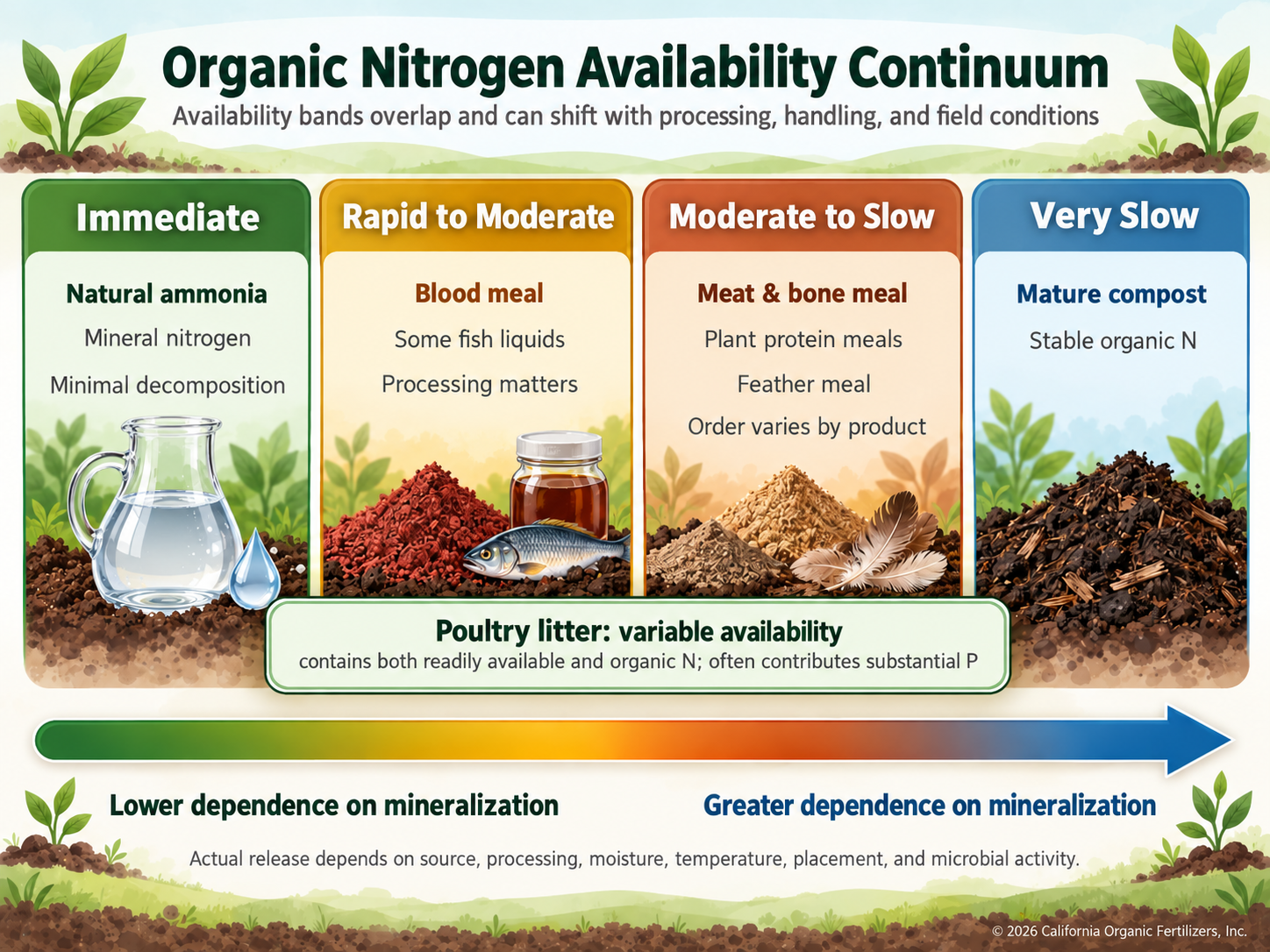
Organic nitrogen availability continuum comparing natural ammonia, blood meal, fish liquids, poultry litter, meat and bone meal, plant protein meals, feather meal, and mature compost by dependence on mineralization.
Figure 1. Organic nitrogen sources occupy overlapping availability bands rather than a rigid
fastest-to-slowest order. Poultry litter spans a particularly broad range because its available
nitrogen depends heavily on composition, handling, processing, and incorporation. Processing,
soil conditions, placement, and biological activity can shift other materials within or between
bands.
The figure deliberately uses overlapping bands. Published guidance does not consistently rank
every product in the same order, and commercial processing can materially change release
behavior.
Figure 2. How Organic Nitrogen Becomes Plant-Available
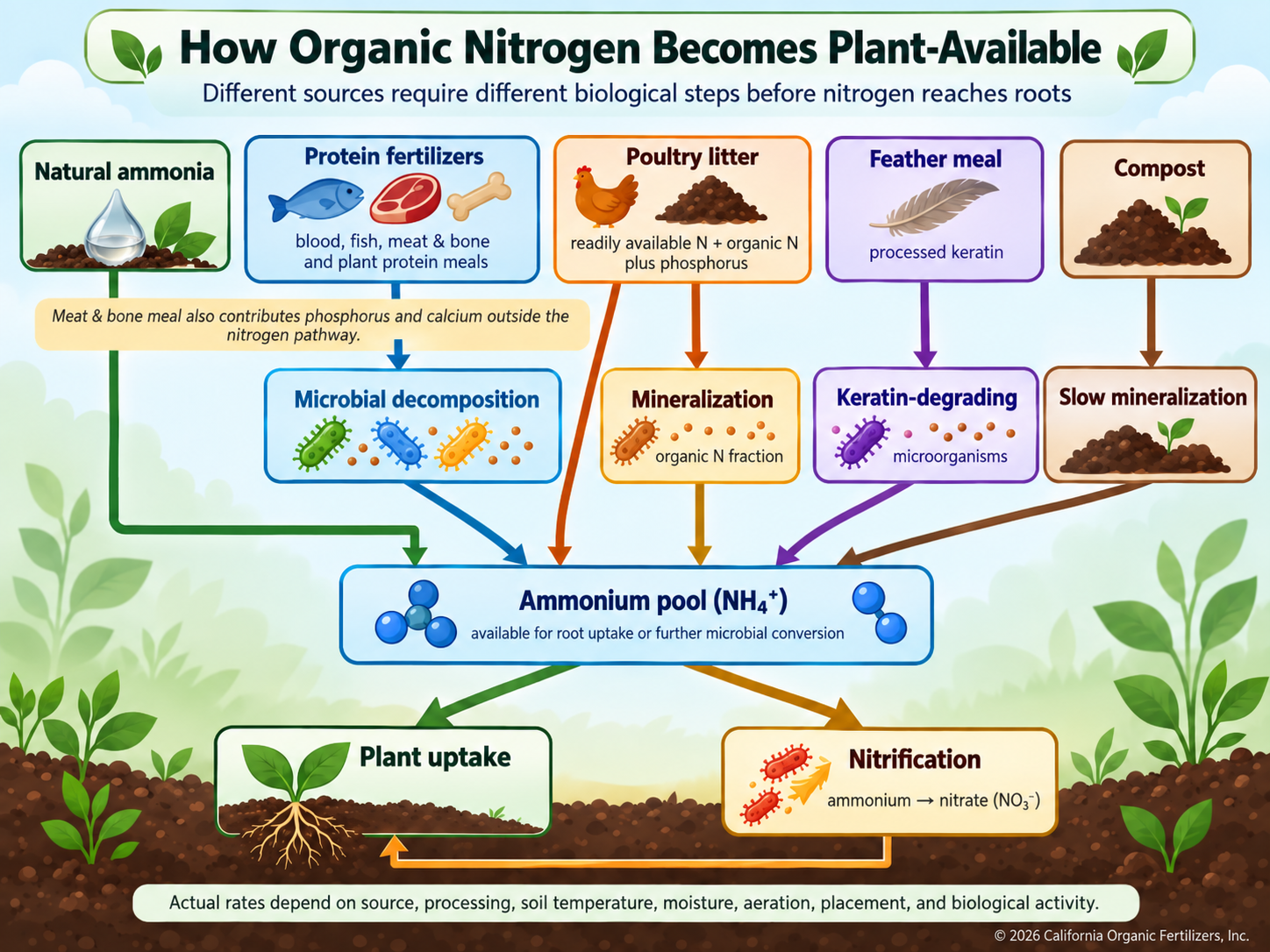
Diagram showing how organic nitrogen becomes plant-available, comparing direct ammoniacal nitrogen with nitrogen sources that depend on mineralization through microbial activity before crops can use them.
Figure 2. Organic nitrogen sources differ in the number and type of biological steps required
before nitrogen reaches the ammonium pool. Poultry litter contains both readily available and
organic nitrogen fractions, so part of its nitrogen can enter the ammonium pool sooner while
the remainder depends on mineralization. Ammonium can be taken up by roots or converted to
nitrate through nitrification.
Pathways in Plain Text
• Natural ammonia: ammonia → ammonium → plant uptake or nitrification
• Blood meal: proteins → amino compounds → ammonium → plant uptake or
nitrification
• Fish fertilizer: soluble and particulate proteins → amino compounds → ammonium →
plant uptake or nitrification
• Meat and bone meal: animal proteins → amino compounds → ammonium; bone
minerals also contribute phosphorus and calcium
• Plant protein meals: plant proteins and associated carbon → microbial decomposition
→ ammonium
• Feather meal: processed keratin → keratin-degrading microorganisms → simpler
nitrogen compounds → ammonium
• Poultry litter: readily available nitrogen + organic nitrogen → mineralization →
ammonium; also supplies phosphorus
• Compost: stable organic nitrogen → gradual mineralization → ammonium
Matching the Source to Crop Demand
Early Seedling or Transplant Establishment
A dependable early supply of plant-available nitrogen.
Cool-Soil Planting
Less reliance on rapid microbial mineralization.
Rapid Vegetative Growth
Timely mineral nitrogen plus continued supply.
Long-Season Crop
A combination of earlier and later nitrogen availability.
High-Phosphorus Soil
A nitrogen source with little accompanying phosphorus.
Soil-Building Program
Stable organic inputs combined with a separate plan for crop-available nitrogen.
In-Season Correction
A source capable of reaching the root zone quickly.
A blended strategy can be useful. An immediately or rapidly available source can support early demand, while protein meals or soil organic matter contribute later nitrogen. The correct balance depends on crop, soil, irrigation, weather, expected yield, and residual soil nitrogen.
Avoid These Common Mistakes
Comparing Products Only by Nitrogen Percentage
A 10% nitrogen fertilizer is not automatically more effective than a 5% material. The percentage does not reveal how much nitrogen becomes available during the crop’s period of demand.
Treating All “Organic Nitrogen” as One Category
Blood, feathers, fish, poultry litter, plant meals, compost, and ammoniacal nitrogen follow different pathways. Grouping them together hides meaningful differences in plant availability,timing, and accompanying nutrients.
Ignoring Accompanying Nutrients
Meat and bone meal, poultry litter, and many fish materials can add substantial phosphorus. Repeated applications based only on nitrogen demand may create nutrient imbalance or phosphorus buildup.
Assuming a Fixes Release Rate
Mineralization estimates are conditional. Soil temperature, moisture, oxygen, processing,
particle size, and placement can change field performance.
Expecting Compost to Function Like a Concentrated Fertilizer
Compost can support soil function and long-term nutrient cycling, but mature compost usually
supplies only a fraction of its total nitrogen during one season.
Management Recommendations
1. Begin with a complete nutrient budget. Include residual soil nitrate, irrigation-water
nitrogen, soil organic matter mineralization, previous crop residues, cover crops,
compost, manure-based materials, and fertilizers.
2. Identify the crop’s critical nitrogen-demand periods. Early establishment, rapid
canopy expansion, fruit sizing, or other stages may require different release patterns.
3. Evaluate the actual product. Review guaranteed analysis, raw materials, processing
method, physical form, soluble fraction, and accompanying nutrients.
4. Use soil and plant testing. Preplant soil tests, in-season nitrate tests, tissue analysis,
and crop observations can reveal whether predicted nitrogen supply matches crop
demand.
5. Account for phosphorus and salts. This is particularly important for repeated use of
animal-derived meals, composts, and some liquid organic materials.
6. Confirm organic eligibility before use. Product acceptance should be verified with
the operation’s accredited certifying agent and documented in the organic system plan.
7. Treat release estimates as ranges. Adjust for field temperature, moisture, irrigation,
and biological activity.
Scientific Interpretation
Established Science
• Plants use primarily ammonium and nitrate.
• Organic nitrogen generally must be mineralized before becoming plant-available.
• Mineralization is controlled by biological activity and environmental conditions.
• Organic amendments differ in nitrogen concentration, chemical form, and
accompanying nutrients.
• Synchronizing nitrogen supply with crop uptake improves nutrient-use efficiency.
Practical Interpretation
A source that performs well in one field may perform differently in another because soil and
management conditions alter decomposition and nutrient movement. Product-specific
experience is useful, but it should be supported by testing rather than treated as universal.
Practical Interpretation
A source that performs well in one field may perform differently in another because soil and
management conditions alter decomposition and nutrient movement. Product-specific
experience is useful, but it should be supported by testing rather than treated as universal.
Future Research
• How do commercial processing methods alter release from feather meal, blood meal,
and plant meals?
• How reliably can laboratory incubations predict nitrogen availability under drip
irrigation?
• How do source and placement affect rhizosphere microbial communities?
• Which combinations best synchronize nitrogen supply with specific organic crops?
• How should growers account for nitrogen supplied by soil organic matter during
increasingly variable weather?
Conclusion
Organic nitrogen sources differ in far more than their guaranteed analysis. They differ in
chemical form, protein structure, solubility, accompanying nutrients, dependence on soil
biology, and timing of release.
Natural ammonia can contribute mineral nitrogen directly. Protein fertilizers must pass
through biological decomposition. Feather meal depends on the breakdown of processed
keratin. Meat and bone meal supplies phosphorus and calcium along with nitrogen. Plant
meals contribute both protein nitrogen and plant-derived carbon. Compost functions primarily
as a soil amendment and long-term nutrient reservoir.
The best nitrogen source is therefore not simply the material with the highest analysis. It is the
source—or combination of sources—that supplies the right nutrients in the right amounts
when the crop can use them.
Key Takeaways
• Equal nitrogen analyses do not guarantee equal crop response.
• Plants absorb nitrogen mainly as ammonium and nitrate.
• Most protein-based fertilizers require microbial mineralization.
• Release rates overlap and vary with processing and field conditions.
• Animal and plant protein fertilizers should be evaluated individually.
• Poultry litter, meat and bone meal, and many fish materials can add substantial
phosphorus.
• Compost is usually more valuable for soil building than for immediate nitrogen.
• Matching nitrogen supply to crop demand is more important than choosing a source by
analysis alone.
Continue Your Learning
• Understanding the Nitrogen Cycle
• Mineralization: How Soil Biology Releases Plant Nutrients
• Feather Meal and Seedlings: Does It Burn?
• Crop Nutrition and Pest Dynamics
• The Rhizosphere: Where Plant Nutrition Begins
• Natural Ammonia in Organic Agriculture
References
1. University of California Agriculture and Natural Resources. “Organic Nitrogen
Availability.” Solution Center for Nutrient Management.
https://ucanr.edu/site/solution-center-nutrient-management/organic-nitrogen-
availability
2. University of California Agriculture and Natural Resources. “Nitrogen From Organic
Sources.” Solution Center for Nutrient Management. https://ucanr.edu/site/solution-
center-nutrient-management/nitrogen-organic-sources
3. Oregon State University Extension Service. OSU Organic Fertilizer & Cover Crop
Calculator: Predicting Plant-Available Nitrogen. EM 9235.
https://extension.oregonstate.edu/catalog/pub/em-9235-osu-organic-fertilizer-cover-
crop-calculator-predicting-plant-available
4. USDA Natural Resources Conservation Service. Soil Biology Primer.
https://www.nrcs.usda.gov/resources/education-and-teaching-materials/soil-biology-
primer
5. USDA Natural Resources Conservation Service. Soil Health—Nitrogen.
https://www.nrcs.usda.gov/sites/default/files/2022-11/Nitrogen%20-
%20Soil%20Health%20Guide_0.pdf
6. Electronic Code of Federal Regulations. “7 CFR § 205.203—Soil Fertility and Crop
Nutrient Management Practice Standard.”
https://www.ecfr.gov/current/title-7/subtitle-B/chapter-I/subchapter-M/part-205/
subpart-C/section-205.203
• USDA Agricultural Marketing Service. “Soil Building - Manures & Composts.”
National Organic Program. https://www.ams.usda.gov/grades-standards/soil-
building-manures-composts
• Oklahoma State University Extension. “Using Poultry Litter as Fertilizer.”
https://extension.okstate.edu/fact-sheets/using-poultry-litter-as-fertilizer
Suggested Citation
The Organic Agronomist. (2026). The Difference Between Organic Nitrogen Sources. California Organic Fertilizers, Inc. Reviewed and verified by Tim Stemwedel, CCA and COFI Founder.
© 2026 California Organic Fertilizers, Inc. All rights reserved.
Published by The Organic Agronomist.
Permission to Use
© 2026 California Organic Fertilizers, Inc. All rights reserved. Readers may download, save, and print this publication for personal, educational, or internal business use. Brief excerpts may be quoted with attribution to The Organic Agronomist and a link to the original article. This publication may not be republished, altered, sold, distributed commercially, or presented as another party’s work without prior written permission from California Organic Fertilizers, Inc.
Need help saving a PDF? Click here for instructions.
To save a copy to your computer:
- Right-click the yellow PDF button above.
- Choose Save link as... from the menu.
- Choose where to save the file, such as Downloads.
- Click Save.
Already opened the PDF? Click the printer icon, select Save as PDF as the printer or destination, then click Save.
