Published by The Organic Agronomist
Agronomic review: Tim Stemwedel, CCA and COFI Founder
California Organic Fertilizers, Inc.
Executive Summary
A productive pepper crop needs enough nutrition to build a canopy and sustain fruit production. Too much nitrogen can produce abundant foliage while delaying fruiting. The goal is to support the crop through establishment and harvest without assuming that a greener, larger plant will always deliver more marketable peppers. [1]
For organic growers, that requires attention to both nitrogen quantity and release timing. A practical approach combines field testing, an estimate of nitrogen supplied by existing inputs, and repeated checks of crop development and irrigation. The framework below applies those principles to the decisions growers make during a pepper season. [2, 3]
Establish the Crop Without Overfeeding It
Peppers need healthy roots and foliage before they can support a substantial fruit load. Excess nitrogen is not a shortcut to that balance: University of Minnesota Extension notes that overfertilized peppers can become bushy and slow to bear fruit. [1]
Start with the soil test and field history when planning the preplant program. Account for amendments and previous fertilizer applications. Use the test to assess phosphorus and potassium as well as nitrogen; adding a blended fertilizer solely to increase nitrogen may also add nutrients the field does not need. [2, 3]
Protect the Early Growth Window
Pepper transplants establish slowly and initially compete poorly with weeds. UC IPM identifies competition for light, water, and nutrients as a cause of reduced yields and delayed maturity. Early weed management therefore helps protect the investment already made in fertility and irrigation. [4]
Before planting, review drainage, rotation, and the field’s pest history. UC IPM recommends considering soilborne pathogens, nematodes, weeds, and insects in the rotation plan. Nutrition works best as part of that broader production plan. [5]

Pepper crop management timeline showing establishment, bloom and first fruit, and repeated harvest, with checks for roots, weeds, fruit set, moisture, and nitrogen needs.
Plan for Continued Fruit Production
Sweet peppers grown for repeated harvests may need continued nitrogen supply during the production period. UC guidance distinguishes this sustained production pattern from a single planting-time fertilizer decision. Its conventional fertilizer examples illustrate timing; they should not be copied directly into an organic program without accounting for nitrogen already present and the release characteristics of the chosen material. [2]
The practical implication is to revisit the plan as fruit load and the expected harvest window change. Ask how much productive season remains, what recent tests indicate, and whether earlier applications are still contributing available nitrogen. A calendar reminder can prompt that assessment; it should not automatically trigger another application.
Separate Total Nitrogen from Available Nitrogen
The nitrogen analysis on an organic fertilizer describes total nitrogen, not necessarily the amount available to roots immediately. Microorganisms convert organic nitrogen into mineral forms, and the release rate depends on the material and soil conditions. Soil temperature is an important driver. [3]
Keep separate records for total nitrogen applied and estimated plant-available nitrogen during the crop’s growth window. Include contributions from soil, cover crops, compost, and other inputs. Release estimates are planning tools, so compare them with field observations and testing as the season progresses. [3]
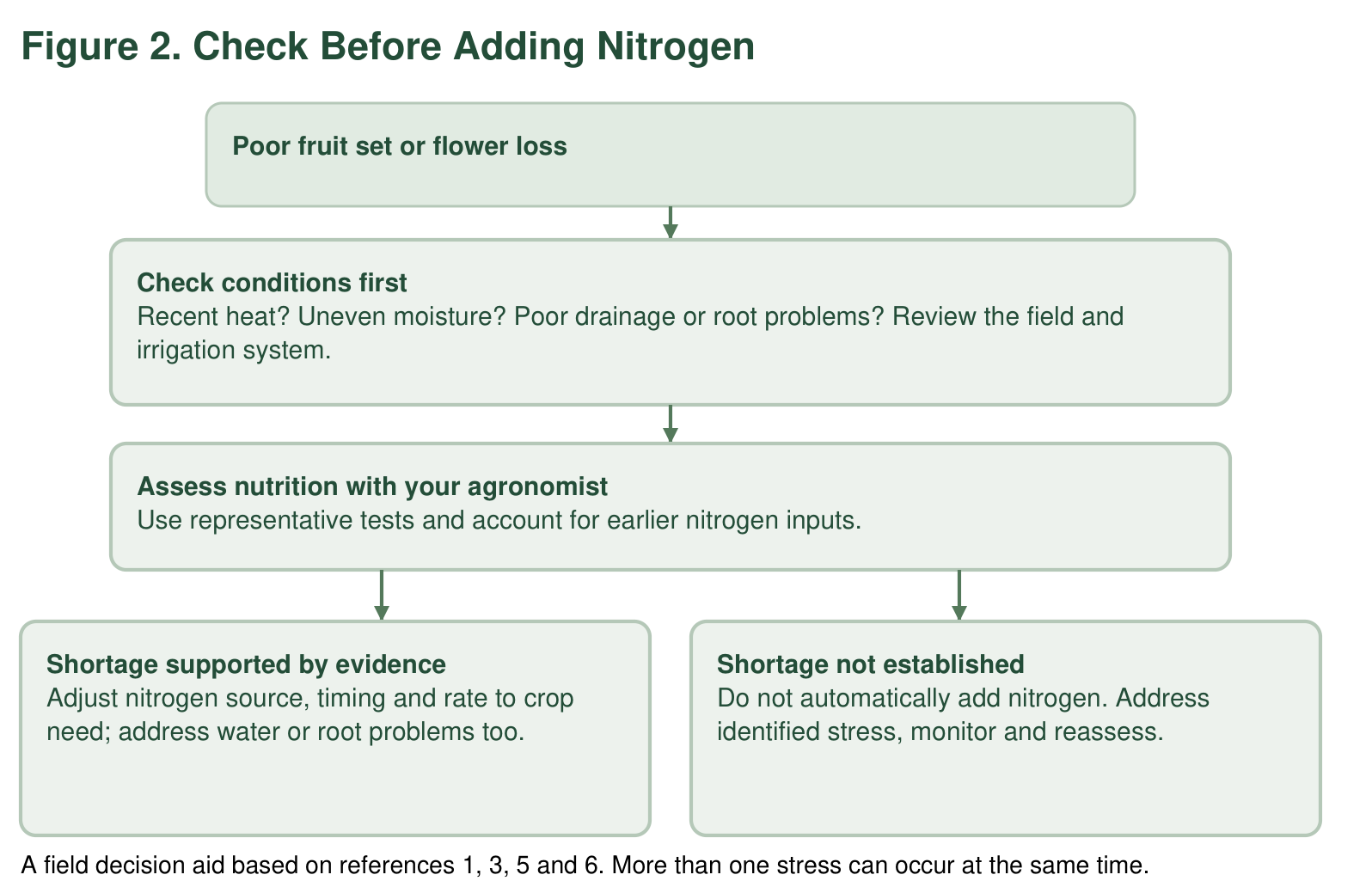
“Decision chart for poor pepper fruit set: check growing conditions, assess nutrition, and adjust nitrogen only when evidence supports a shortage.”
Diagnose Poor Fruit Set Before Adding Fertilizer
Flower loss or weak fruit set does not establish a nitrogen shortage. Heat can cause pepper flowers to drop, and poor soil moisture can weaken flowers and young fruit. More fertilizer will not correct those conditions. [1]
Review recent temperatures, irrigation performance, root-zone moisture, and crop condition before changing the feed rate. Where nutrition remains a concern, use representative soil and tissue samples interpreted with your agronomist. Treat the results as part of the diagnosis rather than using leaf color alone to decide.
Keep Water Supply Consistent
UC IPM identifies moisture stress during bloom as a risk to fruit set and stress during early fruit growth as a contributor to blossom-end rot. Avoid letting plants alternate between water shortage and excessive wetness. Check that irrigation reaches the active roots consistently across the field. [6]
Blossom-end rot should prompt a review of water management as well as nutrition. An additional fertilizer application cannot compensate for an irrigation system that leaves part of the crop dry. [1, 6]
A Practical Field Review
Use these questions at each major fertility decision. They translate the preceding principles into a repeatable field check:
Establishment: Are plants rooting and growing uniformly? Are weeds or drainage problems limiting progress?
Bloom and first fruit: Is fruit setting normally? Could heat or moisture stress explain flower loss?
Repeated harvest: What do crop condition, testing, and the remaining harvest window indicate about the next nitrogen application?
Before applying: What nitrogen is already available or expected from previous inputs, and can the irrigation system distribute the next application uniformly?
Season end: Record marketable yield, fertilizer inputs, and observed problems to improve the next program.
Conclusion
A useful organic pepper program supports establishment, responds to fruit production, and adapts as the season changes. Pair nitrogen decisions with water management and field evidence. The aim is sufficient nutrition for the next productive growth period, with each application serving a clear purpose.
References
University of Minnesota Extension. Growing peppers.
UC Small Farms Network. Fertilizing Vegetables. Pepper section.
Oregon State University Extension. Nutrient Management for Sustainable Vegetable Cropping Systems in Western Oregon. EM 9165.
UC IPM. Peppers: Integrated Weed Management.
UC IPM. Peppers: Preplant.
UC IPM. Watering Peppers and Eggplants.
Suggested Citation
The Organic Agronomist. (2026). Growing Organic Peppers: Matching Nitrogen to Fruit Set and a Long Harvest. California Organic Fertilizers, Inc.
Permission to Use
© 2026 California Organic Fertilizers, Inc. All rights reserved. Readers may download, save, and print this publication for personal, educational, or internal business use. Brief excerpts may be quoted with attribution to The Organic Agronomist and a link to the original article. This publication may not be republished, altered, sold, distributed commercially, or presented as another party’s work without prior written permission from California Organic Fertilizers, Inc.
Need help saving a PDF? Click here for instructions.
To save a copy to your computer:
- Right-click the yellow PDF button above.
- Choose Save link as... from the menu.
- Choose where to save the file, such as Downloads.
- Click Save.
Already opened the PDF? Click the printer icon, select Save as PDF as the printer or destination, then click Save.