Published by The Organic Agronomist
Agronomic review: Tim Stemwedel, CCA and COFI Founder
California Organic Fertilizers, Inc.
Executive Summary
An apple or pear orchard needs enough nitrogen to support productive growth, but more nitrogen is not always better. A useful fertility plan considers crop load, tree vigor, nutrient tests, and the nitrogen already supplied by the orchard system. The objective is a balanced tree that supports fruit production and quality. [1]
For organic production, timing adds another question: how much of an application will become available while the tree needs it? This article combines orchard nutrition guidance with organic nitrogen principles to provide a practical framework for reviewing each block. It does not prescribe one fertilizer rate for all pome fruit.
Read the Tree and the Tests Together
Shoot growth provides a visible signal of tree vigor, but it is not a complete nitrogen test. Soil and tissue analyses, crop observations, and trends over several seasons provide a stronger basis for decisions than any single measurement. Washington State University recommends using these tools together. [1]
Separate blocks with different varieties, rootstocks, ages, and crop loads when reviewing performance. Record yield, fruit quality, shoot growth, and fertilizer history alongside test results. This makes it easier to distinguish a persistent block problem from a seasonal change.
Keep the Pear Benchmark in Context
The CDFA FREP project document by Glozer and Ingels describes earlier California European pear recommendations of approximately 2 lb actual nitrogen per ton of crop, with nitrogen withheld when average shoot growth exceeds 12 inches. Under that benchmark, a 30-ton-per-acre crop corresponds to 60 lb nitrogen per acre. [2]
Those figures describe a particular pear recommendation discussed in a research project. They are not a universal nitrogen demand or shoot-growth threshold for every apple and pear orchard. The project itself sought to re-evaluate fertilizer practices and highlighted the influence of irrigation and tree water status on vigor. Use the benchmark as context for discussion with an orchard adviser. [2]
Think Beyond This Season’s Fertilizer
Perennial fruit trees draw on stored nitrogen during early growth. Nutrition decisions therefore affect both the crop being grown now and the reserves that support later growth. Washington State University’s fall nutrition guidance emphasizes assessing whether reserves actually need replenishment before adding nitrogen. [3]
A heavy crop, weak growth, and supporting tissue results may justify a different plan from a lightly cropped, vigorous block. Additional nitrogen is not automatically useful after harvest. Where tree nitrogen status and vigor are adequate, further feeding may be ineffective or encourage excessive growth. [3]
Match Organic Nitrogen Release to the Need
Organic nitrogen must be converted by microorganisms into mineral forms before roots can use that portion of an input. Release depends on the material and soil conditions, including temperature. Total nitrogen applied and nitrogen available during a particular period are different quantities. [4]
Estimate contributions from compost, cover crops, soil organic matter, and earlier fertilizers before planning another application. Keep those estimates separate from the total applied nitrogen record. The mineralization principles described by Oregon State University are useful here, but vegetable-crop rates in that publication should not be transferred to orchards. [4]
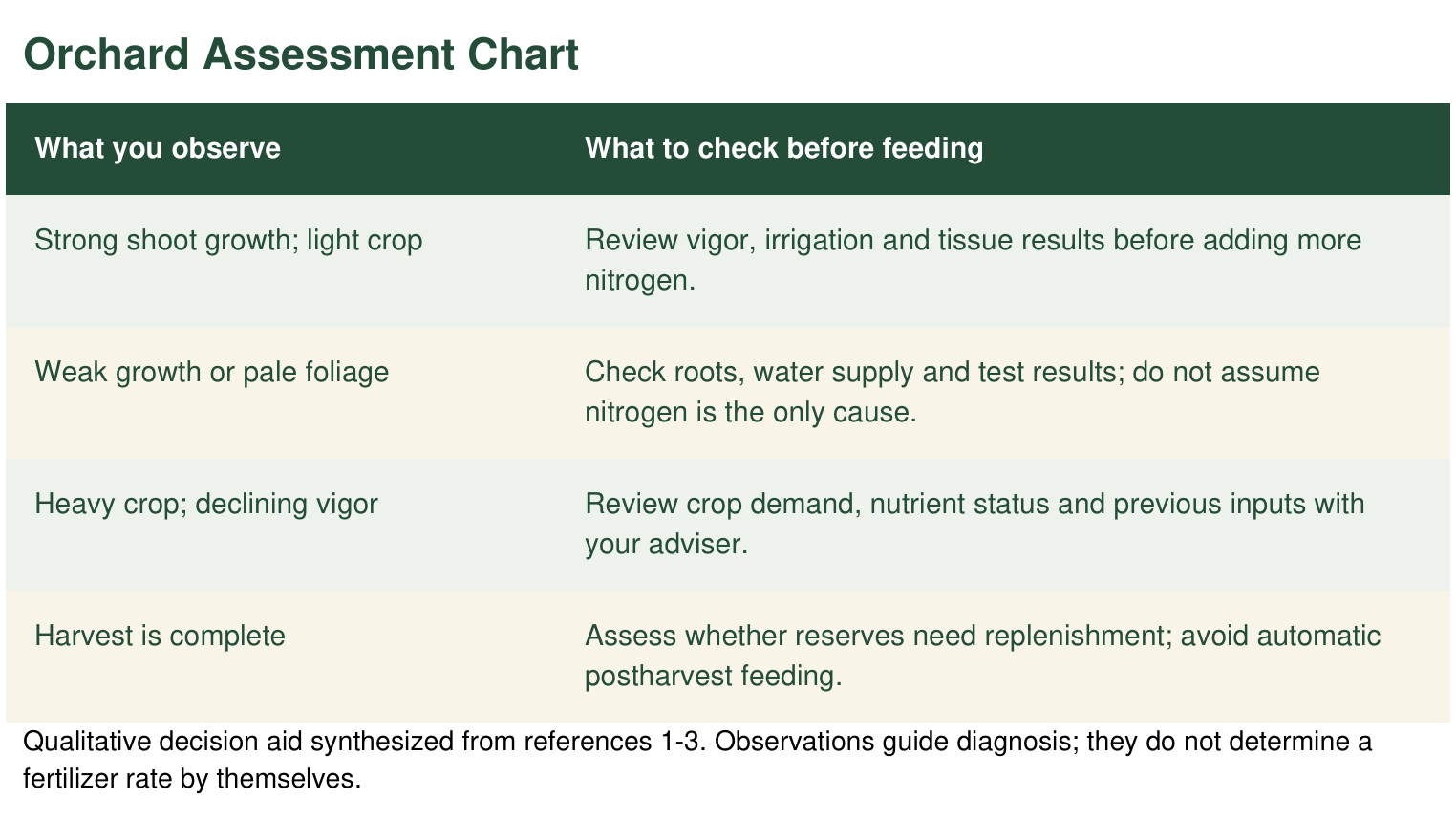
Orchard assessment chart showing what to check before adding nitrogen when trees have strong shoot growth, pale foliage, a heavy crop, declining vigor, or have completed harvest.
Manage Vigor as Part of Fire Blight Prevention
UC IPM identifies excess nitrogen, heavy pruning, and over-irrigation among the factors influencing fire blight development in pears. Seasonal weather is a primary driver, and variety and rootstock also matter. Keeping trees within an appropriate vigor range is one component of management. [5]
Reducing unnecessary nitrogen does not replace disease monitoring or a crop-specific prevention program. Coordinate nutrition, irrigation, pruning, and fire blight management with your adviser, especially in susceptible blocks. [5]
Protect Fruit Quality, Not Just Leaf Color
A soil nutrient result does not show how much the tree actually absorbs or where nutrients move within it. Calcium-related fruit disorders illustrate this distinction: WSU notes that bitter pit in apples and cork spot in pears can occur even when soil calcium is adequate. Vigor, crop load, and irrigation also need attention. [1]
The practical lesson is to investigate the cause of a quality problem before adding fertilizer. More nitrogen cannot substitute for diagnosing root limitations, uneven irrigation, or an imbalance between vegetative growth and fruit production.
Conclusion
Build the program around the orchard block. Combine crop load and vigor observations with nutrient testing, account for existing nitrogen supply, and select application timing with release characteristics in mind. Reassess as the season develops. The strongest program is one that responds to evidence rather than repeating last year’s schedule.
References
Sallato, B., DuPont, T., and Granatstein, D. Tree Fruit Soil Fertility and Plant Nutrition in Cropping Orchards in Central Washington. WSU Extension. Revised 2022.
Glozer, K., and Ingels, C. European Pear Growth and Cropping: Optimizing Fertilizer Practices Based on Seasonal Demand and Supply with Emphasis on Nitrogen Management. CDFA FREP project 10-0105-SA.
Washington State University Tree Fruit. Fall Nutrient Sprays in Tree Fruit.
Oregon State University Extension. Nutrient Management for Sustainable Vegetable Cropping Systems in Western Oregon. EM 9165.
UC IPM. Pear: Fire Blight.
Suggested Citation
The Organic Agronomist. (2026). Growing Organic Pome Fruit: Balance Nitrogen, Crop Load, and Tree Vigor. California Organic Fertilizers, Inc.
Permission to Use
© 2026 California Organic Fertilizers, Inc. All rights reserved. Readers may download, save, and print this publication for personal, educational, or internal business use. Brief excerpts may be quoted with attribution to The Organic Agronomist and a link to the original article. This publication may not be republished, altered, sold, distributed commercially, or presented as another party’s work without prior written permission from California Organic Fertilizers, Inc.
Need help saving a PDF? Click here for instructions.
To save a copy to your computer:
- Right-click the yellow PDF button above.
- Choose Save link as... from the menu.
- Choose where to save the file, such as Downloads.
- Click Save.
Already opened the PDF? Click the printer icon, select Save as PDF as the printer or destination, then click Save.