The nitrogen percentage on a fertilizer label tells you how much total nitrogen is in the product. It does not tell you how much of that nitrogen will become available to the crop — or whether it will become available when crop demand is highest. Understanding plant-available nitrogen helps growers compare fertilizer sources on the basis of timing, efficiency, and actual crop value.
The Organic Agronomist™
Agronomic review: Tim Stemwedel, CCA & Founder
A fertilizer label tells you how much nitrogen is guaranteed to be in the product. It does not tell you how much of that nitrogen will become available to the crop — or whether it will become available when the crop actually needs it.
That distinction matters in every fertility program, but it is especially important in organic production, where much of the nitrogen applied may depend on biological processes before plants can use it.
Two fertilizers can carry similar nitrogen analyses and still perform very differently in the field.
The difference is plant-available nitrogen.
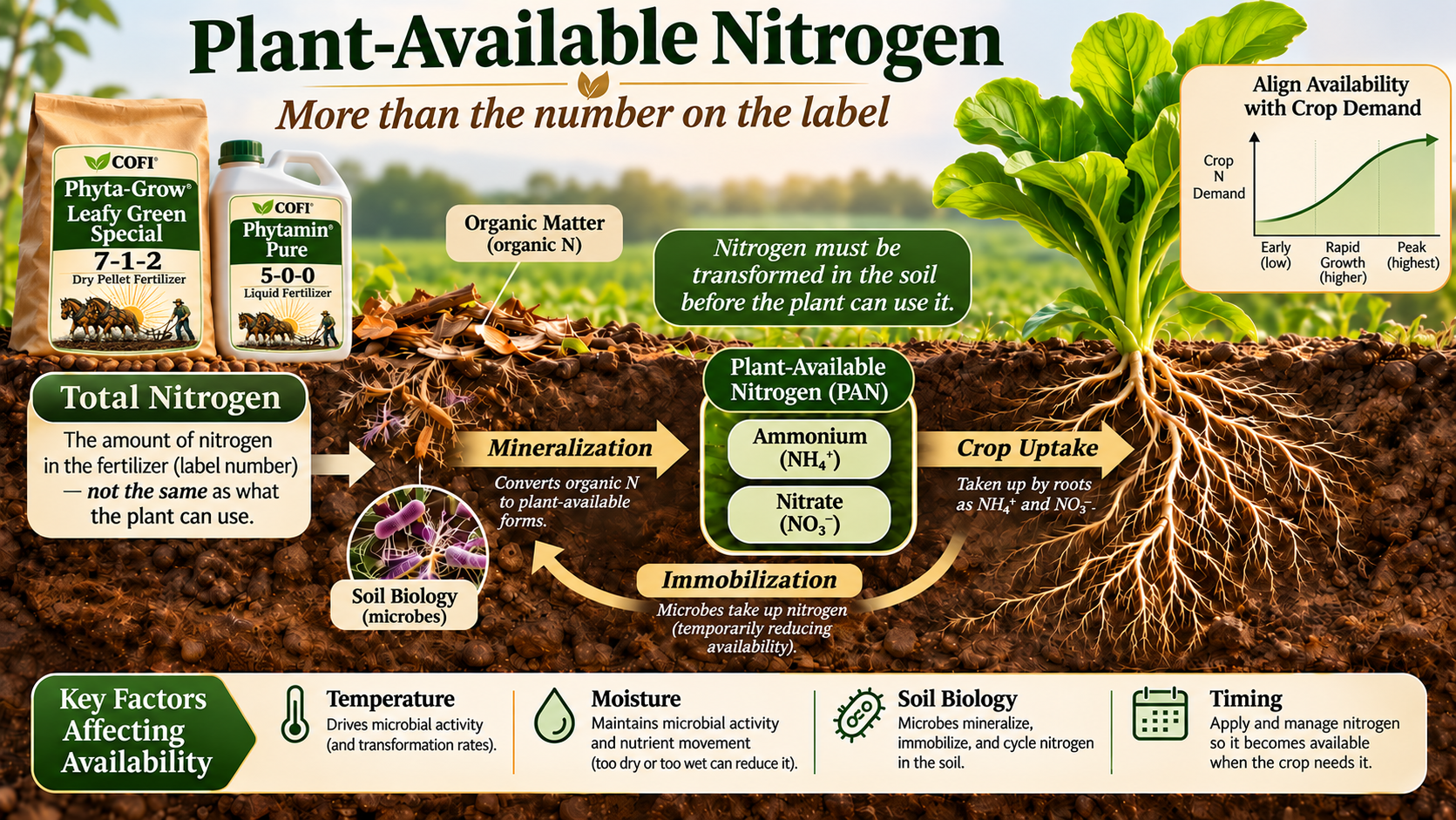
Infographic showing plant-available nitrogen, with COFI Leafy Green Special and Phytamin Pure products beside a soil cross-section illustrating mineralization, ammonium, nitrate, crop uptake, immobilization, soil biology, and the effects of temperature, moisture, and timing on nitrogen availability.
Total Nitrogen Is Not the Same as Plant-Available Nitrogen
The nitrogen percentage on a fertilizer label represents total nitrogen. Depending on the fertilizer source, that nitrogen may exist in several forms.
Some nitrogen is already present as ammonium or nitrate — forms that plant roots can absorb.
Other nitrogen is bound in organic compounds such as proteins and must first be broken down by soil microorganisms.
That conversion process is called mineralization.
So the useful question is not simply:
How much nitrogen did I apply?
It is:
How much nitrogen will become plant available during the period when the crop needs it?
That is the basis of plant-available nitrogen, or PAN.
What Is Plant-Available Nitrogen?
Plant-available nitrogen is the portion of applied nitrogen that is in — or is expected to convert into — forms the crop can absorb during the relevant growing period.
Plants primarily take up nitrogen as:
Ammonium (NH₄⁺)
Nitrate (NO₃⁻)
Organic nitrogen generally must be converted by microorganisms before it enters these plant-available forms.
That creates an important distinction:
Plant availability is not simply a percentage. It is a percentage over time.
A fertilizer that eventually releases most of its nitrogen may still perform poorly if that release occurs after peak crop demand has passed.
Mineralization Controls the Timing of Organic Nitrogen
Soil microorganisms decompose organic materials and convert organically bound nitrogen into ammonium. That ammonium may then remain available to plants or be converted through nitrification into nitrate.
The speed of this process depends on several interacting factors.
Raw Material
Different nitrogen-containing materials decompose at different rates.
Proteins, amino compounds and other organic fractions vary in their resistance to microbial breakdown. Their physical and chemical characteristics influence both the beginning of nitrogen release and how long that release continues.
Temperature
Microbial activity generally increases as soils warm within a biologically favorable range.
Cool soil can substantially slow decomposition and nitrogen mineralization, even when adequate fertilizer has been applied.
Moisture
Microorganisms require moisture.
A dry soil may contain abundant organic nitrogen but release relatively little of it until adequate moisture returns.
Excessively wet or poorly aerated soils can create different problems by altering microbial processes and nitrogen transformations.
Soil Biology
Mineralization is a biological process.
Fields with strong microbial activity may break down organic fertilizers more rapidly than fields where biological activity is limited by soil conditions, temperature, moisture, salinity or other factors.
Placement
Fertilizer that is incorporated into moist, biologically active soil generally has greater contact with the organisms responsible for decomposition than material left dry on the soil surface.
Placement therefore affects both the speed and consistency of nutrient release.
Manufacturing and Processing
The raw material alone does not determine fertilizer performance.
Particle size, pellet density, heat treatment, binders and other manufacturing characteristics can influence how rapidly moisture penetrates a fertilizer and how accessible the material becomes to soil microorganisms.
Two fertilizers made from similar ingredients may therefore release nutrients at different rates.
Carbon Can Affect How Much Nitrogen Remains Available
Microorganisms require both carbon and nitrogen to grow.
When they decompose materials containing significant carbon, they may temporarily use available soil nitrogen to build microbial biomass.
This process is called immobilization.
The nitrogen has not disappeared. It has temporarily moved into the microbial population rather than remaining available for immediate crop uptake.
This is one reason carbon-to-nitrogen relationships matter when evaluating organic fertilizers.
A fertilizer can contain nitrogen on the guaranteed analysis while still supplying less plant-available nitrogen during the crop's critical growth period than its total nitrogen percentage might suggest.
Crop Demand Does Not Wait for Mineralization
Crop nitrogen demand changes throughout the season.
Young plants may initially require relatively little nitrogen. Demand then rises as leaf area expands, roots develop and vegetative growth accelerates.
For many crops, there is a period when nitrogen uptake increases rapidly.
If fertilizer mineralization keeps pace with that demand, the crop has access to an adequate nitrogen supply.
If mineralization lags behind crop demand, a nitrogen gap can develop.
The field may contain substantial total nitrogen, but the crop can still experience inadequate nitrogen availability.
This is why visible fertilizer remaining in the soil after harvest can be important information. Nutrients that become available after the crop has finished using them did not contribute to that season's yield potential when they were needed most.
Pre-Plant Fertility Builds the Foundation
Organic pre-plant fertilizers remain an important part of a sound fertility program.
They can establish the nutrient base that supports crop development over an extended period.
The challenge is predicting how quickly those nutrients will become available.
A good pre-plant program considers:
The nitrogen source
Expected mineralization rate
Soil temperature
Soil moisture
Soil biological activity
Application timing
Placement
Crop duration
Expected nitrogen demand
The objective is not simply to place enough total nitrogen in the soil.
The objective is to synchronize nutrient release with crop uptake.
In-Season Nitrogen Can Help Close the Gap
Even a well-designed pre-plant program cannot completely control weather, irrigation, root development or biological activity.
For that reason, nitrogen management should continue after planting.
Soil testing, tissue testing, crop observations and knowledge of crop growth stage can help determine whether nitrogen availability is keeping pace with demand.
When mineralization from pre-plant sources is insufficient, an in-season source of plant-available nitrogen may help close the gap.
This does not make the pre-plant fertilizer unnecessary.
The two approaches perform different jobs:
Pre-plant fertility establishes the foundation.
In-season fertility can respond to crop demand as the season develops.
The Guaranteed Analysis Is a Starting Point
The guaranteed analysis is essential information, but it is not a complete measure of fertilizer performance.
A nitrogen analysis tells you how much nitrogen is in the fertilizer.
It does not tell you:
How much will mineralize during the crop cycle
How quickly mineralization will begin
Whether microorganisms will temporarily immobilize some nitrogen
How soil temperature will affect release
How moisture will affect biological activity
Whether the nitrogen will be available during peak crop demand
How much of the applied nitrogen the crop will ultimately capture
Those questions require looking beyond the percentage printed on the label.
Compare Nitrogen on an Available-Nitrogen Basis
A lower-cost fertilizer is not necessarily less expensive if much of its nitrogen becomes available too late to support the crop.
Likewise, a fertilizer with a high nitrogen analysis does not necessarily provide more usable nitrogen during the growing season.
A more useful comparison asks:
What is the cost per pound of nitrogen expected to become plant available during the crop's demand period?
That comparison brings fertilizer source, release timing and agronomic performance into the economic decision.
It also provides a better basis for comparing materials that may look similar when judged only by guaranteed analysis.
Want to compare fertilizer sources on a plant-available nitrogen basis?
Use the COFI PAN Calculator to compare total nitrogen, estimated immobilization, in-season efficiency, and cost per pound of plant-available nitrogen.
Match Nitrogen Availability to Crop Demand
Nitrogen management is ultimately a timing problem.
The fertilizer must contain enough nitrogen.
But that nitrogen must also:
Become plant available.
Become available in the root zone.
Become available during the crop's period of demand.
Remain available long enough for the crop to use it.
The number on the fertilizer label is therefore only the beginning of the evaluation.
Successful nitrogen management focuses on when nitrogen becomes available — not simply how much nitrogen was applied.
Key Definitions
Total Nitrogen
The total amount of nitrogen guaranteed in a fertilizer, regardless of its immediate availability to plants.
Plant-Available Nitrogen (PAN)
Nitrogen present in, or expected to convert into, forms plants can absorb during the relevant crop period.
Mineralization
The microbial conversion of organically bound nitrogen into ammonium and other plant-available forms.
Immobilization
The temporary incorporation of available nitrogen into microbial biomass during decomposition.
Ammonium (NH₄⁺)
A plant-available form of nitrogen.
Nitrate (NO₃⁻)
A plant-available form of nitrogen produced directly or through nitrification of ammonium.
Nitrogen Use Efficiency
The relationship between nitrogen supplied and nitrogen successfully taken up and used by the crop.
References
University of California Agriculture and Natural Resources. Organic Nitrogen Availability. Solution Center for Nutrient Management.
USDA Natural Resources Conservation Service. National Agronomy Manual, Part 503 — Crop Production.
University of California Agriculture and Natural Resources. Nitrogen From Organic Sources. Solution Center for Nutrient Management.
Geisseler, D. J., & Leinfelder-Miles, M. M. Nitrogen Mineralization in Organic and Mineral Soils. University of California Cooperative Extension.
USDA Natural Resources Conservation Service. Nutrient Management in Organic Systems — Western States Implementation Guide.
University of California Agriculture and Natural Resources. Soil Fertility Management for Organic Crops. Publication 7249.
Suggested Citation
The Organic Agronomist™. (2026). Why Plant-Available Nitrogen Matters More Than the Number on the Fertilizer Label. California Organic Fertilizers, Inc. Agronomic review by Tim Stemwedel, CCA & Founder.
Permission to Use
© 2026 California Organic Fertilizers, Inc. All rights reserved. Readers may download, save, and print this publication for personal, educational, or internal business use. Brief excerpts may be quoted with attribution to The Organic Agronomist™ and a link to the original article. This publication may not be republished, altered, sold, distributed commercially, or presented as another party’s work without prior written permission from California Organic Fertilizers, Inc.
Need help saving a PDF? Click here for instructions.
To save a copy to your computer:
- Right-click the yellow PDF button above.
- Choose Save link as... from the menu.
- Choose where to save the file, such as Downloads.
- Click Save.
Already opened the PDF? Click the printer icon, select Save as PDF as the printer or destination, then click Save.