Organic fertilizer does not release nutrients simply because it has been applied to the soil. Bacteria, fungi, moisture, temperature, oxygen, fertilizer composition, and physical breakdown all influence when nutrients move from an organic material into forms a crop can use. Understanding that biological process helps growers better match fertilizer selection and application timing to crop demand.
Author: The Organic Agronomist™
Agronomic review: Tim Stemwedel, CCA & Founder
Organic fertilizers depend on a living soil system.
A fertilizer may contain the right nutrients and carry an appropriate guaranteed analysis, but those nutrients cannot benefit the crop until they become accessible to plant roots.
For many organic fertilizer materials, that requires several steps.
The fertilizer must absorb moisture. Its physical structure must begin to break down. Soil organisms must gain access to the organic material. Complex compounds must be decomposed, and organically bound nutrients must be converted into plant-available forms.
Soil biology drives much of that process.
Understanding what happens between application and plant uptake helps explain why the same fertilizer can perform differently under different field conditions.
Figure 1 — From Fertilizer to Plant-Available Nutrients
Organic fertilizer first undergoes physical breakdown and microbial decomposition. Soil microorganisms convert organically bound nutrients into plant-available forms. Temperature, moisture, oxygen, fertilizer composition, and soil biological activity influence both the rate and timing of the process.
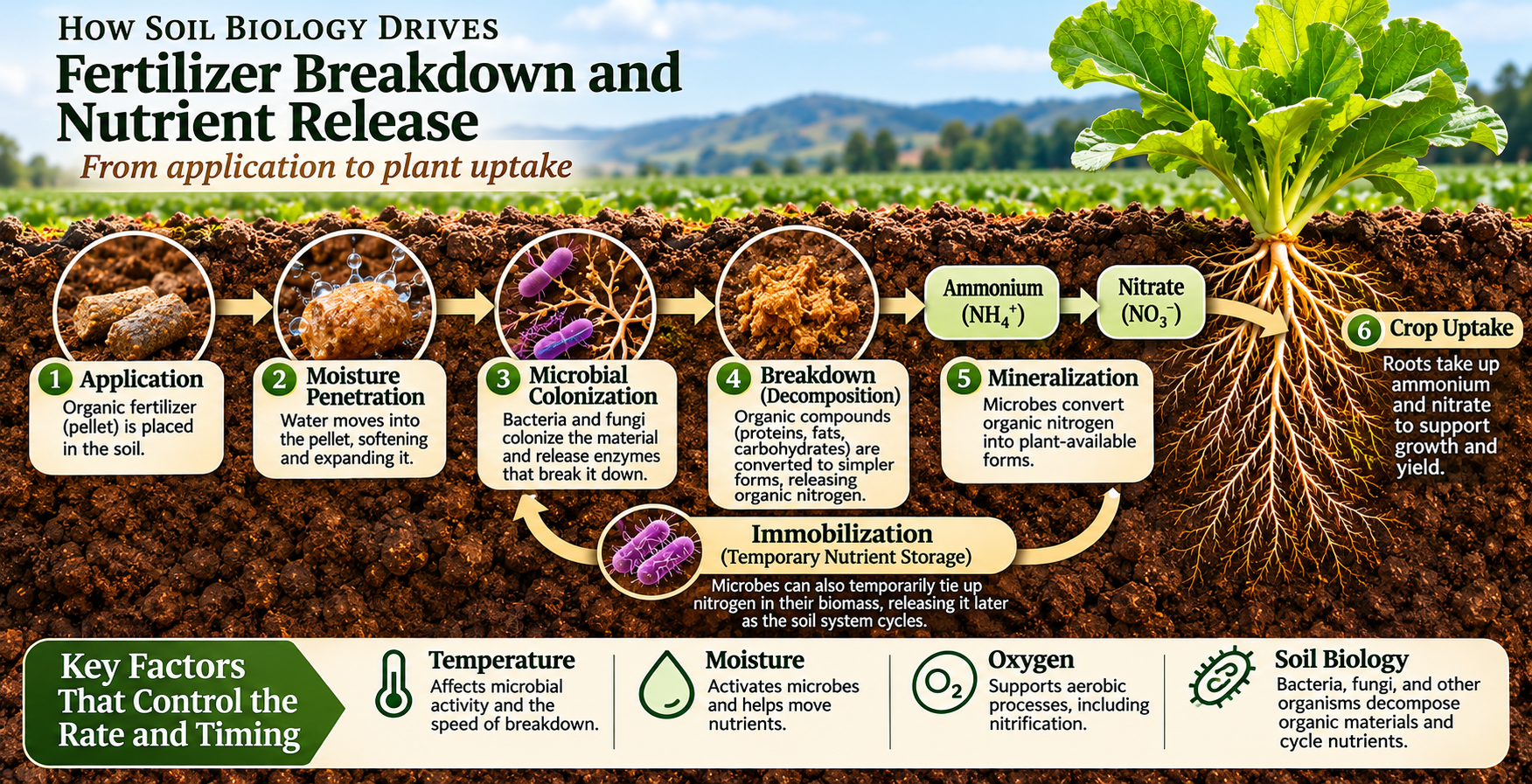
Infographic showing how soil biology drives fertilizer breakdown and nutrient release, from organic fertilizer application through moisture penetration, microbial colonization, decomposition, mineralization into ammonium and nitrate, temporary immobilization, and root uptake, with temperature, moisture, oxygen, and soil biology shown as key factors controlling the rate and timing of nutrient availability.
Fertilizer Application Is the Beginning, Not the End
Applying an organic fertilizer places nutrients into the soil system.
It does not necessarily make all of those nutrients immediately available to the crop.
Many organic fertilizers contain nitrogen in proteins and other complex organic compounds. Before plants can use much of that nitrogen, soil organisms must break those compounds down.
This creates an important sequence:
Fertilizer application → physical breakdown → microbial decomposition → mineralization → plant-available nutrients → root uptake
Each step can affect how quickly the fertilizer contributes to crop nutrition.
That is why nutrient management cannot be based solely on how many pounds of fertilizer were applied.
The condition of the soil and the characteristics of the fertilizer determine what happens next.
Soil Microorganisms Are the Decomposition Workforce
Soils contain enormous and diverse populations of bacteria, fungi, and other organisms.
These organisms use organic materials as sources of energy and nutrients.
When an organic fertilizer enters the soil, microorganisms begin interacting with its organic components. They produce enzymes and other compounds that help break large molecules into smaller ones that can be further processed.
Bacteria and fungi play particularly important roles.
Bacteria
Bacteria participate in the decomposition of many readily degradable organic compounds and are involved in numerous nutrient transformations.
Some groups convert organic nitrogen into ammonium. Others convert ammonium into nitrate through nitrification.
Both ammonium and nitrate can be taken up by plants.
Fungi
Fungi can colonize organic materials and use enzymes to decompose compounds that may be more resistant to breakdown.
Their threadlike hyphae also extend through soil pores and across particles, allowing them to interact with organic material beyond the immediate location of a fungal cell.
The biological community is not performing one single reaction. It is part of a continuously changing food web in which nutrients are repeatedly consumed, stored, released, and transformed.
Physical Breakdown Comes Before Biological Access
A soil organism cannot efficiently decompose material it cannot reach.
That makes the physical characteristics of a fertilizer important.
For a pelletized fertilizer, moisture must penetrate the pellet. The pellet must soften, swell, fracture, or otherwise open enough for microorganisms and their enzymes to gain access to the material inside.
A pellet that remains extremely dense or intact can restrict that access.
This is one reason fertilizer manufacturing can influence nutrient-release behavior.
Factors such as:
Pellet density
Pellet diameter
Particle size
Compression
Heat treatment
Binder selection
Raw-material characteristics
These factors can affect how readily water and microorganisms penetrate the finished fertilizer.
The guaranteed analysis may be identical, while the physical behavior of the fertilizer in the soil may not be.
Moisture Activates the Process
Water is essential to both physical fertilizer breakdown and microbial activity.
When dry fertilizer contacts moist soil, water begins moving into the material.
That moisture helps soften the fertilizer and allows soluble compounds to move into the surrounding soil.
At the same time, soil organisms require water to function.
When soil becomes too dry, microbial activity slows. As a result, decomposition and nutrient mineralization may also slow.
But more water is not always better.
Saturated soil can limit oxygen and alter the microbial processes taking place. Under prolonged anaerobic conditions, nitrate can also be lost through denitrification.
The objective is therefore not simply wet soil.
It is adequate moisture in an aerated root zone.
Temperature Controls Biological Speed
Soil temperature has a major influence on microbial activity.
When soils are cold, biological processes slow.
An organic fertilizer applied into cold soil may therefore contain plenty of nitrogen but release relatively little of it during the early period after application.
As soils warm, microbial activity and mineralization generally increase.
This explains why a fertilizer can behave differently when applied:
In early spring versus late spring
In a cool coastal environment versus a warm inland environment
Under a dense canopy versus exposed soil
At different soil depths
Calendar time alone does not determine fertilizer release.
Biological time depends heavily on soil conditions.
Mineralization Converts Organic Nitrogen Into Plant-Available Nitrogen
One of the most important biological processes in organic fertility is mineralization.
During mineralization, microorganisms convert organically bound nitrogen into inorganic forms.
A simplified pathway is:
Organic nitrogen → ammonium (NH₄⁺) → nitrate (NO₃⁻)
The first conversion releases ammonium.
Under aerobic soil conditions, specialized microorganisms can then convert ammonium through nitrification into nitrate.
Both ammonium and nitrate are forms plants can absorb.
This is the critical transition between nitrogen being present in an organic material and nitrogen being available for crop uptake.
Mineralization is therefore one of the major links between soil biology and fertilizer performance.
Microbes Can Temporarily Compete With the Crop for Nitrogen
Microorganisms need nitrogen too.
As microbial populations grow while decomposing organic materials, they incorporate nitrogen into their own cells.
This process is known as immobilization.
Immobilized nitrogen has not disappeared from the soil, but it is temporarily contained within microbial biomass rather than being available for immediate plant uptake.
The balance between mineralization and immobilization is influenced strongly by the material microorganisms are decomposing.
Materials containing a high proportion of carbon relative to nitrogen can stimulate microbial growth and increase temporary nitrogen immobilization.
This is why the carbon-to-nitrogen ratio, or C ratio, matters.
The microbes are not working for the crop.
They are responding to the food source available to them.
The crop receives the nutritional benefit when biological cycling releases nutrients into plant-available forms at the right time.
Organic Materials Do Not All Decompose at the Same Rate
The term organic fertilizer describes a regulatory and production category. It does not describe one uniform biological behavior.
Different raw materials contain different proteins, fats, carbohydrates, fibers, minerals, and other compounds.
Some are relatively easy for soil organisms to process.
Others are much more resistant.
A soybean-based material, feather-derived material, bone material, compost, and plant residue should not be expected to decompose on identical timelines simply because each is organic.
The physical form matters as well.
Grinding, hydrolysis, pelletizing, composting, fermentation, extraction, and other processing methods can alter how readily organisms can gain access to the material.
Therefore:
Ingredient + processing + soil conditions = nutrient-release behavior
The fertilizer analysis alone cannot describe that entire relationship.
Healthy Soil Biology Does Not Mean Instant Nutrient Release
It is tempting to think that biologically active soil will immediately release nutrients from any organic fertilizer.
That is an oversimplification.
Strong biological activity creates favorable conditions for nutrient cycling, but microorganisms are still constrained by:
Temperature
Moisture
Oxygen
Substrate quality
Carbon availability
Nitrogen availability
Soil pH
Physical access to the fertilizer
A biologically active field can still experience a nutrient-timing problem if the fertilizer material decomposes more slowly than the crop requires.
Conversely, a rapidly decomposing fertilizer cannot fully compensate for extremely cold, dry, saturated, or biologically inactive soil.
Fertilizer and soil must work as a system.
Placement Changes the Biological Environment Around the Fertilizer
Where a fertilizer is placed influences its contact with moisture, roots, microorganisms, and oxygen.
A dry pellet sitting on the soil surface experiences a different environment from one incorporated into moist soil.
Incorporation can increase contact between fertilizer particles and the biologically active soil around them.
Placement may also influence:
Moisture consistency
Temperature
Root proximity
Microbial access
Exposure to drying
Potential nutrient movement
There is no single placement method appropriate for every crop and fertilizer.
But when nutrient release depends on biological decomposition, contact with the active soil environment matters.
Crop Demand and Biological Release Must Be Synchronized
The ultimate objective is not maximum microbial activity.
It is successful crop nutrition.
A fertilizer may be decomposing exactly as biology dictates and still fail to supply enough nutrients during the crop's period of greatest demand.
This is where fertilizer breakdown connects directly to plant-available nitrogen.
If biological nutrient release occurs too slowly, crop demand can move ahead of nutrient supply.
If nutrient release occurs too early, nutrients may be vulnerable to movement, loss, or uptake before the crop reaches peak demand.
The goal is therefore synchronization:
Nutrient release should rise as crop nutrient demand rises.
This is one reason growers should think about fertilizer programs as a combination of source, timing, soil conditions, and crop demand rather than simply application rate.
What Growers Can Observe in the Field
Fertilizer decomposition is not entirely invisible.
Field observations can provide useful clues.
When evaluating an organic fertilizer program, consider:
Are fertilizer pellets still clearly intact weeks or months after application?
Is the field unusually cold or dry?
Was the fertilizer incorporated into biologically active soil?
Is irrigation reaching the fertilizer?
Does crop tissue testing indicate adequate nutrient uptake?
Does soil testing show available nitrogen when the crop needs it?
Does crop growth indicate that nutrient release is keeping pace with demand?
Finding intact fertilizer after harvest does not automatically prove that no nutrients were released.
But persistent physical material can be a useful reason to investigate whether breakdown and nutrient availability matched the crop's growing season.
Soil Biology Is Part of the Fertilizer Program
Organic fertilizer performance begins with the fertilizer, but it does not end there.
The soil becomes part of the delivery system.
Microorganisms, moisture, temperature, oxygen, fertilizer composition, processing, placement, and time all influence what happens after application.
That means an organic fertility program should ask more than:
How much nutrient did we apply?
It should also ask:
What must happen in the soil before the crop can use it?
Understanding that process helps growers make better decisions about fertilizer sources, application timing, placement, irrigation, and in-season nutrient management.
The goal is not simply to feed the soil or simply to feed the crop.
It is to manage the biological system so that nutrients become available when the crop can use them.
Key Definitions
Decomposition
The physical and biological breakdown of organic material into simpler components.
Mineralization
The microbial conversion of organically bound nutrients into inorganic forms that can become available for plant uptake.
Immobilization
The temporary incorporation of plant-available nutrients into microbial biomass.
Ammonium (NH₄⁺)
A plant-available form of nitrogen produced during organic nitrogen mineralization and through other processes.
Nitrification
The biological conversion of ammonium into nitrite and then nitrate under suitable aerobic conditions.
Nitrate (NO₃⁻)
A plant-available and relatively mobile form of nitrogen.
C Ratio
The relationship between carbon and nitrogen in an organic material. This ratio can influence whether microorganisms release nitrogen through mineralization or temporarily immobilize available nitrogen.
References
University of California Agriculture and Natural Resources. Organic Nitrogen Availability. Solution Center for Nutrient Management.
University of California Agriculture and Natural Resources. Soil Fertility Management for Organic Crops. Publication 7249.
University of California Agriculture and Natural Resources. Nitrogen From Organic Sources. Solution Center for Nutrient Management.
USDA Natural Resources Conservation Service. National Agronomy Manual, Part 503 — Crop Production.
USDA Natural Resources Conservation Service. Soil Biology Primer.
USDA Natural Resources Conservation Service. Soil Health — Nitrogen.
Suggested Citation
The Organic Agronomist™. (2026). How Soil Biology Drives Fertilizer Breakdown and Nutrient Release. California Organic Fertilizers, Inc. Agronomic review by Tim Stemwedel, CCA & Founder.
Permission to Use
© 2026 California Organic Fertilizers, Inc. All rights reserved. Readers may download, save, and print this publication for personal, educational, or internal business use. Brief excerpts may be quoted with attribution to The Organic Agronomist™ and a link to the original article. This publication may not be republished, altered, sold, distributed commercially, or presented as another party's work without prior written permission from California Organic Fertilizers, Inc.
Need help saving a PDF? Click here for instructions.
To save a copy to your computer:
- Right-click the yellow PDF button above.
- Choose Save link as... from the menu.
- Choose where to save the file, such as Downloads.
- Click Save.
Already opened the PDF? Click the printer icon, select Save as PDF as the printer or destination, then click Save.