Understanding When Mycorrhizal Fungi Help Crops—and When They Don’t
Published by The Organic Agronomist Agronomic Review: Tim Stemwedel, COFI Founder and CCA California Organic Fertilizers, Inc.
Executive Summary
Walk through the exhibits at almost any agricultural trade show and you will find products containing mycorrhizal fungi. The claims are often impressive: improve nutrient uptake, increase drought tolerance, build larger root systems, reduce fertilizer requirements, and increase yields.
Some of these claims are supported by decades of research. Others are only partly true. A few are not supported when stated as universal promises.
The challenge for growers is separating biology from marketing.
Mycorrhizal fungi are among the oldest and most successful biological partners in terrestrial plant life. In arbuscular mycorrhizal symbiosis, plants invest carbon compounds produced through photosynthesis into fungal partners. In return, fungal hyphae explore soil beyond the immediate root surface and can deliver phosphorus and other resources to the plant.
That exchange can be highly valuable. It is not automatically valuable.
Mycorrhizae do not manufacture nutrients. They do not replace sound fertility management. They do not benefit every crop. And the application of a commercial inoculant does not guarantee higher yield.
The evidence is more useful than either the strongest marketing claims or the strongest skepticism. Mycorrhizal outcomes depend on the crop, fungal partner, phosphorus status, native fungal community, field history, disturbance, environment, and the biological problem the grower is trying to solve.
This Foundation Reference examines how the partnership works, why phosphorus changes its value, what the major claims get right and wrong, when commercial inoculation is biologically defensible, how management can support native fungal communities, and where important scientific uncertainties remain.
The central principle is simple:
Before asking whether mycorrhizae “work,” identify what resource or limitation the partnership is expected to improve—and measure whether the crop receives more value than it invests.
Scope of This Reference
The word mycorrhiza includes several distinct types of plant–fungus symbiosis. This article focuses primarily on arbuscular mycorrhizal fungi (AMF) because they associate with many agricultural crops and are the fungi most commonly discussed in crop inoculant claims.
Ectomycorrhizal, ericoid, orchid, and other mycorrhizal systems are mentioned only when needed for context.
Contents
The Hidden Economy Beneath Every Field
The Oldest Agricultural Partnership on Earth
How the Partnership Works
The Economics of Cooperation
Why Phosphorus Changes Everything
Fact Versus Fiction
Should You Buy a Mycorrhizal Inoculant?
Building Better Partnerships
What We Know—and What We Still Don’t Know
Chapter 1 —The Hidden Economy Beneath Every Field
Imagine standing at the edge of a healthy vineyard just after sunrise.
Above the soil, everything appears familiar. Rows of vines stretch toward the horizon. Leaves capture sunlight. Irrigation lines disappear beneath the canopy. The day’s work has only begun.
Now imagine lifting that entire vineyard into the air.
The roots become visible.
Most people would assume the roots tell the whole story.
They don’t.
What remains hidden is an intricate living network extending beyond many root tips. Microscopic fungal threads weave through the soil, connecting roots with pockets of phosphorus, films of water, soil aggregates, bacteria, and countless microscopic organisms.
This underground network has no leaves, produces no flowers, and bears no fruit. Yet in many plant species it can become an important extension of the root system.
For more than 400 million years, plants and fungi have formed variations of this partnership. Long before modern agriculture, long before flowering plants, and before complex root systems had evolved, fungal associations were already present in some of the earliest terrestrial plants.
That ancient biological strategy still operates throughout agriculture today.
Unfortunately, it is also one of the most misunderstood relationships in crop production.
Mycorrhizae are often described as miracle organisms capable of replacing fertilizer, eliminating drought stress, or dramatically increasing crop yields. At the opposite extreme, some growers dismiss them entirely after applying an inoculant that produced little visible response.
Neither view accurately reflects the evidence.
The truth is both simpler and more interesting.
What Is a Mycorrhiza?
A mycorrhiza is a symbiotic association between a fungus and a plant’s root or root-like tissues. The term includes several distinct forms of plant–fungus partnership. This reference focuses primarily on arbuscular mycorrhizal fungi (AMF) because they associate with many important agricultural crops and form the central subject of most agricultural inoculant claims.
In an arbuscular mycorrhizal association, the fungus colonizes root cortical tissues and develops an external network of microscopic hyphae in the surrounding soil. At specialized exchange structures called arbuscules, the plant and fungus transfer resources across closely associated membranes.
The fungus does not create phosphorus, manufacture water, or replace the crop’s fertility program. Its value comes from extending the plant’s access to soil and exchanging some of the resources it acquires for carbon supplied by the plant.
hat exchange is the organizing idea of this entire reference.
Nature Is Built on Partnerships
Human beings often describe nature in emotional terms.
Plants “help” fungi. Fungi “reward” plants. Roots “feed” microbes.
While these descriptions make biology easier to explain, they can also be misleading.
Nature is not built on generosity. It is built on successful partnerships. Mycorrhizae have persisted for more than 400 million years because, under the right conditions, both the plant and the fungus receive more than they invest.
But every partnership has a cost.
The plant supplies sugars and specialized lipids produced through photosynthesis. The fungus must return enough nutrients, water access, or other benefits to justify that investment.
If the partnership consistently failed to benefit one participant, natural selection would not have preserved it in its present forms across such a wide range of plant lineages.
Instead, evolution refined it.
Plants developed increasingly sophisticated ways to regulate fungal colonization. Fungi evolved efficient methods of locating soil resources that roots alone may not reach as effectively.
The result is one of the most successful biological trading systems on land.
Understanding that trade is the key to understanding everything that follows.
Why This Matters to Growers
Every season, growers make decisions that influence this partnership, whether they realize it or not.
Tillage can disrupt external fungal networks. Crop rotation determines whether compatible hosts are present. Phosphorus fertility changes the plant’s dependence on the fungal nutrient pathway. Cover crops can maintain living hosts between cash crops. Fumigation or severe soil disturbance can sharply alter the biological starting point. Commercial inoculants introduce organisms into an ecosystem that may already contain native mycorrhizal fungi.
These are not isolated management decisions.
They influence a biological relationship that has been evolving since the earliest plants established on land.
Before asking whether a mycorrhizal product works, growers should first ask a more fundamental question:
What problem is the fungus expected to solve?
That single question shifts the discussion from marketing claims to agronomy.
It recognizes that mycorrhizae are biological tools—not magic. Like every biological tool, their value depends on when, where, and why they are used.
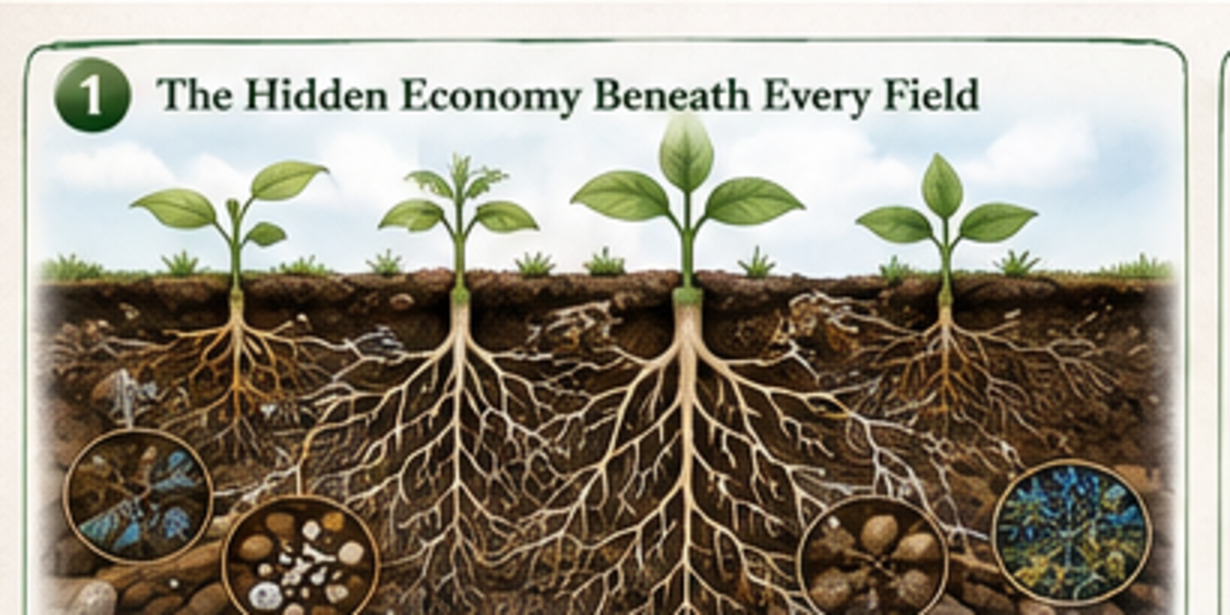
Cross-section of crop roots connected to arbuscular mycorrhizal fungal hyphae extending into surrounding soil to access phosphorus, water, and other soil resources beyond the immediate root zone.
Figure 1 — The Hidden Underground Economy
Why We Begin Here
Most articles on mycorrhizae begin with a definition.
This reference begins with a question:
Why has this relationship survived for more than 400 million years?
If we answer that question first, everything else—from phosphorus uptake to commercial inoculants—becomes much easier to understand.
Chapter 2 —The Oldest Agricultural Partnership on Earth
How did the first plants obtain nutrients from land before they had the roots we recognize today?
The answer appears to involve fungi.
When the ancestors of land plants began establishing themselves on exposed soil hundreds of millions of years ago, they entered an environment very different from the aquatic habitats their ancestors had known. Water was less dependable. Mineral nutrients were present, but many were difficult to acquire. The first land plants did not possess the deep, branching root systems, root hairs, or vascular complexity found in modern crops.
They needed another way to explore the soil.
Fungal partners offered one.
Fine fungal hyphae could grow through small soil pores, contact mineral surfaces, and retrieve nutrients from beyond the limited reach of primitive plant tissues. In return, plants supplied carbon captured through photosynthesis. That basic exchange—plant carbon for fungal access to soil resources—became one of the most durable partnerships in terrestrial biology.
Modern mycorrhizae are not recent additions to plant life. Fossils, molecular evidence, and the distribution of symbiosis-related genes across living plant lineages all indicate that fungus–plant partnerships arose very early in the history of land plants.
The Move from Water to Land
Land offered early plants an enormous opportunity. Sunlight was abundant, atmospheric carbon dioxide was directly available, and large areas remained biologically unoccupied. But the move also created severe problems.
An aquatic organism is surrounded by water and dissolved nutrients. A land plant must obtain water and minerals from a solid, chemically complex soil while preventing its tissues from drying out. It must anchor itself, transport resources internally, and reproduce without depending entirely on continuous water.
The first land plants were small and structurally simple. True roots evolved later and did not appear as one single invention. Fossil and developmental evidence indicates that rooting systems arose stepwise and, in some plant lineages, independently.
The oldest known root meristems in the fossil record are approximately 407 million years old, but plants had begun colonizing land before complex roots were widespread.
This timing matters. It leaves an important evolutionary interval in which plants were living on land without the root systems that modern agriculture takes for granted.
Mycorrhiza-like fungal partnerships may have helped bridge that gap.
What the Fossils Show
The Rhynie chert of Scotland preserves one of the most detailed windows into early terrestrial ecosystems. Formed during the Early Devonian, approximately 407 million years ago, this deposit contains exceptionally preserved plants, fungi, and biological interactions.
Inside fossilized tissues of early plants, researchers have identified fungal structures resembling those formed in modern mycorrhizal associations. These include intracellular coils, vesicle-like structures, spores, and arbuscule-like branching forms. A detailed examination of the early land plant Horneophyton lignieri found fungal associations closely resembling those seen in living nonvascular plants.
These fossils do not prove that every early land plant depended on exactly the same fungi used by modern crops. They do show that intimate nutrient-exchange relationships between plants and fungi were already established more than 400 million years ago.
That makes mycorrhizal symbiosis older than flowering plants, older than grasslands, older than most familiar forest ecosystems, and vastly older than agriculture.
Molecular Evidence Supports an Ancient Origin
Fossils show that ancient associations existed. Molecular biology helps scientists ask whether living plants retained parts of the machinery required to form them.
Modern arbuscular mycorrhizal symbiosis requires plants to recognize fungal signals, permit controlled entry into root tissues, construct specialized exchange interfaces, and regulate the movement of carbon and nutrients. These processes depend on coordinated networks of genes.
Phylogenomic studies have identified symbiosis-related genes that are conserved across widely separated groups of land plants. Some components of this genetic toolkit can be traced toward the common ancestry of land plants, while other components appear to have been assembled step by step during early plant evolution.
The broad conservation of these genes supports the conclusion that the capacity for arbuscular mycorrhizal symbiosis arose very early. It also explains why many modern crop plants still recognize and accommodate fungal partners using biological pathways with exceptionally ancient origins.
Research Spotlight
Bravo et al. (2016), Nature Plants
Researchers compared genomes from diverse plant lineages and identified genes conserved in plants capable of forming arbuscular mycorrhizal symbiosis. Their findings supported the hypothesis that the symbiosis arose early and that important parts of its genetic machinery were retained through plant evolution.
Why this matters to growers: A crop’s ability to form mycorrhizae is not a recently acquired response to agricultural management. It is part of an ancient biological program inherited through plant evolution.
Did Fungi Help Plants Conquer the Land?
The evidence strongly supports an ancient association. The larger claim—that fungi enabled plants to colonize land—requires more careful wording.
It is reasonable to say that fungal partnerships likely assisted early land plants by improving access to phosphorus, nitrogen, and soil water. Experiments with living liverworts, which resemble some features of early land plants, have shown that fungal colonization can increase nutrient acquisition, photosynthetic carbon gain, biomass, and reproductive output under conditions designed to approximate ancient atmospheres.
But land colonization was not caused by a single innovation. Early plants also needed protection from drying, reproductive structures, developmental control, cell walls, chemical defenses, and ways to move water and nutrients through their tissues.
Mycorrhizae were probably one important part of a much larger evolutionary package.
The most defensible conclusion is:
Fungal partnerships did not single-handedly move plants onto land, but they likely gave early plants a major nutritional advantage while complex roots were still evolving.
The Evolutionary Story Is Still Being Refined
Earlier accounts often presented the origin of mycorrhizae as a simple partnership between the earliest land plants and fungi now classified within Glomeromycotina—the group containing modern arbuscular mycorrhizal fungi.
Current evidence suggests a more complex history.
Living liverworts and other early-diverging plants can associate not only with Glomeromycotina but also with fungi in Mucoromycotina. Large phylogenetic analyses indicate that mycorrhiza-like associations may have involved more than one ancient fungal lineage, and researchers continue to investigate which partnership most closely represents the ancestral condition.
This does not weaken the main conclusion. It strengthens it by replacing a simplified story with a more accurate one:
Plant–fungus nutritional partnerships are extremely ancient.
More than one fungal lineage may have participated in their early evolution.
The modern arbuscular mycorrhizal relationship is part of a long and dynamic history rather than an unchanged fossil relic.
Scientific understanding improves when uncertainty is acknowledged rather than hidden.
From Primitive Plants to Modern Crops
Over time, plants evolved larger bodies, vascular systems, true roots, root hairs, and more sophisticated nutrient-uptake mechanisms. Yet mycorrhizal partnerships did not disappear.
That persistence is important.
If roots alone had made fungi unnecessary, natural selection would have reduced or eliminated the relationship across most plant lineages. Instead, mycorrhizal associations remain widespread among living plants. The partnership continued because roots and fungi perform different but complementary jobs.
Roots provide structure, transport capacity, and direct access to the surrounding soil. Fungal hyphae extend the reach of those roots into pores and nutrient zones that roots cannot exploit as efficiently.
The result is not a primitive system that plants failed to outgrow. It is a successful division of labor.
Modern agriculture inherited that partnership. Corn, wheat, tomatoes, grapes, almonds, citrus, and many other crops still possess the biological capacity to engage with arbuscular mycorrhizal fungi. Their responses differ, and the value of the partnership changes with soil conditions, but the underlying relationship connects a modern field directly to the earliest terrestrial ecosystems.
Why Evolutionary History Matters in the Field
The evolutionary story is not included merely because it is interesting. It changes how growers should think about management.
Mycorrhizae are not an agricultural product category invented by manufacturers. Commercial inoculants are products, but mycorrhizal symbiosis itself is a natural biological process that existed long before agriculture.
That distinction leads to several practical conclusions:
Many soils already contain mycorrhizal fungi. Their ancient and widespread distribution means that inoculation should not begin with the assumption that a field is biologically empty.
Crops differ in inherited compatibility. Some plant families retained strong mycorrhizal associations, while others reduced or lost the ability to form them.
Management can support or disrupt an existing relationship. Tillage, fallow periods, fumigation, crop rotation, and phosphorus availability influence the fungi already present.
Commercial inoculation is an ecological intervention. Added fungi enter an established community; they are not simply another nutrient applied by weight.
The correct starting point is therefore not:
“How many spores should be applied?”
It is:
“What mycorrhizal community already exists here, and what conditions allow it to function?”
Chapter Conclusion
Mycorrhizal partnerships reach back to the earliest chapters of plant life on land. Fossils document fungus-like structures inside plants more than 400 million years ago. Genetic evidence shows that the machinery needed to recognize and accommodate fungal partners is deeply conserved. Experiments with living early-diverging plants demonstrate how fungal access to soil nutrients could have improved growth and reproduction in primitive terrestrial environments.
The details of the ancestral partnership are still being refined. Early plants may have associated with multiple fungal lineages, and mycorrhizae were only one of many innovations required for life on land.
But the central conclusion is strong:
Plants did not build the terrestrial world alone. Fungi were among their earliest and most important partners.
That history prepares us for the next question: what exactly happens when a modern fungal hypha reaches a root and the two organisms begin negotiating an exchange?
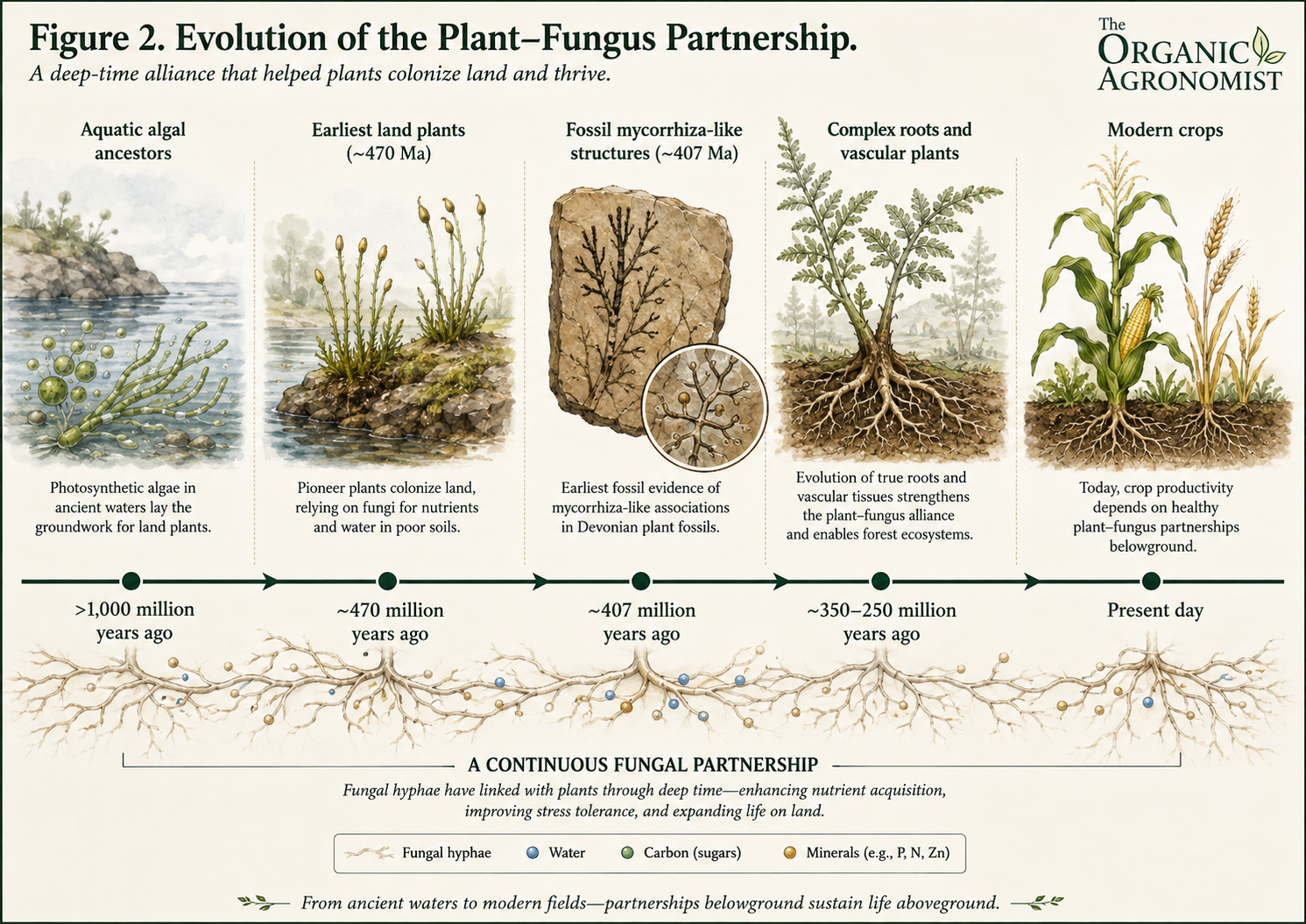
Timeline showing the evolution of plant–fungus partnerships from aquatic algal ancestors and early land plants to fossil mycorrhiza-like structures, complex roots, vascular plants, and modern crops.
Chapter 3 — How the Partnership Works
A mycorrhizal fungus can extend far into the soil, but the most important part of its relationship with a plant occurs at a microscopic interface inside the root. To understand why mycorrhizae sometimes improve crop performance and sometimes do not, we first need to understand what actually happens when a fungus meets a root.
The process is not simply infection. The plant is an active participant. It recognizes fungal signals, reorganizes root cells to accommodate the fungus, builds a specialized membrane around the exchange structure, and regulates the movement of nutrients and carbon across that interface.
The fungus, meanwhile, develops two connected systems: one inside the root and another extending outward through the soil. Together they form a biological supply network linking soil resources to plant metabolism.
Before Entry: Recognition Between Plant and Fungus
Arbuscular mycorrhizal (AM) fungi cannot complete their life cycle independently of a living host. Spores and existing hyphae can initiate growth in soil, but sustained fungal development depends on finding a compatible plant.
Roots do not simply wait passively to be invaded. Plants release compounds into the rhizosphere, including strigolactones under many nutrient-limited conditions, that can stimulate fungal branching and metabolism. The fungus also releases signaling molecules that the plant can recognize. This chemical exchange begins before physical contact.
When a compatible AM fungus reaches the root surface, it can form a specialized attachment and entry structure commonly called a hyphopodium. The plant cell reorganizes internally in preparation for fungal penetration. Researchers have described a prepenetration apparatus—a plant-built cellular pathway that helps guide the incoming hypha through the outer root tissues.
This distinction matters. AM fungi are not simply forcing their way through defenseless tissue. A successful symbiosis requires coordinated development by both organisms.
Inside the Root: The Intraradical Mycelium
After entry, fungal hyphae spread through the root cortex. This portion of the fungal network is called the intraradical mycelium—literally, the mycelium within the root.
The fungus generally occupies cortical tissues rather than colonizing every root cell. Depending on the plant and fungal partners, the internal growth pattern can differ, but the essential function is the same: establish a living connection between the external soil-exploring network and specialized exchange structures inside the root.
The root is therefore not simply coated with fungus. Part of the fungal organism is living within it, while another part extends outward into the surrounding soil. Those two domains remain connected.
That connection is what makes the partnership agronomically important.
The Arbuscule: Where the Trade Happens
The signature structure of arbuscular mycorrhiza is the arbuscule.
An arbuscule is a highly branched fungal structure that develops inside a living root cortical cell. Its name comes from the Latin arbusculum, meaning “little tree,” because under a microscope its many fine branches resemble a tiny tree crown.
The branching is not ornamental. It creates an enormous surface area in a very small space. That surface area allows the plant and fungus to exchange resources efficiently.
Yet an important detail is often missed: the fungus does not simply enter the plant cell and mix directly with its contents. As the arbuscule develops, the plant produces a specialized membrane around it called the periarbuscular membrane. Between the fungal membrane and this plant-derived membrane lies a narrow periarbuscular space.
This microscopic interface is the trading floor of the partnership.
Phosphate and other mineral nutrients delivered by the fungus can cross this interface toward the plant. Plant-derived carbon compounds move toward the fungus. Specialized transport proteins in the membranes help regulate those exchanges.
The arbuscule therefore does not merely show that a fungus is present. It creates the physical and biochemical interface through which the partnership can function.
Teaching Point: Colonization is not the same thing as benefit. An arbuscule creates a place where trade can occur; it does not guarantee that the trade is profitable for the plant.
That distinction becomes critical when evaluating commercial inoculants. A laboratory may demonstrate that an inoculant colonized roots. That proves biological establishment. It does not, by itself, prove greater yield, improved crop quality, or an economic return.
The External Network: The Extraradical Mycelium
While arbuscules conduct exchange inside the root, another portion of the fungus is doing the searching.
Hyphae extend from colonized roots outward into the soil, forming the extraradical mycelium. These microscopic filaments can explore soil beyond the immediate reach of root surfaces and root hairs. Because hyphae are much finer than roots, they can enter small soil pores and contact nutrient sources that roots may not access efficiently.
This is especially important for phosphorus. Phosphate moves slowly through soil and can become depleted close to an actively absorbing root. A root may therefore sit only a short distance from phosphorus that it cannot acquire rapidly enough. Fungal hyphae extend beyond this depletion zone, absorb phosphate from a larger volume of soil, and transport it back toward the root.
The external network includes different functional forms. Larger runner hyphae help extend the network through soil, while finer branched absorbing structures increase contact with soil resources. The network can also produce spores that help the fungus survive and establish future colonization.
This gives us a useful way to picture the system:
Roots provide the central infrastructure. Arbuscules provide the exchange terminals. External hyphae provide the exploration and transport network.
Vesicles and Spores: Storage and Survival
Many AM fungi also form vesicles—swollen structures within roots that commonly store lipids and other reserves. Vesicles can also function as propagules in some fungal groups, meaning they may contribute to future colonization.
Not all AM fungal lineages form vesicles, so their absence does not mean a root lacks a functioning mycorrhizal association.
Spores are generally produced from the external fungal network. They contain substantial stored reserves and are protected by relatively robust walls. Spores are one way AM fungi persist when suitable roots are temporarily unavailable and one source of propagules capable of beginning new associations.
Agronomically, this matters because a field’s mycorrhizal potential is not determined by spores alone. Infective propagules can include spores, colonized root fragments, and living hyphae.
A management practice that preserves an intact fungal network may therefore influence how quickly the next host crop becomes colonized.
The Fungus Is a Transport System, Not a Nutrient Factory
One of the most important misconceptions about mycorrhizae is that they somehow create plant nutrients.
They do not.
The fungus can explore soil, acquire nutrients, transport them, and alter the plant’s access to them. But phosphorus transported by a fungal hypha still has to exist somewhere in the soil system. The same principle applies to nitrogen, zinc, copper, and other elements associated with mycorrhizal uptake.
This is why the phrase biological fertilizer can be misleading when applied too literally to AM fungi. The fungus is better understood as part of a biological acquisition and delivery system. It can change the effective volume of soil explored by the plant and the pathways through which nutrients enter the root, but it cannot manufacture phosphorus out of nothing.
That distinction will matter later when we examine claims that inoculation can “replace fertilizer.”
What the Plant Gives Back
The fungal network is expensive to build and maintain. AM fungi are obligate biotrophs: they depend on their plant partners for carbon.
For many years this exchange was commonly summarized as “sugar for phosphorus.” Modern research shows that the carbon side is more complex. Plants transfer carbohydrates to their fungal partners, but they also provide lipids. Research published in 2017 demonstrated that host plants synthesize fatty acids that support AM fungal development, helping explain the fungus’s deep dependence on living hosts.
The plant therefore does more than tolerate the fungus. It actively supports fungal metabolism and construction.
That investment can be substantial. But carbon transfer is not automatically a loss to the plant. If the fungal network delivers enough of a limiting resource, improved nutrition can support greater photosynthesis and growth, offsetting the carbon invested in the fungus.
The important question is not whether the plant pays a cost. It does.
The question is whether the return justifies the cost.
That is the subject of Chapter 4.
Arbuscules Are Temporary
An arbuscule is not a permanent structure. It develops, functions for a relatively short period, and then degenerates. The plant cell can remain alive and may later participate in another cycle of colonization.
This turnover is another reminder that mycorrhiza is a dynamic process rather than a static coating on a root. At any given moment, a colonized root may contain fungal structures at different developmental stages: advancing hyphae, mature exchange structures, storage structures, and senescing arbuscules.
Measurements of “percent root colonization” compress all of that biological complexity into a single number. That number can be useful, but it cannot tell the entire story.
Two roots with similar colonization percentages may differ greatly in the activity of their arbuscules, the amount of external mycelium in the soil, the fungal taxa present, and the amount of phosphorus or carbon actually being exchanged.
Again, presence is not performance.
From Anatomy to Agronomy
Once the partnership is viewed as a connected system, several practical observations become easier to understand.
A soil may contain AM fungi but still produce little crop response to inoculation because native fungi already occupy the niche. A root may become heavily colonized without producing more yield because the crop was not limited by a resource the fungus could supply. Tillage can matter because the fungal organism extends beyond the root as a living soil network. High phosphorus availability can matter because plants have less reason to invest heavily in a phosphorus-acquisition partnership.
These are not contradictions in mycorrhizal science. They are consequences of how the system works.
The fungus is not an additive that produces the same response every time it is applied. It is a living partner operating inside an existing biological and nutritional environment.
Understanding the anatomy gives us the vocabulary. Understanding the exchange gives us the agronomy.
And that brings us to the central question of the entire article:
When does the plant receive more value from the fungus than it gives away?
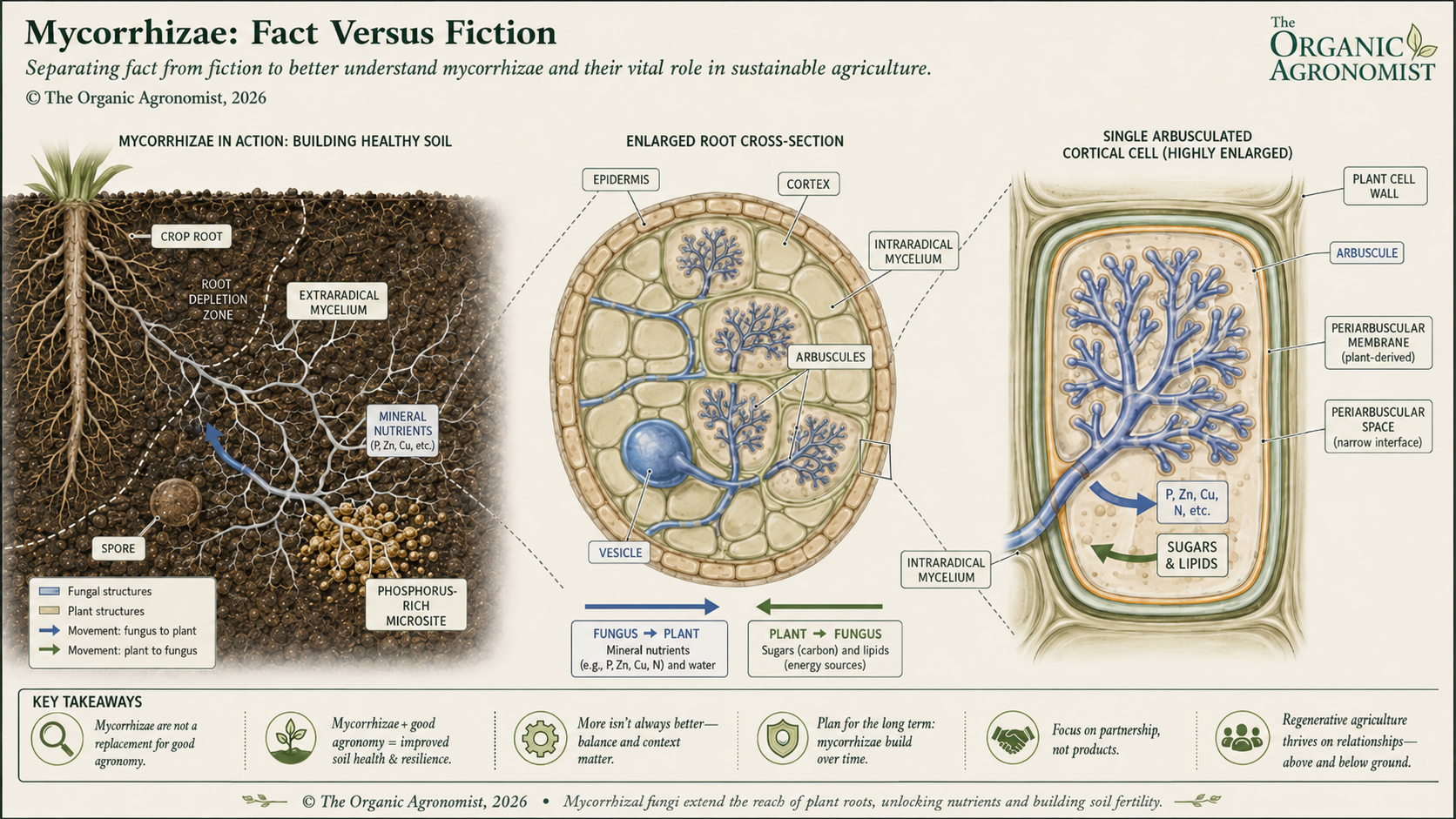
Cross-section of a mycorrhizal root showing fungal hyphae extending through the soil and into root cortical cells, where branched arbuscules form nutrient-exchange interfaces between the fungus and plant.
Chapter 4 — The Economics of Cooperation
Why would a plant give valuable carbon to a fungus?
A green leaf looks self-sufficient. It captures light, takes carbon dioxide from the atmosphere, and uses photosynthesis to manufacture the carbon compounds that support growth. Those compounds can become new leaves, roots, fruit, storage reserves, defensive chemicals, or reproductive structures.
So why would a plant divert some of that hard-earned carbon to a fungus living in and around its roots?
Because under the right conditions, the fungus can purchase something the plant needs more.
That is the central economic logic of the arbuscular mycorrhizal partnership.
The plant is exceptionally good at acquiring carbon. The fungus is exceptionally good at exploring soil. Their partnership allows each organism to specialize, then exchange resources across the arbuscule. The plant supplies photosynthetically derived carbon, including sugars and lipids. The fungus supplies mineral nutrients, especially phosphorus, acquired through a hyphal network that explores soil beyond the immediate root surface.
But the exchange is not free, fixed, or automatically profitable.
A mycorrhizal fungus is a living carbon sink. It must build hyphae, maintain fungal tissue, respire, form spores, and support the structures required for nutrient exchange. Published estimates vary substantially with plant species, fungal partner, growth stage, nutrient status, environment, and measurement method, but reviews commonly place the carbon demand of arbuscular mycorrhizal symbiosis in the range of roughly 4 to 20 percent of recently fixed plant carbon.
That range should not be treated as a universal tax. A crop does not automatically surrender 20 percent of its photosynthesis simply because mycorrhizae are present. The important point is that the investment can be biologically significant.
And significant investments require significant returns.
Nature is not built on generosity. It is built on successful partnerships. Mycorrhizae have persisted for more than 400 million years because, under the right conditions, both the plant and the fungus receive more than they invest.
For agriculture, that sentence leads to the question that matters most:
Is the fungal partner returning enough value to justify the carbon the crop is spending?
Carbon Is Currency
Calling carbon a “currency” is a teaching analogy, not a claim that plants calculate profit in the human sense. But it is useful because carbon is limited and valuable.
Every unit of carbon allocated belowground has an opportunity cost. It could otherwise contribute to plant growth, storage, reproduction, root development, or defense. Supporting a fungal partner therefore makes biological sense only when the partnership improves the plant’s overall performance or fitness under the conditions in which it is growing.
Arbuscular mycorrhizal fungi have an unusually strong dependence on this exchange. They are obligate biotrophs: completion of their life cycle depends on carbon obtained from living host plants.
For many years the exchange was simplified as:
Plant sugar → fungus
Fungal phosphorus → plant
That model captures the basic trade, but modern work shows that it is incomplete. Plants provide both carbohydrates and lipids to arbuscular mycorrhizal fungi. The fungi have lost important components of the machinery needed to synthesize fatty acids independently and rely on host-derived lipids for normal development.
The plant is therefore doing more than feeding a microorganism a little excess sugar. It is supplying energy and essential carbon-rich building material to an organism whose external mycelium may extend far beyond the root.
That fungal network can be expensive to maintain.
It can also be extraordinarily valuable.
What Does the Plant Buy?
The most consistently demonstrated return is improved access to mineral nutrients, particularly phosphorus.
Phosphorus presents a special problem for roots because phosphate moves slowly through many soils and is readily sorbed or precipitated into forms that limit its concentration in soil solution. A growing root can rapidly draw down available phosphate immediately around its surface, creating a depletion zone.
Fungal hyphae are much finer than roots and can extend beyond that depleted zone. They explore additional soil volume, acquire phosphate, move it through the fungal network, and deliver it to exchange structures inside the root.
Under phosphorus-limited conditions, that service can be worth a substantial carbon investment.
Mycorrhizal pathways can also contribute to acquisition of nitrogen and micronutrients such as zinc and copper, although the magnitude and agronomic importance vary with crop, soil, fungus, and environment. Water relations and some forms of stress tolerance can also improve under particular conditions.
The key word is particular.
A benefit has value only when it addresses something that limits the plant.
If phosphorus is limiting growth, better phosphorus acquisition can have a high return.
If phosphorus is already readily available, additional phosphorus acquisition may have little marginal value.
If another factor—nitrogen, temperature, salinity, disease, root damage, or water—is controlling yield, increasing phosphorus delivery may not increase harvestable production at all.
This is why the same fungal colonization can be valuable in one field and economically invisible in another.
A Biological Return on Investment
For teaching purposes, we can describe the relationship as a biological return on investment.
Plant investment
Photosynthetically fixed carbon
Sugars transferred to the fungal partner
Host-derived lipids
Metabolic energy used to establish and regulate the symbiosis
Root cortical space devoted to exchange structures
Potential fungal return
Phosphorus acquisition
Contributions to zinc, copper, nitrogen, and other nutrient acquisition
Access to soil beyond the immediate root depletion zone
Improved water relations under some conditions
Stress-related benefits that depend on the crop and environment
From the plant’s perspective, three broad outcomes are possible.
1. Return exceeds cost
The fungus supplies a resource that strongly limits plant performance. Improved nutrition or stress tolerance more than compensates for the carbon investment.
The plant may grow better, maintain better nutrient status, or ultimately produce more yield.
2. Return roughly equals cost
The fungus is active and the root is colonized, but the resources supplied do not materially change plant performance.
The partnership exists, yet little difference is visible aboveground.
This is one reason a laboratory measurement of colonization should never be treated as proof of agronomic benefit.
3. Cost exceeds return
The fungus continues to consume plant carbon but supplies too little additional value to compensate.
Under these conditions, colonized plants can show no growth advantage and may occasionally perform worse than comparable non-mycorrhizal plants.
This does not mean mycorrhizae have suddenly become “bad fungi.” It means the economics of the particular partnership, under those particular conditions, are unfavorable to the host.
Colonization Is Not Profitability
This distinction is important enough to repeat:
Colonization measures occupation of the root. It does not measure profitability of the partnership.
A root-staining assay may show abundant fungal structures. Molecular methods may confirm that an inoculated fungus became established. Neither result, by itself, demonstrates that the crop received more nutrient value than it paid in carbon.
For an agronomist, there are several separate questions:
Did viable fungus reach the root?
Did the fungus colonize the root?
Did the fungus establish a functional nutrient-exchange pathway?
Did that pathway improve plant nutrition?
Did improved nutrition change biomass, stress tolerance, quality, or yield?
Was the response large and reliable enough to justify the management cost?
Those questions should not be collapsed into one.
This is especially important when evaluating commercial inoculants. A product can successfully increase colonization yet fail to increase yield. That is not contradictory. The biological transaction occurred; the crop simply may not have received a return large enough to affect the outcome being measured.
The Plant Is Not a Passive Customer
The old picture of mycorrhizae sometimes made the plant look like a passive host: the fungus arrives, colonizes the root, and takes whatever carbon the plant happens to provide.
The actual relationship is more regulated.
Plants alter the development of the symbiosis according to nutrient status. Fungal partners also respond to resource availability. Experiments using isotopic tracers have shown that plants can allocate more carbon toward fungal partners providing more phosphorus, while fungi can allocate more phosphorus toward roots that provide more carbon.
This work inspired the idea of a biological market.
The analogy is useful, but it should not be pushed too far. Researchers continue to debate how universally reciprocal rewards explain resource exchange. Competition, sink strength, partner identity, nutrient availability, and physiological constraints also influence the outcome.
The safest conclusion is not that plants and fungi run a perfectly balanced marketplace.
It is that resource exchange is regulated, conditional, and responsive to the value and availability of the resources being traded.
That is a much more useful idea for agriculture.
When Phosphorus Is Abundant, the Deal Changes
One of the strongest examples of this regulation involves phosphorus.
Plants generally become less dependent on the mycorrhizal pathway when phosphate is readily available through direct root uptake. High plant phosphorus status can suppress signaling and colonization associated with arbuscular mycorrhizal symbiosis.
From an economic perspective, the logic is straightforward.
Why spend heavily on an outside phosphorus-acquisition network when the root can obtain adequate phosphorus directly?
This does not mean phosphorus fertilizer “kills mycorrhizae” in every soil, nor does it justify a simplistic rule that all phosphorus applications are harmful to soil biology.
The response depends on phosphorus availability, plant status, rate, placement, crop, soil, fungal community, and other management factors.
But the general biological principle is well established:
As the plant’s need for fungal phosphorus declines, the value of maintaining the partnership can decline as well.
This principle will be examined in detail in Chapter 5, because phosphorus is the nutrient that most clearly reveals why mycorrhizae are valuable in some conditions and much less valuable in others.
The Plant May Increase the Size of the Economy
There is another reason carbon cost should not automatically be interpreted as lost yield.
A strong fungal carbon sink can sometimes stimulate greater photosynthetic activity. If improved nutrient acquisition allows the plant to build more photosynthetic tissue or operate that tissue more effectively, the plant may partly compensate for the carbon transferred to the fungus by fixing more carbon overall.
In other words, the partnership can sometimes enlarge the economic pie.
A plant might allocate more carbon belowground while still ending the season with more total growth than a non-mycorrhizal plant.
That is why simply measuring how much carbon goes to the fungus does not tell us whether the relationship is beneficial.
The correct comparison is not:
How much carbon did the fungus consume?
It is:
What did the plant receive in return, and how did that exchange affect whole-plant performance?
Stress Can Change the Value of the Trade
The return on mycorrhizal investment is not constant throughout a season.
Imagine two identical plants carrying similar fungal partners.
One grows in a field with adequate phosphorus and uniform irrigation.
The other experiences a period of nutrient limitation or water stress.
The fungal network may provide little measurable advantage to the first plant because the resources it helps acquire are already readily available.
The same network may become much more valuable to the second plant because conditions have changed the value of the resources the fungus can access.
This helps explain why mycorrhizal benefits are sometimes inconsistent among years.
A partnership that produces little measurable yield response during an easy season may have greater value during a stressful one.
That possibility is important, but it must also be handled carefully. Claims that mycorrhizae universally “drought-proof” crops go far beyond the evidence. Stress responses vary widely among crops, fungi, soils, and experimental conditions.
The economic framework keeps us disciplined:
The value of the partnership rises when the fungus supplies something the plant cannot obtain adequately on its own.
Research Spotlight — Reciprocal Rewards
A landmark 2011 study by Kiers and colleagues used isotopic tracers to examine resource exchange between plants and different arbuscular mycorrhizal fungal partners.
The researchers found evidence that plants allocated more carbon to more cooperative fungal partners and that fungi allocated more phosphorus to better carbon-providing hosts. The work provided experimental support for reciprocal rewards as one mechanism capable of stabilizing cooperation.
The study became influential because it changed the way many scientists described mycorrhizal symbiosis: not as unconditional cooperation, but as an exchange in which partner quality can influence resource allocation.
Later reviews have added an important qualification. Reciprocal reward is not necessarily the only mechanism governing the relationship, nor does it operate identically in every host-fungus combination. Resource competition, physiological sink strength, nutrient status, and functional differences among partners also matter.
Why this matters to growers: A fungus should not be judged simply by whether it colonizes a root. What matters is the function it performs and the value of the resources it returns to the crop.
What This Explains About Field Results
The carbon-for-nutrient framework helps make sense of several findings that otherwise appear contradictory.
Why inoculation can increase yield in one field and do nothing in another
The limiting resources and resident fungal communities are different.
Why high colonization does not guarantee high yield
Fungal presence does not tell us whether the resource delivered was limiting or whether the return exceeded the carbon cost.
Why native fungi may be enough
If resident fungi already provide an effective nutrient-acquisition pathway, adding another fungus may create little additional value.
Why greenhouse results can look stronger than field results
Controlled systems often create conditions in which fungal access to a limiting resource produces a clear response. Agricultural fields contain native microbes, spatial variability, existing nutrient pools, weather, roots, residues, and multiple simultaneous constraints.
Why a product can be biologically active but economically unsuccessful
Establishment is only the first step. A commercially useful response must travel all the way from viable inoculum to colonization to function to crop response to economic return.
What This Explains About Field Results
The carbon-for-nutrient framework helps make sense of several findings that otherwise appear contradictory.
Why inoculation can increase yield in one field and do nothing in another
The limiting resources and resident fungal communities are different.
Why high colonization does not guarantee high yield
Fungal presence does not tell us whether the resource delivered was limiting or whether the return exceeded the carbon cost.
Why native fungi may be enough
If resident fungi already provide an effective nutrient-acquisition pathway, adding another fungus may create little additional value.
Why greenhouse results can look stronger than field results
Controlled systems often create conditions in which fungal access to a limiting resource produces a clear response. Agricultural fields contain native microbes, spatial variability, existing nutrient pools, weather, roots, residues, and multiple simultaneous constraints.
Why a product can be biologically active but economically unsuccessful
Establishment is only the first step. A commercially useful response must travel all the way from viable inoculum to colonization to function to crop response to economic return.
That is a much higher standard than simply finding fungal structures in a root.
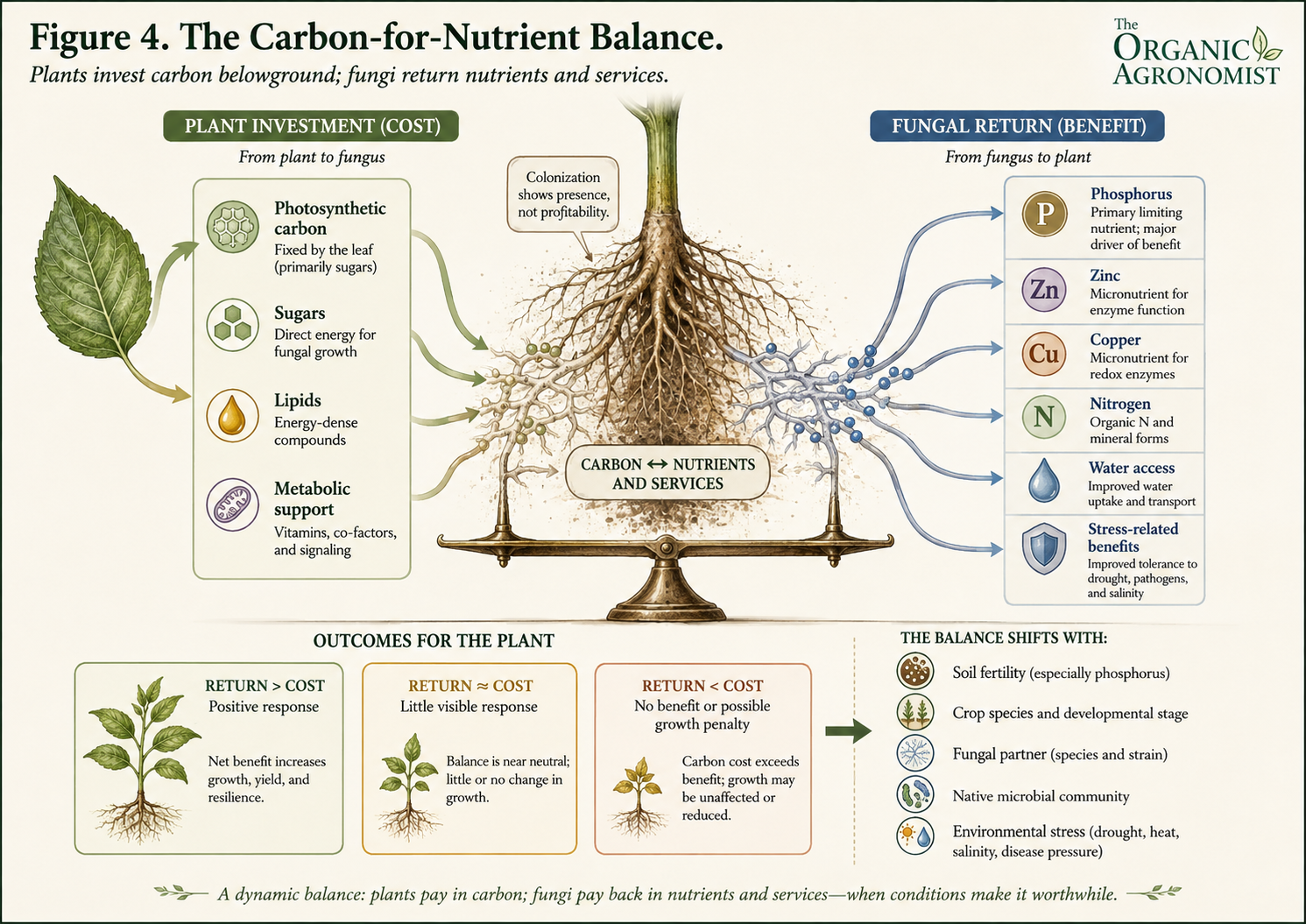
Diagram comparing the plant’s carbon investment in mycorrhizal fungi with the fungal return of phosphorus, micronutrients, water access, and stress-related benefits, showing that root colonization alone does not guarantee an agronomically profitable partnership.
What Every Grower Should Remember
Mycorrhizae cost the plant something.
That is not a criticism of the symbiosis. It is the reason the symbiosis makes sense.
The fungus performs work the plant would otherwise have to accomplish with roots, transport proteins, metabolic energy, or not accomplish at all. In return, the fungus receives the carbon it cannot obtain independently.
When the trade solves a meaningful limitation, both partners can prosper.
When it does not, colonization may produce little visible benefit.
That gives us the foundation for the next question:
Why is phosphorus so often the resource that makes this partnership worthwhile?
That is where Chapter 5 begins.
Chapter 5 — Why Phosphorus Changes Everything
Why is phosphorus the nutrient most closely associated with mycorrhizae?
Plants need phosphorus for nearly every stage of growth. It is part of ATP and other molecules involved in energy transfer. It is required for nucleic acids, membranes, metabolism, root development, flowering, seed formation, and many other processes.
Yet phosphorus creates a peculiar problem for roots.
A soil may contain a large amount of total phosphorus while supplying only a small amount of phosphate to the soil solution at any one time. Roots can absorb phosphate only from the solution immediately surrounding their absorbing surfaces, and that dissolved phosphate does not move through soil nearly as freely as nitrate.
As a root takes up phosphate, it can deplete the soil immediately around itself faster than phosphate can be replenished from the surrounding soil. The result is a phosphorus depletion zone: a narrow region around the root in which readily available phosphate becomes lower than it is farther away.
A root can respond by growing farther, producing more lateral roots, extending root hairs, changing transporter activity, altering root exudation, or investing in other phosphorus-acquisition strategies.
A mycorrhizal plant has another option.
It can send a fungal partner beyond the depletion zone.
That is why phosphorus changes everything.
Phosphorus Is Present, but Often Difficult to Reach
Growers sometimes hear that phosphorus is “immobile.” That description is useful, but incomplete.
Phosphorus does move. The problem is that plant-available phosphate usually moves through soil slowly and over short distances compared with highly mobile nutrients such as nitrate.
Phosphate can be retained on mineral surfaces, react with calcium, iron, or aluminum compounds, enter organic forms, or otherwise become part of soil pools that do not immediately replenish the soil solution at the rate a growing root may demand.
So the agronomic problem is not simply:
How much phosphorus is in the soil?
It is also:
How quickly can phosphate move from the soil into an absorbing surface at the time the crop needs it?
That distinction is fundamental.
Two soils with similar total phosphorus can differ greatly in plant-available phosphorus. Two roots growing only a few centimeters apart can experience different phosphorus environments. And a soil that contains substantial phosphorus reserves may still limit crop phosphorus acquisition because the available fraction is spatially separated from the root or replenished too slowly.
Mycorrhizal fungi do not create phosphorus.
They change the plant’s ability to find and intercept phosphorus that roots alone may not reach efficiently.
The Depletion Zone
Imagine a young root growing through soil.
Immediately ahead of the root tip, phosphate is available in the soil solution.
As the root and its root hairs absorb phosphate, the concentration nearest those absorbing surfaces declines. More phosphate must then diffuse toward the root from surrounding soil or be released from less immediately available soil pools.
Because that replacement is relatively slow, the root can create a zone around itself in which the concentration of available phosphate has been drawn down.
The root has already searched that soil.
The phosphorus it can easily obtain there is becoming exhausted.
Fungal hyphae change the geometry of the problem.
Arbuscular mycorrhizal fungi produce extremely fine external hyphae that extend outward from colonized roots into soil the root surface has not yet depleted. These hyphae can enter small soil pores and explore soil volumes beyond the immediate reach of roots and root hairs.
The fungus acquires phosphate in that external soil, transports phosphorus through its hyphal network, and ultimately releases phosphate at the arbuscular interface inside the root. The plant then takes up that phosphate through specialized transport machinery in the membrane surrounding the arbuscule.
This is not simply “a bigger root system.”
It is a second phosphorus-acquisition pathway.
Two Pathways Feed the Same Plant
A mycorrhizal plant can acquire phosphorus through two major routes.
The direct pathway
Roots and root hairs absorb phosphate directly from the soil solution through phosphate transporters located in root tissues exposed to the soil.
The mycorrhizal pathway
External fungal hyphae acquire phosphate from soil, transport it through the fungus, release it at arbuscules, and the plant absorbs it across the periarbuscular membrane through mycorrhiza-specific phosphate transporters.
These pathways do not simply operate independently at full capacity.
They interact.
Experiments with Medicago truncatula have shown that mycorrhizal colonization can reduce expression and activity associated with parts of the direct phosphate-uptake pathway while the mycorrhizal pathway supplies phosphorus to the plant. In other words, once the fungal route is functioning, the plant may rely less heavily on direct uptake in colonized portions of the root system.
This matters because a plant can receive a large fraction of its phosphorus through the fungal pathway without showing a dramatic increase in total plant phosphorus or biomass compared with a non-mycorrhizal plant.
The route changed.
The final amount did not necessarily change.
That distinction is one of the most important facts in mycorrhizal agronomy.
A mycorrhizal fungus can be doing substantial phosphorus-acquisition work even when the crop does not look larger.
Research Spotlight — The Pathway Can Change Without the Plant Looking Different
Smith, Smith, and Jakobsen (2003) compared phosphorus acquisition in mycorrhizal and non-mycorrhizal plants and demonstrated that arbuscular mycorrhizal fungi could provide the dominant route of phosphorus supply even when mycorrhizal plants did not show greater overall growth or phosphorus content than non-mycorrhizal controls.
The importance of that finding is easy to miss.
If researchers had measured only plant dry weight, they might have concluded that the fungus contributed little.
Tracing the phosphorus pathway told a different story.
Why this matters to growers: A visible growth response is not the same thing as a functioning mycorrhizal phosphorus pathway. Conversely, proving that the fungal pathway is active does not prove that adding an inoculant will increase yield. Function and agronomic response are related, but they are not identical.
The Arbuscule Is a Phosphorus Exchange Interface
Chapter 3 introduced the arbuscule as the finely branched fungal structure that forms inside a living root cortical cell.
Chapter 5 gives that structure an agronomic purpose.
The arbuscule creates a large interface across which nutrients can move between fungus and plant.
In Medicago truncatula, the phosphate transporter MtPT4 is expressed specifically in arbuscule-containing cells and is localized to the periarbuscular membrane. When this pathway is disrupted, normal phosphate transfer and arbuscule maintenance are impaired.
Other experiments have shown that a mycorrhiza-induced proton pump is also required to energize phosphate transport across this interface. When that pump is defective, plants can be colonized by fungal hyphae yet fail to take up phosphorus normally through the mycorrhizal pathway.
That gives us another important distinction:
Fungal structures can be present without the nutrient-exchange machinery functioning normally.
The arbuscule is not decorative anatomy.
It is a working exchange interface whose development and maintenance are closely tied to nutrient transfer.
Mycorrhizae Do Not Manufacture Phosphorus
This misconception deserves direct treatment.
Arbuscular mycorrhizal fungi are not phosphorus factories.
They cannot create the element phosphorus, and inoculating a field does not add phosphorus to the nutrient budget.
What fungi can do is alter the plant’s access to existing phosphorus pools.
They can:
Explore soil beyond the root depletion zone.
Intercept phosphate from a larger soil volume.
Compete effectively for phosphate in the soil solution.
Transport acquired phosphorus through hyphae to the root.
Interact with other organisms and rhizosphere processes that influence phosphorus cycling.
But if the soil system cannot supply enough phosphorus to the fungal network, the fungus cannot deliver phosphorus that does not exist.
This is why the claim that mycorrhizae “replace phosphorus fertilizer” is too broad.
Under some conditions, effective mycorrhizal acquisition may improve phosphorus-use efficiency or reduce the amount of readily soluble phosphorus required to achieve adequate plant nutrition.
That is not the same as saying phosphorus inputs are unnecessary.
The correct fertility question is always based on the crop’s requirement, the soil’s capacity to supply phosphorus, the forms and placement of phosphorus present, the functioning of the root system, and the biological pathways contributing to acquisition.
When Low Phosphorus Makes the Partnership Valuable
Return to the biological economy from Chapter 4.
The plant is paying carbon to maintain the fungal partner.
When phosphorus is difficult for the plant to acquire directly, the fungus can provide a high-value service. Its external hyphae increase the effective volume of soil supplying phosphorus to the plant.
Under those conditions, the fungal pathway may provide enough additional phosphorus to improve plant nutrition, growth, or stress tolerance.
But “low phosphorus” requires careful interpretation.
If phosphorus availability is so low that neither roots nor fungi can acquire enough to support adequate growth, mycorrhizae cannot turn an exhausted nutrient supply into a sufficient one.
Likewise, if another factor is more limiting than phosphorus, improved phosphorus acquisition may not increase yield.
The largest response is therefore not guaranteed at the lowest possible soil phosphorus level.
The response depends on whether fungal access to phosphorus corrects a meaningful, correctable limitation.
When High Phosphorus Changes the Partnership
The opposite condition is equally important.
When a plant can obtain adequate phosphate directly, the value of paying for an external fungal acquisition network decreases.
Plants respond to their phosphorus status at the molecular level. Phosphate-starvation signaling regulates root traits, transporter systems, exudates, and genes involved in establishing arbuscular mycorrhizal symbiosis.
Recent work in rice has shown that the transcription factor PHR2—a central regulator of the phosphate-starvation response—is also required for normal mycorrhizal development and phosphate uptake. Under high-phosphate conditions, the signaling environment that favors full symbiosis is suppressed.
That is a more accurate explanation than saying:
“Phosphorus kills mycorrhizae.”
High phosphorus does not behave like a fungicide.
Instead, high plant phosphorus status can reduce the plant’s investment in establishing and maintaining a symbiosis whose primary nutrient service has become less valuable.
Depending on plant species, fungal species, soil conditions, phosphorus source and placement, colonization may decline, arbuscule abundance may change, signaling may be reduced, and the crop’s responsiveness to inoculation may fall.
There is no single universal soil-test number at which mycorrhizae suddenly stop functioning.
Agricultural interpretation must remain context-specific.
Research Spotlight — Phosphorus Status Is Wired Into Symbiosis
Das and colleagues (2022) demonstrated in rice that PHOSPHATE STARVATION RESPONSE 2 (PHR2), a master regulator of plant responses to phosphate deficiency, also controls genes required for several stages of arbuscular mycorrhizal development.
Rice plants defective in PHR2 showed sharply reduced colonization under low-phosphate conditions. The researchers also showed that PHR2 was required for normal mycorrhizal phosphate uptake and for the yield-promoting effect of the symbiosis in field soil.
When PHR2 activity was experimentally increased, colonization could be promoted even under higher phosphate conditions that normally suppress the symbiosis.
Why this matters to growers: The plant’s phosphorus status is not merely correlated with mycorrhizal colonization. Phosphorus nutrition is connected directly to the regulatory machinery that helps determine whether the plant develops and supports the fungal partnership.
More Phosphorus Is Not Always More Efficient Phosphorus
This chapter is not an argument against phosphorus fertilization.
Phosphorus is essential, and fields that cannot supply enough available phosphorus require correction.
The agronomic question is whether phosphorus is being supplied in a way that supports crop need without unnecessarily reducing the value of biological acquisition pathways or creating avoidable accumulation and environmental risk.
That requires attention to:
Soil test phosphorus and the method used to interpret it.
Soil pH and mineralogy.
Crop phosphorus requirement and growth stage.
Placement of phosphorus relative to active roots.
Phosphorus source and release characteristics.
Irrigation and soil moisture.
Root architecture and root health.
Mycorrhizal host status and field history.
Existing native fungal communities.
The goal is not to maximize phosphorus concentration in the soil.
The goal is to achieve adequate crop phosphorus nutrition efficiently.
Mycorrhizal fungi can be part of that efficiency, but only when the biological pathway is functioning and useful.
Why This Matters Especially in Organic Agriculture
Organic fertility programs often depend on phosphorus sources whose behavior differs from highly soluble conventional fertilizers.
Compost, manures, bone-derived materials, mineral phosphates, and blended organic fertilizers can contribute phosphorus in mixtures of inorganic and organic forms with different rates of release and different interactions with soil chemistry and biology.
That does not automatically mean organic systems are phosphorus deficient, nor does it mean mycorrhizae can access every form of phosphorus present.
It does mean that phosphorus acquisition in an organic field is often governed by a system rather than by a single immediately soluble input.
That system includes:
Mineralization of organic phosphorus compounds.
Chemical reactions controlling phosphate availability.
Root growth and root exudation.
Microbial competition and turnover.
Mycorrhizal exploration of soil beyond root depletion zones.
Timing between nutrient release and crop demand.
For the organic grower, the practical objective is not simply to “feed the fungus.”
It is to manage the soil-root-fungus system so that phosphorus becomes available when the crop needs it without creating unnecessary excess.
A Word About Soil Tests
A routine soil phosphorus test is extremely useful, but it is not a direct measurement of the amount of phosphorus a mycorrhizal fungal network will deliver to a crop during the season.
Soil tests use defined chemical extractants to estimate pools of phosphorus that correlate with crop response under particular soils and calibration systems. Mycorrhizal hyphae acquire phosphate biologically in a living soil environment.
The two are related, but they are not identical measurements.
This means a soil test should not be interpreted as a direct mycorrhizal activity test.
Nor should mycorrhizal biology be used as a reason to ignore calibrated soil testing.
The best agronomy uses both kinds of information appropriately:
Soil testing to evaluate nutrient-supply risk, and biological understanding to explain how roots and fungi may access that supply.
Management Implications
For growers, the phosphorus–mycorrhiza relationship leads to several practical conclusions.
1. Do not confuse total soil phosphorus with plant access
A soil can contain substantial phosphorus while the crop still encounters spatial or chemical limitations to phosphate acquisition.
2. Do not assume inoculation adds phosphorus
An inoculant adds organisms or propagules, not the nutrient phosphorus.
3. Avoid treating colonization as the end goal
The goal is effective crop nutrition and performance, not the highest possible percentage of colonized root length.
4. Correct real phosphorus deficiencies
Mycorrhizae are not a substitute for adequate nutrient supply where the soil cannot meet crop demand.
5. Avoid unnecessary phosphorus excess
Excessive available phosphorus can reduce the plant’s biological incentive to support the mycorrhizal pathway and may create other agronomic or environmental problems.
6. Interpret inoculants in the context of phosphorus status
A commercial inoculant is less likely to create a large phosphorus-acquisition benefit where the crop already has abundant direct access to phosphorus and a functioning native fungal community.
7. Think in pathways, not products
The crop can obtain phosphorus directly through roots and indirectly through fungi. Good management asks how those pathways are functioning together.
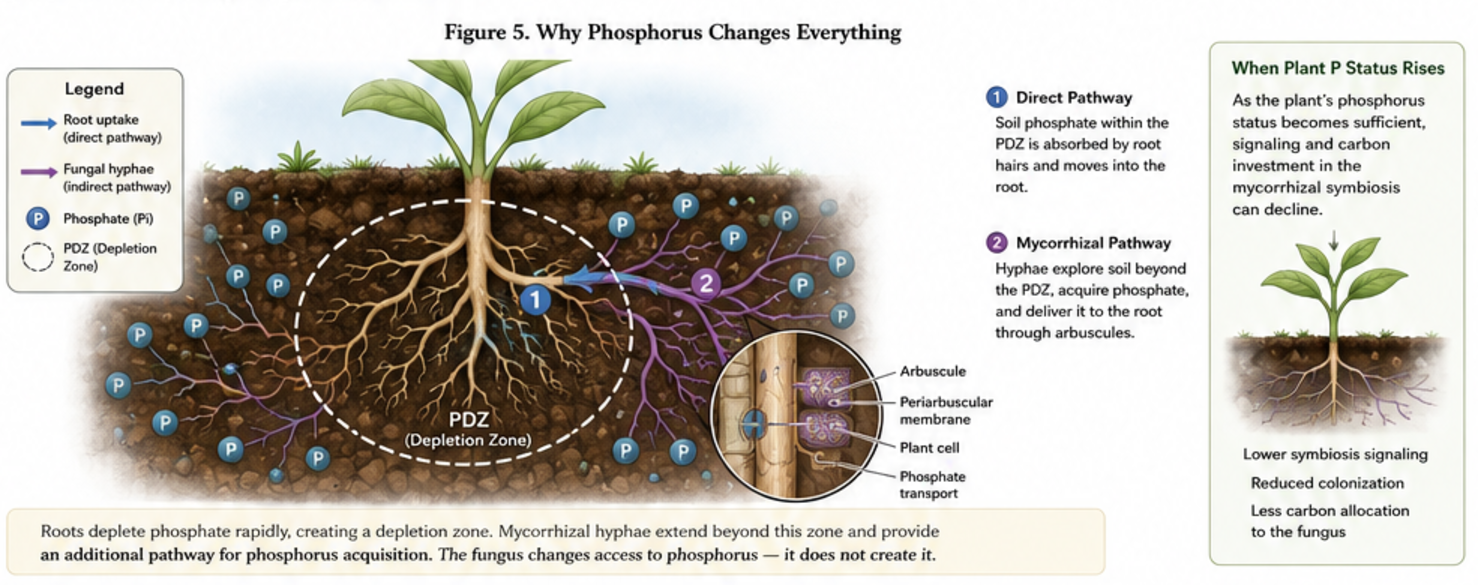
Diagram showing a phosphorus depletion zone around plant roots, direct root uptake within the zone, and mycorrhizal hyphae extending beyond it to acquire phosphate and deliver it through arbuscules, with reduced symbiosis as plant phosphorus status rises.
What Every Grower Should Remember
Phosphorus is the nutrient that most clearly reveals the logic of mycorrhizal symbiosis.
Roots are effective phosphorus-acquisition organs, but their influence is concentrated near their surfaces. Phosphate is often replenished too slowly to keep pace with uptake, creating depletion zones around active roots.
Mycorrhizal fungi overcome part of that spatial limitation by extending a much finer absorbing network into soil beyond the root’s immediate reach.
That service can be extremely valuable when phosphorus acquisition limits the crop.
It can be much less valuable when direct phosphorus supply is already adequate.
And that is why neither of these statements is scientifically defensible:
“Mycorrhizae eliminate the need for phosphorus fertility.”
or
“If phosphorus is present in the soil, mycorrhizae have no value.”
The truth is more useful.
Mycorrhizae alter the pathway by which a plant acquires phosphorus. Whether that pathway improves crop performance depends on phosphorus availability, plant demand, fungal function, native biology, and the other factors limiting growth.
Chapter 6 — Fact Versus Fiction
What does the evidence actually support?
Mycorrhizae are unusual in agriculture because the underlying biology is both genuinely remarkable and easy to oversell.
A fungal network can extend the effective reach of roots. Arbuscular mycorrhizal fungi can supply phosphorus that roots would otherwise have difficulty reaching. Mycorrhizal plants can perform better under some forms of drought stress. In some plant–fungus–pathogen combinations, disease severity can be reduced. Field inoculation can increase crop growth and yield.
All of those statements can be supported by scientific evidence.
The problem begins when can becomes will.
“Can improve phosphorus acquisition” becomes “replaces fertilizer.”
“Can improve drought performance” becomes “drought-proofs the crop.”
“Can increase yield” becomes “every field should be inoculated.”
“Fungal networks can connect plants” becomes “plants use an underground internet to deliberately feed and warn one another.”
Those are very different claims.
The purpose of this chapter is not to diminish the importance of mycorrhizae. It is to separate what is strongly established from what is conditional, exaggerated, unsupported, or false.
The evidence ratings used here follow The Organic Agronomist Research Standard:
Strong Evidence — supported by scientific consensus, meta-analyses, major reviews, or multiple independent studies.
Moderate Evidence — supported by a meaningful body of research, but strongly dependent on crop, fungus, environment, or management.
Limited Evidence — plausible and supported in some systems, but not established broadly enough for a general agronomic claim.
Unsupported — available evidence does not justify the claim as stated.
False — the claim conflicts with established biology or available evidence.
The verdict applies to the claim as stated. A false marketing statement may still contain a smaller scientific truth inside it.
Claim 1 — “Mycorrhizae are a fertilizer.”
Verdict: False
A fertilizer adds one or more plant nutrients to the production system. A mycorrhizal fungus does something different: it acquires nutrients already present in the soil environment and transports some of those nutrients to its host plant.
That distinction matters.
Arbuscular mycorrhizal fungi are particularly important in phosphorus acquisition because their fine external hyphae explore soil beyond the immediate root surface and beyond phosphorus depletion zones. They can also contribute to acquisition of nitrogen, zinc, copper, and other resources under certain conditions.
But the fungus does not manufacture phosphorus. It does not create zinc. It does not create nitrogen unless another biological process has first introduced or transformed nitrogen into a form that can be acquired.
A severely phosphorus-deficient field does not become adequately supplied simply because more fungal spores are added.
The fungus can improve access to a nutrient pool. It cannot create a nutrient pool that does not exist.
What the claim gets right
Mycorrhizae can improve nutrient-use efficiency. In some production systems, improved nutrient acquisition may allow a crop to perform adequately with less external fertilizer than a comparable non-mycorrhizal treatment.
That is very different from saying mycorrhizae replace fertilizer.
Practical interpretation
Think of mycorrhizae as part of the crop’s nutrient-acquisition system, not as a nutrient source.
Claim 2 — “Mycorrhizae improve phosphorus uptake.”
Verdict: Strong Evidence
This is the central nutritional function of arbuscular mycorrhizal symbiosis and one of the strongest conclusions in the entire mycorrhizal literature.
Plants capable of forming arbuscular mycorrhizae can acquire phosphorus through two pathways:
The direct root pathway, through the root epidermis and root hairs.
The mycorrhizal pathway, in which external fungal hyphae acquire phosphate from soil and deliver it through arbuscules to root cortical cells.
Classic physiological studies demonstrated something even more important: the mycorrhizal pathway can become a dominant route of phosphorus supply even when the plant shows little or no visible growth response.
That means an absence of additional biomass does not prove that the fungus is inactive.
It also means phosphorus uptake and yield response must not be treated as the same measurement.
What growers should remember
The strongest agronomic case for mycorrhizae remains improved access to relatively immobile phosphorus—not a universal increase in every nutrient under every field condition.
Claim 3 — “Every crop benefits from mycorrhizae.”
Verdict: False
Most vascular plant species form some type of mycorrhizal association, but not all plants form arbuscular mycorrhizae.
Global analyses estimate that roughly 72 percent of vascular plant species are arbuscular mycorrhizal, while additional groups form ectomycorrhizal, ericoid, or orchid associations. A meaningful minority are nonmycorrhizal or inconsistently mycorrhizal.
Important agricultural non-host or weak-host groups include many members of:
Brassicaceae — broccoli, cabbage, cauliflower, kale, mustard, canola.
Amaranthaceae/Chenopodiaceae — including beets, spinach, and related crops.
Several other plant families in which functional arbuscular mycorrhizal associations are absent or inconsistent.
Researchers occasionally observe fungal hyphae or vesicle-like structures in roots considered nonmycorrhizal. That observation does not automatically establish a functional nutrient-exchange symbiosis. Arbuscules—the primary exchange structures—are typically absent or rare in these non-host interactions.
The mistake behind the myth
A product containing an arbuscular mycorrhizal fungus may be biologically active and still be irrelevant to a crop that does not form the appropriate symbiosis.
Crop biology comes before inoculant selection.
Claim 4 — “More root colonization means more yield.”
Verdict: False
Colonization is useful information, but it is not a yield meter.
This is one of the most important conclusions from both physiological studies and recent field trials.
Smith, Smith, and Jakobsen showed that mycorrhizal fungi can dominate phosphorus supply without producing a corresponding growth response. More recently, a 54-field maize study in Switzerland found that establishment of the inoculated fungus and total root colonization did not explain the variation in crop growth response.
The introduced fungus established in some fields without producing a meaningful benefit. Across the study, maize responses ranged from negative to strongly positive.
Why?
Because colonization answers only one question:
Is the fungus in the root?
Yield requires several additional questions:
Is the fungus functioning?
What resources is it supplying?
Are those resources actually limiting the crop?
What is the carbon cost to the plant?
Is another factor controlling yield?
Does the biological effect persist long enough to influence harvestable production?
Practical interpretation
A colonization assay can confirm biological establishment. It cannot, by itself, prove agronomic or economic value.
Claim 5 — “If a mycorrhizal inoculant is applied, yield will increase.”
Verdict: False
Meta-analyses show that AMF inoculation can increase plant biomass, nutrient acquisition, and crop yield on average. That biological potential is real.
But averages are not guarantees.
A 2024 meta-analysis compiling 187 studies found overall positive effects of AMF inoculation on biomass and nitrogen and phosphorus nutrition. The same analysis also showed substantial variation with plant type, fungal treatment, nutrient conditions, water availability, and whether experiments were performed in the laboratory or field. Effects were generally stronger in controlled experiments than in field conditions.
The 54-field Swiss maize trial makes the variability especially clear. Growth response ranged from approximately -12 percent to +40 percent. Significant positive responses occurred in about one-quarter of the fields, while two fields showed significant negative responses.
A positive average response therefore means:
The biological potential is real.
It does not mean:
Every grower should expect the average response.
Research Spotlight — When field context mattered more than establishment
Lutz and colleagues inoculated maize in 54 working agricultural fields and measured soil chemistry, soil biology, native fungal communities, colonization, and crop response. The introduced fungus often established successfully, but establishment itself did not predict crop response. Soil microbiome indicators explained far more of the variation.
Why this matters: Successful inoculation is not simply a question of whether the fungus survives. The organism enters an existing ecological system, and that system helps determine whether inoculation creates additional value.
Claim 6 — “More spores or a higher inoculant rate always gives a bigger response.”
Verdict: Unsupported
This claim applies fertilizer logic to a biological organism.
With many fertilizers, increasing the amount applied increases nutrient supply until another limitation or toxicity threshold is reached. Mycorrhizal inoculation does not behave that simply.
The outcome depends on far more than propagule count:
Whether propagules are viable
Whether they reach a compatible host root
Fungal identity and functional traits
Competition with resident fungi
Soil phosphorus status
Crop genotype
Moisture and temperature
Timing and placement
Whether the resulting colonization provides a useful function
Research on commercial products has also shown that label claims, spore counts, infectivity, and crop response do not necessarily track together. A 2022 global evaluation of 28 commercial inoculants found that many products failed to establish effective colonization under test conditions. A 2024 assessment of 23 commercial products likewise reported large differences in viable fungal activity and crop response. A 2025 meta-analysis concluded that research-grade inocula generally outperformed globally sourced commercial products in the studies that met its inclusion criteria.
None of this proves that higher rates never help. It shows that dose alone is a poor universal predictor of benefit.
Chapter 7 will examine inoculant quality and purchasing decisions in detail.
Claim 7 — “Mycorrhizae drought-proof crops.”
Verdict: False as stated; Strong Evidence for improved drought response under some conditions
This is a good example of a real scientific effect becoming an unrealistic marketing promise.
Meta-analyses have found that mycorrhizal inoculation can improve biomass, root traits, nutrient uptake, water relations, and several physiological measures in plants subjected to drought. A 2022 meta-analysis found overall positive effects of AMF inoculation on plant growth and nutrient acquisition under drought stress, with particularly strong effects on phosphorus uptake.
But the size of the response changed with drought intensity, crop, and fungal identity.
Mycorrhizae cannot supply water that is not present. They cannot prevent stomatal closure indefinitely. They cannot make a crop immune to hydraulic failure, extreme heat, insufficient irrigation capacity, or prolonged severe drought.
What they can sometimes do is improve the plant’s ability to exploit available soil resources and maintain function under water limitation.
Better wording
Not:
Mycorrhizae make crops drought resistant.
But:
Mycorrhizal symbiosis can improve drought performance in some crop–fungus–soil combinations, especially where improved nutrient acquisition and root–soil exploration matter.
Claim 8 — “Mycorrhizae protect plants from disease.”
Verdict: Strong Evidence for suppression of some pathogens; not universal disease control
Mycorrhizal pathogen protection is more than a marketing invention.
A meta-analysis based on 106 studies found substantial average suppression of fungal pathogens and plant-parasitic nematodes in mycorrhizal plants. Later syntheses have also supported improved plant performance in the presence of biotic stressors.
Several mechanisms may contribute:
Improved plant nutrition and vigor
Competition for root infection sites or host-derived carbon
Changes in root exudation
Induced or primed plant defenses
Changes in the broader rhizosphere microbial community
But fungal identity matters. Host identity matters. Pathogen identity and environmental conditions matter.
A mycorrhizal inoculant is therefore not a general-purpose fungicide or nematicide.
It should not replace disease diagnosis, sanitation, resistant genetics, crop rotation, irrigation management, or other established components of an integrated disease-management program.
What the evidence supports
Mycorrhizal symbiosis can contribute to disease suppression.
It does not guarantee disease prevention.
Claim 9 — “Phosphorus kills mycorrhizae.”
Verdict: False
This statement is memorable, simple, and biologically misleading.
As discussed in Chapter 5, the plant regulates mycorrhizal symbiosis partly according to its phosphorus status. High phosphate status suppresses the phosphate-starvation signaling network that helps promote arbuscular mycorrhizal colonization and function.
Work in rice has demonstrated a direct regulatory connection between the plant’s phosphate-starvation response and mycorrhizal development. At higher phosphate status, colonization can decline dramatically.
That is not the same as phosphorus acting as a fungicide.
The response depends on:
The plant’s phosphorus status
Soil phosphorus availability rather than simply total soil phosphorus
Crop species and genotype
Fungal community
Fertilizer rate and placement
Other environmental conditions
Better wording
High phosphorus availability can reduce the plant’s investment in arbuscular mycorrhizal symbiosis because the direct root pathway becomes more competitive.
That explanation is less dramatic than “phosphorus kills mycorrhizae,” but it is much closer to the actual biology.
Claim 10 — “Healthy soils already have mycorrhizae, so inoculants are never needed.”
Verdict: Unsupported as a universal rule
The first half is often true. The second half does not follow automatically.
Many established agricultural soils contain native arbuscular mycorrhizal communities. In some field studies, uninoculated controls already show substantial root colonization. Management systems with compatible host crops and reduced disturbance can support those communities over time.
That means growers should not assume that a field is biologically empty until a product is added.
But native presence does not guarantee that the resident community is:
Abundant enough
Functionally effective for the crop
Compatible with current management
Recovering from fumigation or severe disturbance
Positioned close enough to new roots during establishment
Capable of providing the particular function a grower is trying to improve
Conversely, introduced fungi are not automatically superior simply because they came from a package.
The correct question is not:
“Native or commercial?”
It is:
“What is already functioning in this field, what limitation are we trying to overcome, and is an introduced organism likely to add a function that is currently missing?”
That is the question Chapter 7 will answer.
Claim 11 — “The fungal network is an underground internet where plants deliberately talk to and feed one another.”
Verdict: Limited Evidence for broad communication claims; Strong Evidence that fungal networks and some resource transfer exist
This is one of the most compelling stories in modern popular ecology, and it requires unusually careful language.
Mycorrhizal fungi can form networks that associate with more than one plant. Experimental studies have detected movement of carbon, nutrients, and defense-related signals in systems where plants share fungal connections.
Those observations are scientifically interesting.
What remains much harder to demonstrate is the larger narrative often built around them: that plants routinely use fungal networks as intentional communication systems, that older plants deliberately feed weaker neighbors, or that net resource transfer commonly improves the fitness of recipient plants in natural systems.
Recent critical reviews have argued that some popular descriptions of common mycorrhizal networks exceed the strength of the underlying evidence, particularly in forests. Other researchers point to mycoheterotrophic plants and experimental transfer studies as strong evidence that functional transfers through shared fungi can occur.
Both points can be true:
Networks and transfers are real.
The ecological meaning of those transfers is not always what popular descriptions imply.
For an agricultural reference, there is no need to solve that broader ecological debate.
The practical message is simpler:
Do not confuse evidence of transfer with evidence of intention, generosity, or guaranteed benefit to neighboring crops.
The Fact Versus Fiction Scorecard
| Statement | Evidence Rating | What the Evidence Supports |
|---|---|---|
| Mycorrhizae are a fertilizer | False | They improve access to existing nutrient pools; they do not manufacture nutrients. |
| AM fungi improve phosphorus acquisition | Strong Evidence | Phosphorus transport is a central, well-established function of the symbiosis. |
| Every crop benefits from AM fungi | False | Many crops are hosts, but important non-host groups exist. |
| More colonization guarantees more yield | False | Colonization confirms presence, not agronomic profitability. |
| Applying an inoculant guarantees higher yield | False | Mean responses can be positive, but field outcomes range from negative to strongly positive. |
| Higher inoculant rates always give larger responses | Unsupported | Viability, strain, host, soil, placement, native fungi, and function matter more than dose alone. |
| AM fungi can improve drought performance | Strong Evidence, Context-Dependent | Benefits occur across many studies, but drought tolerance is not immunity to water shortage. |
| AM fungi can suppress some pathogens | Strong Evidence, Context-Dependent | Disease and nematode suppression occur, but effects vary by fungus, host, pathogen, and environment. |
| Phosphorus kills mycorrhizae | False | High plant phosphorus status can suppress symbiosis; phosphorus is not simply a fungicide. |
| Healthy soils never need inoculation | Unsupported | Native fungi are common, but whether they are sufficient is site- and crop-specific. |
| Mycorrhizal networks prove plants deliberately feed and warn one another | Limited Evidence as stated | Networks and some transfers occur; broad claims of intention and recipient benefit remain debated. |
Research Spotlight — Positive averages can hide negative fields
Meta-analysis is powerful because it combines many studies and estimates an average response. But an average can conceal enormous field-to-field variation.
Wu, Chen, and Wang's 2024 synthesis of 187 studies found significant average increases in plant biomass and nutrient acquisition following AMF inoculation. Yet field responses were smaller and more variable than laboratory responses.
Lutz and colleagues then demonstrated the same problem at farm scale: across 54 maize fields, the same inoculation strategy produced responses ranging from approximately -12 percent to +40 percent.
These findings are not contradictory.
They illustrate the difference between two questions:
Can AMF inoculation benefit crops? — Yes.
Will AMF inoculation benefit this field? — That requires field-specific information.
Why this matters: Agronomy happens in individual fields, not in statistical averages.
Why So Many Myths Persist
Most mycorrhizal myths survive because they are built around an observation that is partly true.
Mycorrhizae improve phosphorus acquisition.
Mycorrhizae can increase yield.
Mycorrhizae can improve drought performance.
Mycorrhizae can suppress some pathogens.
Mycorrhizal networks can connect plants.
Those are scientifically interesting facts.
Marketing becomes misleading when the conditions disappear from the sentence.
Scientific language tends to say:
under these conditions in this crop with this fungal isolate at this nutrient status on average in this experiment
Marketing language tends to remove those qualifiers.
That makes the claim easier to sell and harder to defend.
The Organic Agronomist takes the opposite approach.
The qualifiers stay.
They are not weaknesses in the science. They are the information a grower needs to make a good decision.
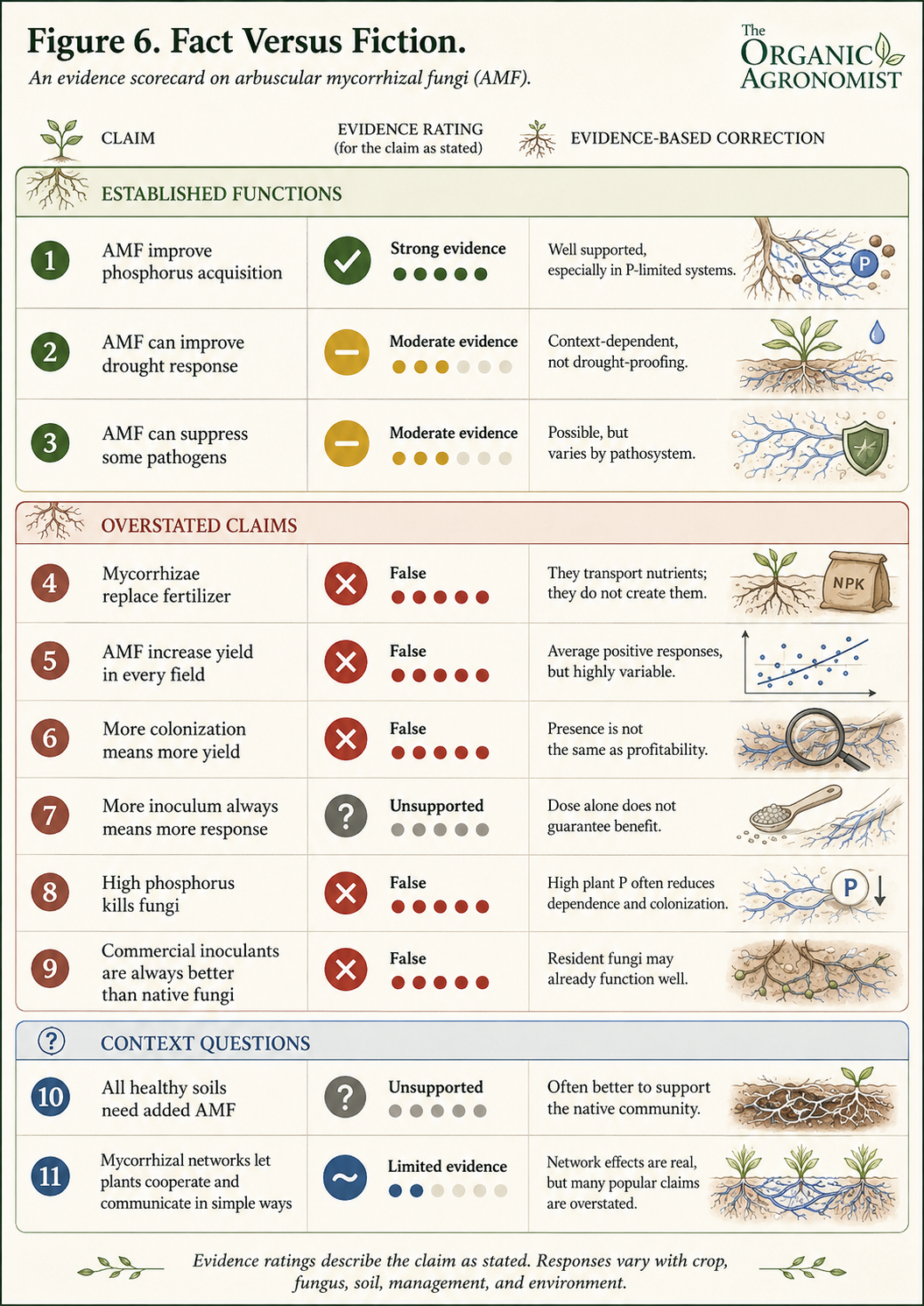
“Evidence scorecard comparing established functions, overstated claims, and context-dependent questions about arbuscular mycorrhizal fungi, including phosphorus acquisition, drought response, pathogen suppression, yield, inoculant use, phosphorus effects, and fungal networks.”
What Every Grower Should Remember
Mycorrhizae are neither a miracle nor a myth.
They are a biological partnership with well-established functions and highly context-dependent outcomes.
The most defensible conclusions are straightforward:
Arbuscular mycorrhizal fungi are important phosphorus-acquisition partners for many crops.
They can improve plant performance, including yield, under appropriate conditions.
They can contribute to drought tolerance and pathogen suppression, but those benefits are not universal.
Root colonization proves that a fungus is present; it does not prove that the crop made money from the partnership.
Native fungi are common in agricultural soils, and introduced fungi must compete and interact with those existing communities.
Commercial inoculants vary in viability and effectiveness.
No inoculant should be evaluated independently of crop biology, field history, fertility, soil biology, and the specific problem the grower is trying to solve.
Chapter 7 — Should You Buy a Mycorrhizal Inoculant?
The right question is not “Do mycorrhizae work?”
A grower standing in front of a mycorrhizal product is usually being asked to make a simple decision: buy it or do not buy it.
The biology is not that simple.
Arbuscular mycorrhizal fungi are real. Their ability to colonize roots, extend soil exploration, and contribute to phosphorus acquisition is supported by a very large scientific literature. Field experiments also show that introduced fungi can improve crop growth or yield under some conditions.
But none of those statements proves that a particular field needs inoculation, that a particular commercial product contains viable and effective propagules, or that the introduced fungus will outperform the community already living in the soil.
That distinction is the heart of this chapter.
Before asking which inoculant to buy, ask what biological or agronomic problem the inoculant is expected to solve.
If there is no defined problem, there is no rational way to judge whether the product solved it.
A mycorrhizal inoculant should therefore be treated like any other agronomic input: it should have a purpose, a plausible mechanism, a measurable outcome, and an economic standard for success.
In Most Fields, the Choice Is Not Fungi Versus No Fungi
The marketing image of inoculation often suggests an empty root system waiting for beneficial fungi to arrive.
That may be true in sterilized potting media, newly constructed soils, fumigated systems, mine spoils, or other severely disturbed environments.
It is often not true in an established agricultural field.
Many agricultural soils already contain resident arbuscular mycorrhizal fungi. In a global evaluation of commercial products, non-inoculated field soils already produced substantial mycorrhizal root colonization in tomato, soybean, and leek. In the North American portion of that work, soybean roots in non-inoculated soil were already about half colonized.
That changes the decision.
The grower is often choosing among three strategies:
Rely on the resident mycorrhizal community.
Manage the field to protect and strengthen that resident community.
Introduce an inoculant because there is a specific reason to believe the existing community is absent, depleted, poorly matched, or not providing the desired function.
Those are very different strategies.
The third should not automatically replace the first two.
Native Does Not Mean Perfect — and Commercial Does Not Mean Better
It is tempting to turn this into another simple rule:
Native fungi are better than commercial fungi.
The evidence does not support that universal claim either.
Resident fungi have one obvious advantage: they have already survived the soil, climate, cropping history, nutrient regime, competitors, and disturbances of that field. A locally adapted community may therefore be well matched to the environment.
But resident fungi are not automatically the most beneficial partners for every crop or management goal. Agricultural disturbance can reduce abundance or diversity. A resident community may be dominated by fungi that colonize effectively but provide limited benefit to a particular crop. A selected introduced strain can sometimes establish and improve crop performance.
Field work with soybean and cotton, for example, demonstrated that an introduced Rhizophagus clarus isolate could compete in soils already containing indigenous AM fungi and improve nutrient uptake and yield under the tested conditions.
The correct conclusion is more useful:
The question is not whether native or commercial fungi are inherently superior. The question is whether an introduced fungus adds a useful function that the resident community is not already providing.
That function must be demonstrated in the field, not assumed from the label.
Research Spotlight — 54 Fields, One Inoculant, Very Different Outcomes
Lutz and colleagues tested an arbuscular mycorrhizal inoculant in 54 commercial maize fields in northern Switzerland over three years.
The results should change how growers think about biological inoculants.
Growth responses ranged from approximately -12% to +40%. Fourteen fields showed significant positive responses of roughly 12% to 40%, while two fields showed significant negative responses. Most fields fell between those extremes.
Even more important, establishment of the inoculated fungus did not explain the growth response. The introduced strain established strongly in some fields that showed little benefit, and establishment varied widely among sites.
The soil fungal community was more informative. A combination of soil microbiome indicators and soil properties explained much of the variation in crop response in that study.
Why this matters to growers: A viable fungus can colonize a crop and still fail to produce an agronomically useful response. Field context matters as much as the organism being applied.
This leads to one of the most important rules in this reference:
Establishment is not efficacy.
When Inoculation Has the Strongest Biological Rationale
There are situations where adding mycorrhizal fungi makes much more sense than in a healthy, continuously cropped field.
1. Sterilized or nearly sterile growing media
Greenhouse substrates, propagation media, and other systems that have been sterilized or manufactured from components with little biological inoculum may have few or no functioning AM fungal propagules.
Here the biological question is straightforward: a compatible host cannot form a mycorrhizal partnership if an appropriate fungus is absent.
2. Fumigated or biologically disrupted soil
Soil fumigation can greatly alter microbial communities. Where AM fungal propagules have been substantially reduced, reintroduction may be biologically reasonable.
That does not guarantee yield response, but it removes one of the biggest sources of redundancy: a strong resident community.
3. Severely disturbed or reconstructed soils
Mine reclamation, construction sites, topsoil replacement, erosion-damaged fields, and other severely disturbed systems may have low biological continuity and weak fungal networks.
In these settings inoculation can be part of rebuilding a functioning plant-soil system.
4. Containerized perennial crops and transplant production
Where young plants are established in a biologically simplified medium before moving to the field, early colonization may be useful if the crop is strongly mycorrhizal and the inoculant is compatible.
The potential value here may be establishment rather than immediate yield.
5. Fields with reason to suspect weak native AMF function
Long non-host rotations, long fallow periods, repeated severe disturbance, or other practices that interrupt host continuity can reduce mycorrhizal propagule pressure or alter community structure.
This is a more complicated category because “low native function” is not easy to diagnose from a routine soil test. It is still a more defensible reason to investigate inoculation than simply assuming every field needs more fungi.
When Inoculation Has a Weak Rationale
The opposite situations should make a grower cautious.
A biologically active field with continuous host crops
If host crops have been growing successfully and roots already encounter a functioning resident AM fungal community, an inoculant has to do more than merely colonize. It must outperform or complement what is already there.
A crop that does not form the targeted mycorrhizal association
No product can override basic host biology. Brassicas and several other crop groups generally do not form normal arbuscular mycorrhizal associations. Applying an AMF inoculant to a non-host crop is therefore difficult to justify as a direct crop inoculation strategy.
A field where phosphorus is already readily available
As Chapter 5 explained, the value of the mycorrhizal phosphorus pathway declines when the crop can obtain sufficient phosphorus directly. This does not mean all high-phosphorus fields are non-mycorrhizal. It means the economic case for buying an additional phosphorus-acquisition partner is weaker when phosphorus acquisition is not limiting.
A field with no defined response to measure
“Improve soil biology” is not specific enough.
What is the desired outcome?
Earlier phosphorus acquisition?
Improved transplant establishment?
Better growth in a disturbed soil?
Greater nutrient uptake under low-input conditions?
Increased marketable yield?
Without a defined outcome, almost any result can be called a success after the fact.
Product Quality Is a Real Agronomic Variable
Even when inoculation makes biological sense, the product itself can still fail.
Arbuscular mycorrhizal fungi are living organisms. A commercial product must survive production, formulation, storage, transportation, handling, and field application before it ever reaches a root.
Two large product evaluations make this point difficult to ignore.
A 2022 global evaluation tested 28 commercial AMF inoculants across Australia, Europe, and North America. In sterilized soil — conditions that remove competition from native AM fungi and should make viable inoculum easier to detect — 84% of the tested commercial treatments failed to produce mycorrhizal root colonization. Laboratory cultures used as positive controls colonized strongly.
A separate 2024 study evaluated 23 commercial mycorrhizal inoculants and reported large discrepancies between stated propagule information and measured spores, poor colonization by many products, contamination with fungal plant pathogens in some products, and limited crop-growth benefit after fertilizer effects were controlled.
These studies do not prove that all commercial inoculants are poor quality.
They prove something more practical:
A grower cannot infer viability or efficacy merely from the fact that a product is commercially available.
That should influence purchasing decisions.
What Should a Grower Ask Before Buying?
A useful product evaluation begins before the product is opened.
1. What exactly is in the product?
Look for meaningful identification of the AM fungi rather than only the word “mycorrhizae.”
Species or strain information does not guarantee performance, but it makes the product more scientifically interpretable and makes independent research easier to evaluate.
2. How is viable inoculum quantified?
Ask what the stated propagule number represents and how viability or infectivity is determined.
Spore counts, colonized root fragments, hyphae, and infective propagule assays are not interchangeable measurements.
A large number printed on a label is useful only if the measurement has biological meaning.
3. What are the storage requirements and shelf life?
The fungi must remain viable until application.
Heat, time, moisture, formulation, and storage conditions can influence living inoculum. A grower should know how the product is supposed to be stored and whether the supplier supports its viability through the stated shelf life.
4. Has this product been tested on the crop you grow?
A positive trial on one plant species does not establish efficacy on another.
Host genotype, fungal identity, soil, nutrient status, and climate can alter the response.
5. Has it been tested in soil similar to yours?
A greenhouse trial in sterilized substrate answers a different question than a replicated field trial in biologically active agricultural soil.
Both have value. They should not be treated as equivalent evidence.
6. Was the comparison fair?
Some microbial products contain fertilizers or other biologically active ingredients in addition to fungi. A good efficacy trial should allow the fungal contribution to be separated from nutrients or other formulation effects whenever possible.
7. What outcome improved?
Colonization?
Tissue phosphorus?
Biomass?
Marketable yield?
Quality?
Stress tolerance?
Those are different endpoints.
For a commercial farm, the final question is usually economic.
8. Is there independent evidence?
Supplier trials can be useful, but independent replicated research greatly strengthens confidence.
The more expensive or operationally disruptive the treatment, the stronger the evidence should be.
| Evidence | What It Establishes | Value to a Grower |
|---|---|---|
| Product contains a named fungus | Identity claim | Low by itself |
| Viability/infectivity assay | Living inoculum can colonize a host | Necessary but insufficient |
| Greenhouse trial in sterile media | Biological potential | Moderate |
| Greenhouse trial in field soil | Performance with microbial competition | Better |
| Replicated field trial | Agronomic response under field conditions | High |
| Multi-site / multi-year field trials | Repeatability and context | Very high |
| On-farm strip trial in your field | Local economic response | Highest practical relevance |
The ladder does not mean a grower must have every level before trying a product.
It means confidence should increase as evidence moves closer to the grower’s actual production system.
The Best Test May Be on Your Own Farm
When the research is promising but local uncertainty remains, a small replicated field comparison is often more informative than a full-field application.
The objective is not to conduct a university experiment. It is to avoid confusing normal field variation with product response.
A useful on-farm test should, when practical:
Compare inoculated and non-inoculated areas under the same fertility and irrigation program.
Repeat the comparison in several strips or blocks rather than using one treated side of the field and one untreated side.
Keep all other inputs as similar as possible.
Measure the outcome chosen before the trial begins.
Evaluate marketable yield or another economically meaningful endpoint, not appearance alone.
Repeat in another season if the first result is close to break-even.
If inoculation is inexpensive and easy to apply, a modest response may justify adoption.
If it is costly, difficult to handle, or requires changing the production system, the evidence threshold should be higher.
Research Spotlight — Commercial Products Are Not Interchangeable
Salomon and colleagues evaluated 28 commercial AMF inoculants in independent studies on three continents.
Under non-sterilized conditions, native AM fungi already colonized control plants, and commercial inoculation usually did not increase colonization. In sterilized soils, most commercial treatments failed to establish mycorrhizal colonization even though laboratory cultures of Rhizophagus irregularis colonized strongly.
Only a minority of treatments improved plant biomass.
The study is important not because it condemns commercial inoculation, but because it separates the potential of AM fungi from the performance of products sold as AM fungal inoculants.
Those are not the same question.
Why this matters to growers: A biologically sound concept can still be delivered by an ineffective product. Product quality must be evaluated independently from the underlying science of mycorrhizae.
Persistence: What Happens After Application?
Another overlooked question is whether an introduced fungus remains in the field after the crop season.
A three-year Saskatchewan study tracked a commercial Rhizophagus irregularis inoculant at four field sites. The introduced fungus persisted for different lengths of time depending on the site — through all three cropping seasons at some locations but for shorter periods at others.
The inoculation also altered parts of the indigenous AM fungal community, and those changes varied with soil environment.
A related multi-site Canadian study likewise found establishment of a commercial isolate to be strongly site-specific.
This matters for two reasons.
First, a product sold as a one-season input may behave like an ecological introduction rather than an inert fertilizer application.
Second, persistence is not automatically desirable or undesirable. A persistent beneficial strain could reduce the need for repeated application; an introduced strain could also alter resident communities in ways that are difficult to predict.
The science is not mature enough to turn this into a simple management rule.
It is mature enough to justify caution.
Introducing a living organism into soil is an ecological intervention, not merely an input application.
Could the Better Investment Be Management Instead of Inoculum?
Sometimes the best way to obtain more mycorrhizal function is not to add fungi.
It is to stop disrupting the fungi already present.
Research in organic vegetable systems in south Texas compared cover cropping, farm-produced indigenous inoculum, and commercial inoculum. The work showed that farm management could increase native AM fungal abundance and that indigenous inoculum could perform well under those local conditions.
The broader point is more important than any one trial.
Native AM fungal communities respond to management.
Practices that maintain compatible living roots, reduce unnecessary disturbance, diversify crop sequences, and avoid excessive nutrient conditions that reduce plant dependence on the symbiosis can help preserve the biological infrastructure already in the field.
This creates a useful economic comparison:
Option A: Purchase organisms repeatedly.
Option B: Manage the field so resident organisms can maintain themselves.
In some systems, both approaches may be useful.
But Option B should never be ignored simply because Option A comes in a bag, jug, or seed treatment.
Chapter 8 will examine those management practices in detail.
The Inoculant Decision Tree
A grower can reduce a complicated biological question to a disciplined sequence of decisions.
Step 1 — Is the crop an arbuscular mycorrhizal host?
No: Do not expect direct AMF inoculation to create a normal symbiosis in that crop.
Yes: Continue.
Step 2 — Is there a specific problem or goal?
Examples include weak colonization after fumigation, biologically simplified transplant media, degraded soil, poor early phosphorus acquisition, or a documented response in a similar production system.
No: The case for inoculation is weak.
Yes: Continue.
Step 3 — Is the resident community likely to be absent, depleted, or inadequate for that goal?
Evidence may come from management history, severe disturbance, sterilization, fumigation, research on the site, or carefully interpreted biological testing.
No / unknown: Protecting and managing the native community may be the better first strategy. Consider a small trial rather than full adoption.
Yes: Continue.
Step 4 — Is the proposed product demonstrably viable?
Look for credible infectivity or viability information, appropriate storage, and a realistic shelf life.
No / unclear: Do not assume efficacy.
Yes: Continue.
Step 5 — Is there relevant evidence for this crop and production environment?
No: Treat the application as an experiment, not an established recommendation.
Yes: Continue.
Step 6 — Is the expected response economically meaningful?
Consider product cost, application cost, operational complexity, expected yield or quality gain, and the probability of response.
No: Do not inoculate simply because the biology is interesting.
Yes: A replicated on-farm trial or targeted adoption is defensible.

“Decision tree for evaluating whether to use a mycorrhizal inoculant, including crop host status, agronomic need, native AMF function, product viability, crop and site evidence, and economic response.”
A Purchasing Checklist
Before committing acreage to a commercial AMF inoculant, a grower or adviser should be able to answer most of these questions:
Is my crop a host for the fungi in question?
What specific limitation am I trying to address?
Why do I believe the resident fungal community is insufficient?
What organism or organisms does the product contain?
How is viable or infective propagule content measured?
What are the storage and shelf-life requirements?
Has the product been tested on this crop?
Has it been tested in biologically active field soil?
Are there replicated field data?
Were fertilizer or carrier effects controlled in the comparison?
What outcome improved: colonization, nutrient uptake, biomass, marketable yield, or quality?
How large was the response?
How consistent was the response across sites or years?
What will the treatment cost per acre, including application?
What response is required to break even?
Can I test it first on a small replicated area?
If a supplier cannot answer the basic questions, that is useful information too.
What Not to Use as a Buying Decision
Several arguments sound persuasive but are weak evidence by themselves.
“Mycorrhizae are natural.”
True, but irrelevant to whether a particular product adds value in a particular field.
“The product has many species.”
Species count does not establish viability, compatibility, function, or field performance.
“The roots were heavily colonized.”
Colonization demonstrates biological presence, not economic return.
“The treated crop looked better.”
Without a fair comparison, normal field variability, fertilizer ingredients, irrigation differences, or other factors can create convincing visual differences.
“It worked for another grower.”
That is a reason to investigate, not proof that the response will transfer to a different crop, soil, climate, fertility program, or fungal community.
“It cannot hurt.”
Any purchased input has a financial cost, and introduced organisms can interact with resident communities. Field experiments have also documented neutral and negative crop responses under some conditions.
The correct standard is not “probably harmless.”
The correct standard is likely to provide enough value to justify the cost and uncertainty.
The Organic Agronomist Recommendation
Mycorrhizal inoculants should neither be dismissed nor applied automatically.
They are best treated as targeted biological tools.
The strongest case for inoculation occurs when:
The crop is a compatible host.
The production system has a credible reason for low or inadequate resident AMF function.
A specific limiting problem has been identified.
The inoculant is demonstrably viable.
Evidence exists for the crop and conditions being treated.
The expected response can justify the cost.
The weakest case occurs when a healthy, biologically active field with a long host-crop history is inoculated simply because mycorrhizae are beneficial organisms.
In that situation, the grower may be purchasing a biological function that is already present.
The most useful question is therefore not:
“Should every grower use mycorrhizae?”
It is:
“Where is added mycorrhizal function actually limiting crop performance?”
That question turns inoculation from a belief into an agronomic decision.
And it leads to the next chapter.
If the field already contains a valuable native fungal community, how should we manage the farm to keep that community functioning?
That is the subject of Chapter 8: Building Better Partnerships.
Chapter 8 — Building Better Partnerships
Managing the field so useful mycorrhizal fungi can persist and function
The most important mycorrhizal management decision may have nothing to do with buying fungi.
It may be deciding how to manage the fungi that are already there.
By the time a crop is planted into a biologically active agricultural soil, it is entering an ecosystem with a history. Previous crops, weeds, cover crops, tillage, phosphorus management, fallow periods, soil disturbance, irrigation, and past fumigation can all influence the amount and identity of arbuscular mycorrhizal fungal inoculum available to the next crop.
That history matters because arbuscular mycorrhizal fungi are not free-living fertilizer factories. They depend on living host plants for carbon. Their external hyphae can be physically disrupted. Their propagules can decline when suitable roots disappear for long periods. Their value to a plant can also decline when nutrients — especially phosphorus — are already readily available.
The practical goal, therefore, is not to maximize fungal colonization at any cost.
The goal is to create field conditions in which useful native mycorrhizal partnerships can form when the crop has something to gain from them.
That distinction keeps management focused on crop performance rather than biology for biology’s sake.
Start With the Native Community
A healthy agricultural soil may already contain a large reservoir of mycorrhizal inoculum. Spores, colonized root fragments, and living hyphae can all initiate colonization of a new compatible host.
This means that a grower does not begin every season from zero.
The native community has also been filtered by the local environment. It has survived the soil’s temperature regime, texture, pH, moisture cycles, crop history, and management practices. That does not guarantee that every resident fungus is highly beneficial to every crop, but it does mean the field is usually an existing biological marketplace rather than an empty container.
For that reason, the first management question should be:
What can I do to preserve or improve the function of the resident community?
Only after that question should the grower ask whether an introduced inoculant is necessary.
Chapter 7 established the purchasing logic. Chapter 8 deals with the other side of the equation: building conditions in which the biology already present has a chance to work.
Management Lever 1 — Keep Compatible Living Roots in the System
Arbuscular mycorrhizal fungi are obligate biotrophs. They depend on living host plants for the carbon required to maintain active symbiosis and complete their life cycle.
That makes periods without living roots biologically important.
A bare fallow does more than leave soil uncovered. It removes the carbon source that maintains an active host-fungus partnership. Spores and colonized root fragments may persist, but the active network is no longer being continually supported by a living crop.
Cover crops can shorten that biological interruption.
A 2017 meta-analysis of 54 field studies across five continents found that winter cover crops increased mycorrhizal colonization of subsequent summer cash-crop roots by about 29 percent compared with winter fallow. Less intensive tillage produced a similarly sized increase. The authors concluded that continuity of root associations can be at least as important as reducing soil disturbance.
A 2025 global meta-analysis reached a similar conclusion. Across 82 publications and 86 field studies, cover crops increased several indicators of AMF abundance relative to fallow, including root colonization, spore abundance, hyphal length density, and extraradical biomass.
Not every cover crop plays the same role
A cover crop that forms arbuscular mycorrhizae can directly support the fungal life cycle through its roots. Many grasses, cereals, and legumes are compatible hosts.
Members of the Brassicaceae — including crops such as mustard, canola, radish, and many brassica vegetables — are generally considered nonmycorrhizal or very weak hosts for arbuscular mycorrhizal fungi. They should not be assumed to maintain an AMF population in the same way that a strongly mycorrhizal grass or legume does.
This does not mean brassica cover crops are “bad” for soil biology. They can serve many other agronomic purposes, and the 2017 meta-analysis even found that non-host cover crops were sometimes followed by greater AMF colonization than bare fallow, showing that whole-system effects can be more complicated than a simple host/non-host label.
But if maintaining AMF continuity is a specific objective, it is reasonable to include at least one compatible host species in the rotation or cover-crop mixture when other agronomic goals allow it.
Management implication
Strong Evidence: Maintaining living roots with compatible host crops can help preserve mycorrhizal inoculum and increase colonization of a following host crop compared with extended bare fallow.
The practical principle is simple:
Do not leave a carbon-dependent symbiosis without a carbon source longer than necessary.
Research Spotlight — Cover Crops and Tillage Across Five Continents
Citation: Bowles, T.M., Jackson, L.E., Loeher, M., & Cavagnaro, T.R. (2017). Ecological intensification and arbuscular mycorrhizas: a meta-analysis of tillage and cover crop effects. Journal of Applied Ecology, 54, 1785–1793.
Principal finding: Across 54 field studies, winter cover cropping increased AMF colonization of subsequent cash-crop roots by approximately 28.5 percent relative to winter fallow. Lower-intensity tillage also increased colonization by roughly 30 percent. AMF taxon richness was about 11 percent greater under lower-intensity than conventional tillage.
Practical importance: Two different management levers — preserving living root continuity and reducing physical disturbance — can both support resident mycorrhizal communities. The study also showed that responses vary with cover-crop type, tillage system, soil texture, and other field conditions.
Management Lever 2 — Reduce Unnecessary Soil Disturbance
An arbuscular mycorrhizal fungus does not stop at the root surface.
Its external hyphae extend into soil and form a fine exploration network. Those hyphae can be severed when soil is inverted, aggressively mixed, or repeatedly disturbed.
That gives reduced-tillage systems an obvious biological advantage: more of the existing network can remain physically intact between crops.
But the relationship is not as simple as “tillage kills mycorrhizae.”
AMF survive through multiple propagules. Spores can remain in soil. Colonized root fragments can initiate new infections. Hyphal fragments may also remain viable under some conditions. Different fungal taxa vary in their sensitivity to disturbance, and soils differ in how quickly networks recover.
This explains why individual tillage studies do not always produce the same result.
A broad meta-analysis by Lekberg and Koide found that reduced soil disturbance increased mycorrhizal colonization on average, but the increase was smaller than the effect of inoculation or shortening fallow periods. Reduced disturbance also increased early shoot phosphorus concentration, while biomass response was less consistent.
The management lesson is therefore not that every tillage pass destroys the symbiosis.
It is that repeated unnecessary disturbance can make the fungus rebuild infrastructure that might otherwise have remained functional.
Practical approach
Where crop, weed, residue, compaction, and seedbed requirements allow:
Reduce the number of disruptive tillage passes.
Avoid deeper or more aggressive inversion than the agronomic problem requires.
Pair lower disturbance with living-root continuity when possible.
Evaluate tillage changes as part of a whole system rather than as a single soil-health metric.
A grower should not sacrifice crop establishment or weed control merely to maximize fungal colonization. The purpose of reduced disturbance is to protect useful biological infrastructure while still meeting the needs of the crop.
Management implication
Strong Evidence: Lower-intensity tillage generally increases AMF colonization and can alter AMF community composition, but the magnitude of the response varies among soils and systems.
Management Lever 3 — Avoid Unnecessarily Long Bare Fallow Periods
Long fallow provides one of the clearest demonstrations that mycorrhizal populations can become agronomically limiting.
The classic example comes from Australian agriculture, where “long fallow disorder” was associated with poor early phosphorus nutrition and weak growth in subsequent mycorrhiza-dependent crops. Research linked the disorder to declining viable mycorrhizal propagules during extended periods without suitable host plants.
This is important because it reverses the usual question.
Most growers ask whether too many fungi can hurt a crop.
Long fallow research asks what happens when there are too few functioning fungi at the moment a dependent crop needs them.
Lekberg and Koide’s meta-analysis found that shortened fallow increased colonization by about 20 percent across the studies they analyzed. Shortened fallow was also associated with increased early-season shoot phosphorus concentration and biomass in the studies where those outcomes were measured.
The effect is not universal. A crop with a strong root system in a phosphorus-sufficient soil may show little response to a temporary decline in AMF inoculum. Another crop in a low-phosphorus soil may respond strongly.
That is exactly what the carbon-for-nutrient model predicts.
Management implication
Strong Evidence: Extended periods without compatible hosts can reduce AMF inoculum potential and, under susceptible conditions, contribute to poor early phosphorus nutrition in a following crop.
Research Spotlight — When Fungal Abundance Becomes Limiting
Citation: Lekberg, Y., & Koide, R.T. (2005). Is plant performance limited by abundance of arbuscular mycorrhizal fungi? A meta-analysis of studies published between 1988 and 2003. New Phytologist, 168, 189–204.
Principal finding: Across 290 field and glasshouse trials, inoculation, shortened fallow, and reduced soil disturbance all increased mycorrhizal colonization. Increased colonization was less likely to improve plant biomass when soil phosphorus or indigenous inoculum potential was already high.
Practical importance: The study provides a useful rule for management: increasing mycorrhizae is most likely to matter where fungi or phosphorus acquisition are actually limiting. More colonization is not automatically better.
Management Lever 4 — Use Crop Rotation Intelligently
Crop rotation is often recommended as a general soil-health practice, but its mycorrhizal effects depend on what is being rotated.
A sequence of compatible host crops can maintain access to AMF partners through much of the year. A sequence containing a long non-host phase or bare fallow can interrupt that continuity.
At the same time, simply adding more crop species does not guarantee a larger or more beneficial fungal community.
The 2005 meta-analysis found that the effect of rotation depended on whether the crop in the rotation was mycorrhizal. The 2025 diversification meta-analysis found that cover crops and intercropping increased several measures of AMF abundance, while crop rotation by itself did not consistently increase AMF abundance and was associated with lower AMF richness in crop roots in the studies analyzed.
That result is a useful warning against slogans.
Diversity is not a magic input. The identity, timing, compatibility, and function of the plants in the sequence matter.
Practical approach
When AMF continuity is agronomically valuable:
Identify which cash crops in the rotation are strong AMF hosts.
Identify long windows without compatible roots.
Use cover crops or host crops to bridge those windows where practical.
Do not assume a non-host crop must be removed if it serves another important purpose; instead, manage the sequence so AMF-dependent crops are not repeatedly planted after long biological interruptions.
Management implication
Moderate to Strong Evidence: Cropping sequence affects AMF communities, but the response depends on host identity and management context. Cover cropping and intercropping currently have clearer global evidence for increasing AMF abundance than crop rotation alone.
Management Lever 5 — Manage Phosphorus for the Crop, Not for the Fungus
Chapter 5 established that plant phosphorus status strongly influences mycorrhizal demand.
That creates two equally unhelpful extremes.
The first is excessive phosphorus availability that reduces the plant’s incentive to maintain an expensive fungal pathway.
The second is deliberately starving the crop of phosphorus in an attempt to “force” mycorrhizae to work.
Neither is good agronomy.
The objective is not to create phosphorus deficiency. The objective is to manage phosphorus efficiently enough that the crop can meet its requirements without chronically maintaining nutrient conditions that make the fungal pathway biologically unnecessary.
This requires ordinary agronomic discipline:
Use appropriate soil and tissue testing.
Consider crop demand and yield goal.
Account for phosphorus already present in soil and organic amendments.
Avoid unnecessary accumulation of plant-available phosphorus.
Evaluate placement, timing, and source rather than treating every phosphorus application as biologically equivalent.
A mycorrhizal system should be allowed to contribute where it is useful. It should not be protected at the expense of crop nutrition.
Management implication
Strong Evidence: High plant phosphorus status can suppress AM symbiosis, and high soil phosphorus can reduce the probability that increased colonization will improve crop growth. There is no universal soil-test phosphorus threshold at which mycorrhizae suddenly stop functioning.
Management Lever 6 — Recognize Severe Biological Resets
Most agricultural disturbance does not sterilize soil.
Some disturbances come much closer.
Soil fumigation, sterilized growing media, major topsoil removal, extended bare fallow, severe erosion, and some land-reclamation situations can sharply reduce the amount of viable mycorrhizal inoculum available to a crop.
USDA Agricultural Research Service field work has shown that fumigation can directly reduce AMF infective propagules, while solarization can reduce propagules indirectly when weed hosts that had maintained fungi are removed.
These are the kinds of situations in which Chapter 7’s case for targeted inoculation becomes much stronger.
A grower dealing with an intact, biologically active field and a long history of compatible host crops is in a very different situation from a grower planting into fumigated soil, sterilized substrate, reconstructed soil, or land that has gone through a prolonged non-host period.
Recovery options may include:
- Re-establishing compatible host plants.
- Reducing further unnecessary disturbance during recovery.
- Allowing time for indigenous propagules to rebuild.
- Using a carefully selected inoculant when there is a defensible reason to believe native inoculum is inadequate.
- Testing crop response rather than assuming biological recovery from colonization alone.
Management implication
Strong Evidence: Severe disturbances such as fumigation can substantially reduce AMF propagules. These systems are more defensible candidates for inoculation or deliberate biological rebuilding than fields with an established host-crop history.
Management Lever 7 — Do Not Optimize One Organism at the Expense of the Farm
Mycorrhizae are one component of a larger soil ecosystem.
A field also contains bacteria, saprophytic fungi, nematodes, protozoa, arthropods, roots, residues, pathogens, predators, and organisms whose functions have barely been characterized.
The most mycorrhizal field is not automatically the most productive field.
The objective is a productive, resilient cropping system in which biological functions contribute to nutrient efficiency, soil structure, crop health, and long-term performance.
That means a management practice should not be judged solely by one fungal measurement.
For example:
A cover crop may be valuable for nitrogen capture, erosion control, compaction management, weed suppression, or habitat even if it is not the strongest AMF host.
Tillage may disrupt fungal hyphae but still be necessary in a particular organic weed-management program.
Phosphorus fertilizer may reduce colonization while correcting a yield-limiting deficiency.
A non-host crop may be economically or rotationally essential even if it temporarily interrupts AMF continuity.
Agronomy is the management of tradeoffs.
The correct question is not:
“Which practice creates the most mycorrhizae?”
It is:
“Which combination of practices creates the most functional and profitable cropping system, while preserving useful biological capacity whenever practical?”
That is a higher standard.
| Field Condition | Likely Implication for AMF | Practical Response |
|---|---|---|
| Frequent compatible host crops | Native inoculum often maintained | Protect and evaluate the resident community before inoculating. |
| Winter or off-season bare fallow | Loss of active host support | Consider a compatible cover crop where agronomically appropriate. |
| Repeated intensive soil disturbance | Greater disruption of external hyphae | Reduce unnecessary passes or intensity where crop management allows. |
| Long fallow or long non-host sequence | Lower inoculum potential may develop | Reintroduce compatible hosts; consider inoculation only if risk is credible. |
| High plant-available phosphorus | Lower plant dependence on fungal P pathway | Manage P for crop sufficiency and avoid unnecessary accumulation. |
| Low P plus an AMF-responsive crop | Greater potential value from fungal P acquisition | Preserve native AMF capacity and diagnose inoculum limitations before buying product. |
| Recently fumigated or sterilized soil | Native propagules may be sharply reduced | Stronger case for deliberate rebuilding and targeted inoculation. |
| Healthy soil with active native AMF | Added inoculum may be redundant | Prioritize management of existing biology. |
The table is deliberately framed around conditions, not prescriptions.
A grower cannot manage mycorrhizae independently of soil fertility, weeds, disease, crop value, water, labor, equipment, and rotation economics.
What Good Mycorrhizal Management Looks Like
Good management is usually less dramatic than product marketing.
It looks like:
Keeping suitable living roots in the soil when that fits the production system.
Avoiding unnecessary disturbance while still accomplishing agronomic objectives.
Preventing phosphorus accumulation beyond crop need.
Designing rotations with host continuity in mind.
Recognizing when a field has undergone a genuine biological reset.
Testing responses instead of assuming them.
Protecting native biological capacity before trying to replace it.
None of these practices guarantees a yield response from mycorrhizae.
That is not the point.
The point is to preserve the option value of the symbiosis.
When phosphorus becomes limiting, when roots encounter a dry zone, when a crop is establishing after stress, or when the direct root pathway cannot fully exploit the soil volume, a functioning native fungal community gives the plant another route through which resources may be acquired.
A field with no useful AMF cannot call on that pathway.
A field with a functioning community can — if the crop, soil, fungus, and environment make the trade worthwhile.
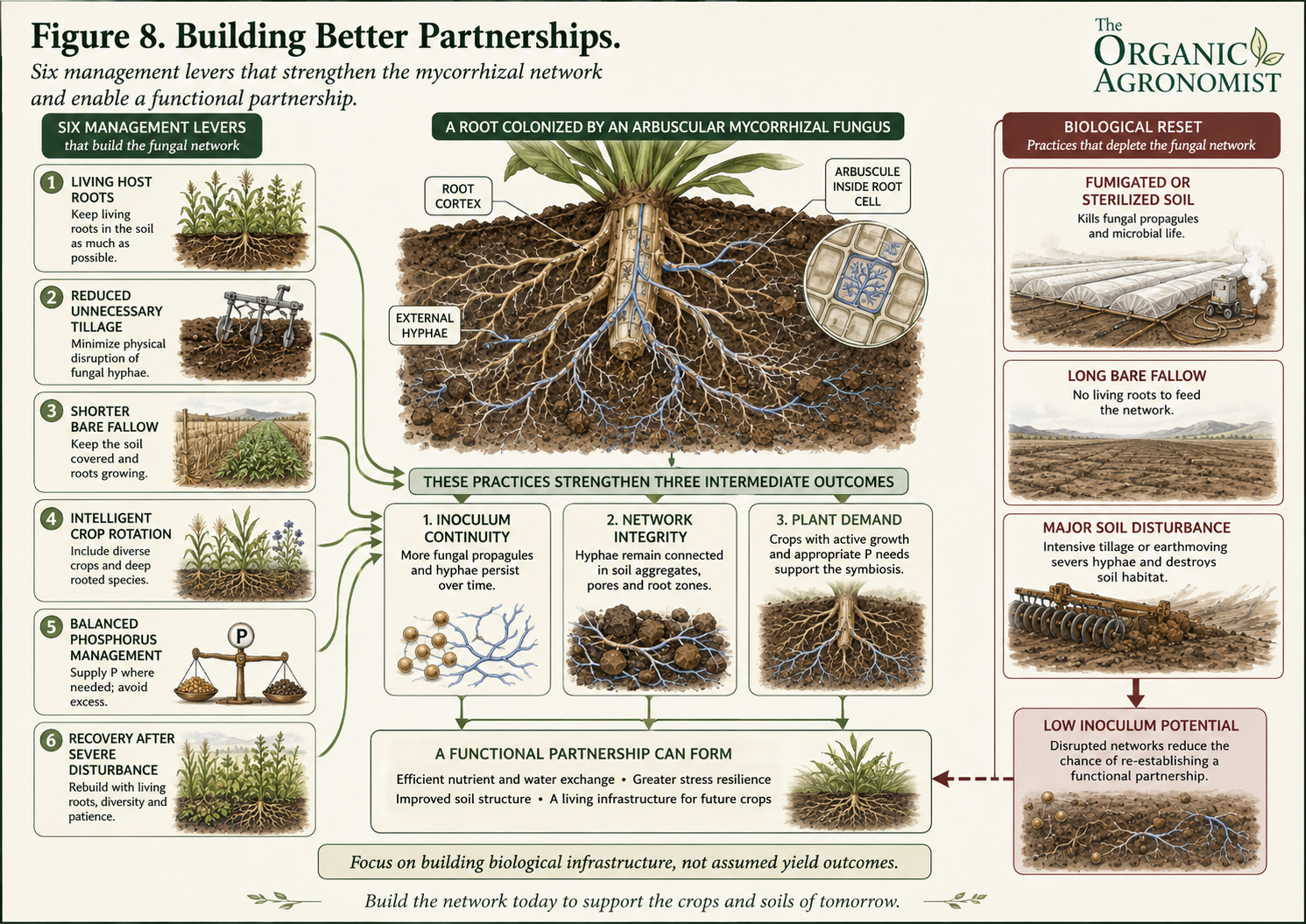
“Diagram showing six management practices that support arbuscular mycorrhizal fungi: living host roots, reduced unnecessary tillage, shorter bare fallow, intelligent crop rotation, balanced phosphorus management, and recovery after severe disturbance, contrasted with biological resets such as fumigation, long bare fallow, and major soil disturbance.”
What Every Grower Should Remember
The best mycorrhizal management program may never include a bag of inoculant.
It may simply preserve the biological infrastructure that the field already contains.
Three principles matter most:
Keep the partnership supplied with compatible living roots when practical. AMF depend on host carbon, and long periods without hosts can reduce inoculum potential.
Protect useful infrastructure without turning soil biology into a religion. Reduced disturbance can preserve hyphal networks, but tillage, fertility, and crop management still have to serve the farm.
Manage for function, not colonization. The objective is not the highest possible fungal count. The objective is a crop that can use the fungal pathway when that pathway provides a meaningful return.
That brings us to the final scientific question in this reference.
Chapter 9 — What We Know—and What We Still Don’t Know
The Science Is Stronger Than the Sales Pitch—and More Complicated
After more than a century of scientific study, mycorrhizae are no longer mysterious organisms at the edge of agricultural science.
We know that arbuscular mycorrhizal fungi form ancient symbioses with most terrestrial plant lineages. We know they acquire plant carbon and can deliver phosphorus and other resources through fungal pathways that extend beyond the immediate root surface. We know plants regulate the relationship. We know soil fertility, crop genetics, fungal identity, resident microbial communities, disturbance, and environment can all alter the outcome.
We also know something equally important:
Knowing how the partnership works does not mean we can predict its agronomic value in every field.
That distinction is where a responsible discussion of mycorrhizae should end.
The biology is real. The mechanisms are real. Many benefits are real. But field performance is conditional, and the conditions are still being mapped.
What We Know with High Confidence
1. Arbuscular mycorrhizal symbiosis is a normal part of plant biology
For most compatible plant species, interaction with arbuscular mycorrhizal fungi is not an exotic condition created by an inoculant. It is an ancient and widespread biological strategy.
The symbiosis predates modern agriculture by hundreds of millions of years. In agricultural soils, native AM fungal communities often already occupy the root zone and can colonize compatible crops without any commercial inoculation.
Evidence rating: Strong Evidence
2. The fungal nutrient-acquisition pathway is real and physiologically important
Mycorrhizal plants can acquire phosphorus through two pathways: direct uptake by the root and uptake through fungal hyphae followed by transfer across the symbiotic interface.
The mycorrhizal pathway can make a substantial contribution to plant phosphorus even when total plant growth does not increase. That finding changed an important assumption in mycorrhizal research: absence of a visible growth response does not mean the fungus was physiologically inactive.
Evidence rating: Strong Evidence
3. The plant pays for the service
AM fungi are obligate biotrophs. They depend on living hosts for carbon. Plants supply sugars and lipids that support fungal growth, respiration, external hyphae, reproductive structures, and nutrient acquisition.
This carbon cost is why the interaction should be understood as an exchange rather than a gift.
A partnership can be strongly beneficial, nearly neutral, or costly to the host depending on what the fungus returns and what resources are limiting plant performance.
Evidence rating: Strong Evidence
4. Phosphorus availability changes the value of the partnership
When phosphorus is difficult for the plant to acquire, fungal soil exploration can be highly valuable. When phosphorus is readily available to the root, the marginal value of fungal phosphorus acquisition usually declines, and plant regulation of the symbiosis changes accordingly.
There is no single universal soil-test phosphorus threshold at which mycorrhizae become useful or useless. The response depends on plant species, soil chemistry, phosphorus form and placement, fungal community, and other environmental conditions.
Evidence rating: Strong Evidence for the biological principle; field thresholds are context dependent.
5. Field response to inoculation is variable
This is one of the most important conclusions in the entire article.
Across field studies, AM fungal inoculation can increase colonization, nutrient uptake, biomass, or yield on average. But the range of outcomes is broad.
In a large on-farm maize experiment conducted across 54 Swiss fields, plant growth responses to the same inoculant ranged from approximately -12% to +40%. The introduced fungus could establish without necessarily producing a positive growth response.
The lesson is not that inoculation fails.
The lesson is that field context determines whether biological activity becomes agronomic value.
Evidence rating: Strong Evidence
6. Native fungal communities matter
Introduced fungi do not enter empty soil.
They enter an ecological community containing resident AM fungi, bacteria, pathogens, saprophytic fungi, roots, soil fauna, and existing nutrient-acquisition networks. Competition and complementarity within that community influence whether an introduced fungus establishes and what it accomplishes.
Several field studies have shown that native AM abundance or community composition can influence the establishment and crop response of introduced inoculants. Other studies have found native inocula equal to or more effective than selected exotic isolates under particular conditions.
That does not prove native fungi are always superior.
It proves they cannot be ignored.
Evidence rating: Strong Evidence that native communities influence outcomes; superiority of native versus introduced fungi is context dependent.
7. Management can change the biological starting point
Crop rotation, living-root continuity, host versus non-host crops, fallow periods, tillage intensity, phosphorus status, fumigation, and other disturbances can influence AM fungal abundance, community structure, inoculum potential, or network continuity.
The practical implication is fundamental:
A grower manages mycorrhizae whether or not a mycorrhizal product is ever purchased.
Evidence rating: Strong Evidence
What We Still Do Not Know Well Enough
The remaining questions are not minor details. They determine whether mycorrhizal management can move from a promising biological concept to a consistently predictive agronomic tool.
1. We Still Cannot Reliably Predict Field Response from a Simple Soil Test
Agronomy works best when management decisions can be tied to diagnostics.
Soil nitrate, tissue potassium, irrigation-water salinity, and many other variables can be measured and compared with useful decision frameworks. Mycorrhizal management is not yet at that level.
There is currently no widely validated routine test that can take a grower’s soil sample and reliably answer:
Whether inoculation will increase yield.
Which fungal strain or community would perform best.
Whether native fungi are already providing the relevant function.
Whether the expected benefit will exceed the cost of treatment.
The 54-field Swiss maize study is important because it suggests this limitation may eventually be overcome. Researchers found that a relatively small set of soil and microbiome indicators could explain much of the variation in crop response to inoculation. In that experiment, microbiome characteristics — especially the abundance of potentially pathogenic fungi — were more informative than a simple nutrient explanation.
This points toward a future in which biological soil diagnostics help predict whether inoculation is likely to pay.
But one successful prediction framework in one crop and region is not yet a universal agronomic test.
Research Spotlight — Predicting Response Before Inoculation
Study: Lutz, S. et al. (2023), Nature Microbiology.
Principal finding: Across 54 maize fields, growth response to AM fungal inoculation ranged from negative to strongly positive. A model using soil and microbiome indicators predicted much of that field-to-field variation.
Practical importance: The future of mycorrhizal products may depend less on selling the same organism to every grower and more on identifying the fields where a biological response is genuinely likely.
2. We Do Not Yet Have a Reliable “Best Fungus for This Field” System
AM fungi are not functionally identical.
Different taxa—and even different isolates within a species—can vary in nutrient acquisition, carbon demand, hyphal architecture, stress response, host compatibility, and competitive ability.
Plants also differ.
That means the agronomic outcome is produced by an interaction among at least four major variables:
Plant genotype × fungal genotype/community × soil environment × management
A fungus that performs well with one crop, soil, or climate may not perform equally well elsewhere.
Agriculture is accustomed to matching genetics to environments. We select rootstocks, cultivars, hybrids, cover crops, and microbial cultures for particular purposes.
Mycorrhizal agronomy will likely have to become similarly specific.
The unanswered question is how specific.
Do growers need fungal species selected by crop? By soil series? By climate? By phosphorus regime? By stress condition? Or will broader functional groups prove sufficient?
The research has not yet resolved that problem at commercial scale.
3. We Need Better Functional Measurements—not Just Colonization Counts
Root colonization is easy to understand because it produces a percentage.
But colonization percentage is not the same as nutrient delivery, carbon efficiency, yield contribution, or economic value.
Future diagnostics need to move beyond the question:
“How much fungus is in the root?”
and toward questions such as:
How much phosphorus entered through the mycorrhizal pathway?
How much carbon did the plant invest?
Which fungal taxa were responsible?
How far did the external hyphal network explore?
Did the fungus alter water acquisition or stress response?
Did colonization change crop yield or quality?
Did the benefit persist across seasons?
Modern molecular tools can identify fungal taxa with increasing precision, and isotopic methods can track nutrient movement. Automated imaging and computer-vision approaches are making colonization measurements more scalable.
But agriculture still lacks a routine field metric for mycorrhizal function comparable to the practical tests used for many chemical and physical soil properties.
That is a major research opportunity.
4. We Need to Understand the Whole Microbiome, Not Just the Fungus
An AM fungus does not operate alone.
Its hyphae pass through microbial habitats populated by bacteria and other fungi. Some bacteria live closely associated with AM fungal structures. Others inhabit the hyphosphere—the soil influenced by external fungal hyphae. These organisms can participate in nutrient transformations, pathogen interactions, and fungal performance.
Recent research increasingly treats the system as a plant–fungus–bacterium continuum rather than a two-part plant–fungus partnership.
That creates a more realistic model of the rhizosphere.
It also makes prediction harder.
A commercial inoculant may behave differently depending on the bacterial and fungal community already present. A native fungus that looks unremarkable in isolation may perform exceptionally well as part of a locally adapted microbial consortium.
The next generation of research will need to identify not only beneficial fungi, but beneficial community configurations.
Research Frontier — The Hyphosphere
The soil surrounding external AM fungal hyphae may function as its own biologically active habitat. Research is increasingly examining how bacteria associated with fungal hyphae influence nutrient mobilization and transfer.
Practical importance: Some effects attributed to “the mycorrhizal fungus” may ultimately depend on partnerships among several microbial groups. This may help explain why the same fungal strain performs differently in different soils.
5. We Do Not Fully Understand the Long-Term Ecological Consequences of Inoculation
When an introduced AM fungus establishes, what happens next?
Does it disappear after the crop?
Persist for several seasons?
Spread beyond the treated area?
Compete with native fungi?
Alter the resident community in ways that matter agronomically or ecologically?
Field studies show that introduced strains can persist, but persistence is strongly site dependent. Multi-year work in Canadian grain systems has demonstrated that commercial AM fungi can be tracked after application and that their survival and effects on indigenous communities deserve attention.
This matters because microbial inoculation is different from applying a nutrient.
A nutrient is consumed, transformed, immobilized, lost, or harvested.
A living organism can reproduce and spread.
That does not make inoculation inherently risky. It means ecological persistence should be part of product evaluation rather than an afterthought.
The most responsible commercial-development programs will eventually need to demonstrate not only efficacy and viability, but also establishment behavior and compatibility with resident communities.
6. Crop Breeding May Be an Underused Mycorrhizal Management Tool
Modern crop breeding has largely focused on yield, quality, disease resistance, maturity, harvestability, nutrient-use efficiency, and performance under managed fertility.
Mycorrhizal responsiveness has rarely been a primary breeding target.
Yet crop genotypes can differ in colonization, symbiotic signaling, phosphorus-acquisition strategy, and growth response to AM fungi.
This creates an intriguing possibility:
Instead of asking only how to change the fungus, agriculture may also be able to select plants that use fungal partners more efficiently.
Research in rice and other crops has identified genetic variation in the ability to form and benefit from AM symbiosis. Whether intentional selection for mycorrhizal responsiveness can improve commercial crop performance across realistic fertility systems remains an open question.
It may ultimately become especially important in low-input and organic systems where biological nutrient acquisition has greater potential value.
7. Climate Stress Will Change the Economics of the Partnership
Drought, heat, salinity, altered rainfall patterns, and changing soil moisture can modify both plant demand and fungal function.
Mycorrhizae are frequently promoted as climate-resilience tools, and substantial research supports beneficial effects under some stress conditions.
But climate stress does not create a guaranteed mycorrhizal advantage.
Stress affects photosynthesis—and therefore the carbon the plant can afford to invest. It also changes nutrient diffusion, soil hydraulic properties, root growth, microbial competition, and fungal metabolism.
The same drought that increases the value of fungal water or phosphorus exploration can also reduce the plant’s carbon income.
Future research needs to determine when those opposing effects produce a net benefit.
For growers, the relevant question is not whether AM fungi are “drought tolerant.”
It is whether a particular plant–fungus partnership improves crop performance under the timing, intensity, soil conditions, and management system of a real drought.
8. We Need More Multi-Year, Commercial-Scale Experiments
A large part of mycorrhizal science has been built through growth chambers, greenhouses, pots, sterilized soils, and small research plots.
Those experiments are essential for discovering mechanisms.
They are not the same environment in which growers make decisions.
Commercial fields contain:
Established microbial communities.
Soil spatial variability.
Weather variability.
Complex fertility histories.
Irrigation gradients.
Multiple crop stresses.
Machinery traffic.
Rotations.
Weeds.
Pathogens.
Economic constraints.
The field needs more experiments conducted at scales where agronomic noise is not removed but measured.
Recent work is moving in that direction.
A 2026 commercial-scale tomato study used mycorrhizal-capable plants and a genetically related non-mycorrhizal mutant to isolate the contribution of native AM fungi under long-term farming systems. In that system, native AM fungi contributed substantially to yield, with the largest effect occurring in a rotation containing multiple years of alfalfa.
This is a single study and should not be turned into a universal yield claim.
Its importance is methodological: researchers are developing stronger ways to measure what native mycorrhizae actually contribute under commercial field conditions.
Research Spotlight — Measuring Native Mycorrhizal Value in a Real Farming System
Study: Commercial-scale tomato field research published in Applied Soil Ecology (2026).
Principal finding: Using a tomato line unable to form a normal AM symbiosis as a comparison, researchers attributed substantial yield contribution to native AM fungi in some farming-system treatments. The largest contribution occurred where a long alfalfa phase had shaped a distinctive AM fungal community.
Practical importance: The next frontier is not merely proving that inoculants can work. It is quantifying the value already being supplied by native biological systems—and determining how management can strengthen that value.
What Better Mycorrhizal Agronomy Will Look Like
The future of this field is unlikely to be a bag containing the universally best fungus.
It is more likely to be a decision system.
A mature mycorrhizal agronomy program may eventually combine:
Soil chemistry — especially phosphorus availability and nutrient constraints.
Crop identity and genotype — whether the crop is a compatible and responsive host.
Field history — rotations, fallow periods, tillage, fumigation, cover crops, and fertility.
Native AM community information — abundance, composition, and possibly functional traits.
Broader microbiome indicators — including organisms that predict whether inoculation will succeed.
Environmental risk — drought, salinity, temperature, and other stresses that change the value of fungal services.
Inoculant quality data — viable propagules, identity, storage stability, and establishment potential.
Economics — treatment cost, probability of response, expected crop value, and persistence of benefit.
That framework would turn mycorrhizae from a generalized biological claim into a diagnosable agronomic tool.
We are not there yet.
But the science is moving in that direction.
What Growers Should Do While the Science Advances
Uncertainty does not require inaction.
The current evidence already supports a disciplined management approach.
Protect useful native biology where it already exists
Maintain living host roots when agronomically appropriate, avoid unnecessary disruption, use crop diversity intelligently, and manage phosphorus according to crop need rather than slogans about either maximizing or minimizing fertility.
Diagnose the problem before choosing the biological tool
Do not begin with the question “Which inoculant should I buy?”
Begin with:
What constraint am I trying to overcome?
If there is no plausible biological or agronomic limitation for the fungus to solve, the probability of an economically meaningful response is lower.
Treat inoculation as a hypothesis that can be tested
When the rationale is strong, use replicated untreated comparisons whenever practical. Measure outcomes that matter: yield, quality, nutrient status, or another clearly defined objective—not colonization alone.
Demand better product information
A credible biological product should provide more than a list of fungal names. Viability, propagule concentration, handling requirements, shelf life, quality control, and field evidence all matter.
Keep biology in the fertility program—not above it
Mycorrhizae do not eliminate the need for soil testing, balanced fertility, irrigation management, crop rotation, or sound agronomy.
They are part of the system.
That is where they are most useful.
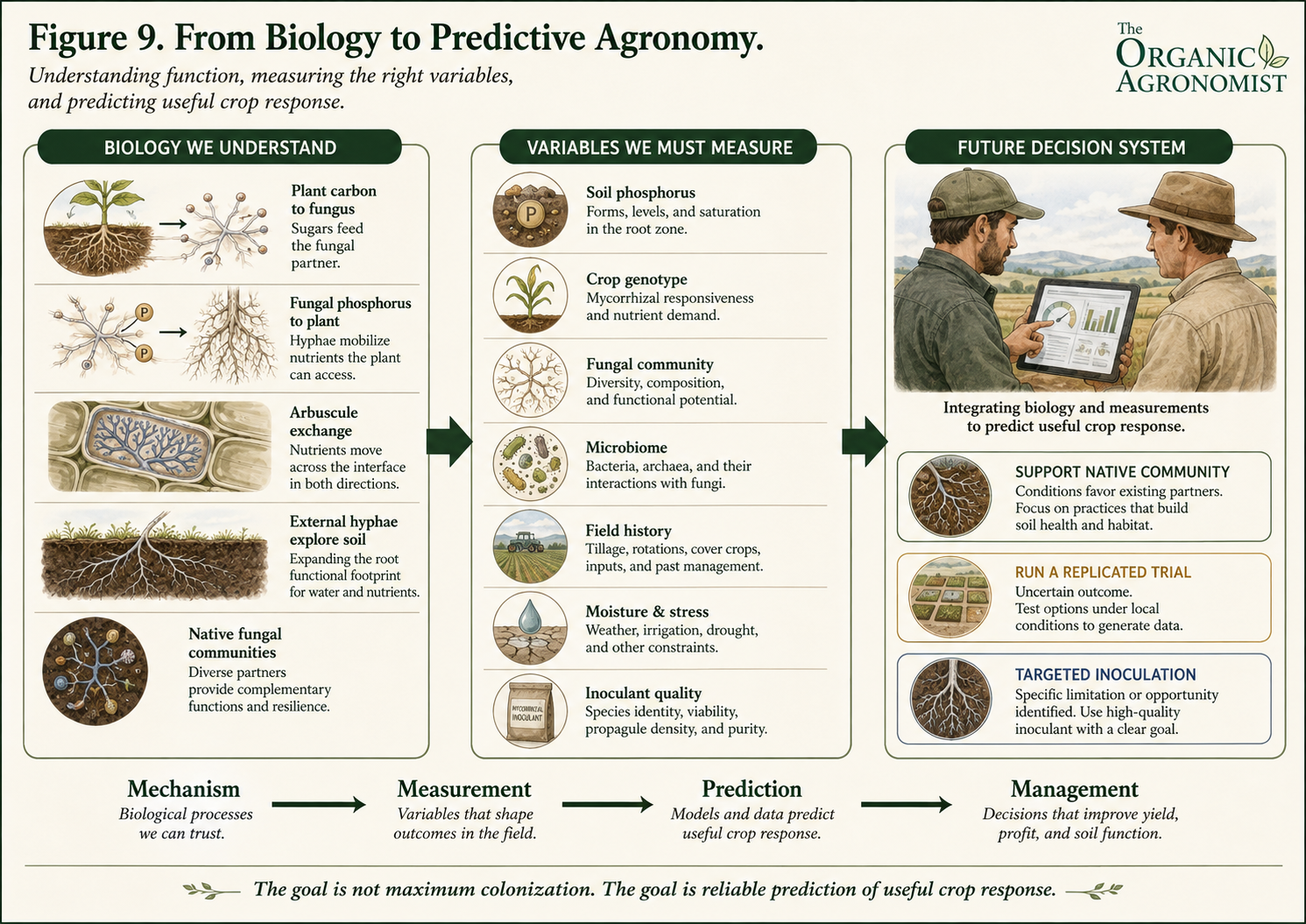
“Diagram showing the progression from established mycorrhizal biology to field measurement and predictive agronomy, integrating soil conditions, crop genetics, native microbial communities, environment, inoculant quality, and economics to guide management decisions.”
What Every Grower Should Remember
Mycorrhizae are neither a miracle nor a myth.
They are an ancient biological partnership whose value depends on context.
The strongest scientific conclusions are already useful:
Most compatible crops can form mycorrhizal associations.
The fungus receives carbon from the plant.
The fungus can provide an important phosphorus-acquisition pathway.
Native fungal communities frequently already exist in agricultural soil.
Soil fertility, crop genetics, management, microbial competition, and environment influence the outcome.
Commercial inoculants can work, but response is not guaranteed.
Colonization is evidence of presence—not proof of profitability.
Management can either support or disrupt the native fungal system.
The largest unanswered problem is prediction.
We still need better tools for determining, before treatment, whether a particular crop in a particular field will receive enough additional value from an introduced or managed mycorrhizal community to justify the investment.
Until those tools mature, the best agronomy remains remarkably familiar:
Understand the field. Identify the limitation. Protect useful biology. Test interventions objectively. Measure crop response.
That approach respects both the promise of mycorrhizae and the limits of what science can currently guarantee.
And that is the difference between biological marketing and biological agronomy.
Key Takeaways
Mycorrhizae are not fertilizers. They are biological nutrient-acquisition partnerships that can improve access to resources already present in the soil.
Phosphorus is central to the agricultural value of AM fungi. Fine fungal hyphae can acquire phosphate beyond the immediate root depletion zone and deliver it through the mycorrhizal pathway.
The plant pays for the service. Plants supply sugars, lipids, and metabolic support to fungal partners. The partnership is useful when the return justifies that investment.
Colonization is not the same as benefit. A colonized root proves fungal presence, not yield response or economic profitability.
High phosphorus does not simply “kill mycorrhizae.” High plant phosphorus status can reduce the plant’s dependence on the symbiosis and suppress its development and function.
Field response is context-dependent. Crop genetics, fungal identity, resident microbiota, soil fertility, disturbance, climate, and management all influence the outcome.
Commercial inoculants are targeted tools, not routine necessities. Their value depends on viable product, an appropriate host, a credible biological limitation, field establishment, and a measurable crop response.
Native communities deserve management attention. Compatible living roots, sensible rotations, avoidance of unnecessarily long bare fallow, and reduced unnecessary disturbance can help preserve mycorrhizal capacity.
The major research frontier is prediction. Agriculture still needs better tools to determine in advance which fields will respond strongly enough to justify inoculation or other mycorrhizal interventions.
References
Bowman, J. L. (2022). The origin of a land flora. Nature Plants, 8, 1352–1369. https://doi.org/10.1038/s41477-022-01283-y
Bravo, A., York, T., Pumplin, N., Mueller, L. A., & Harrison, M. J. (2016). Genes conserved for arbuscular mycorrhizal symbiosis identified through phylogenomics. Nature Plants, 2, 15208. https://doi.org/10.1038/nplants.2015.208
Taylor, T. N., Remy, W., Hass, H., & Kerp, H. (1995). Fossil arbuscular mycorrhizae from the Early Devonian. Mycologia, 87, 560–573. https://doi.org/10.1080/00275514.1995.12026569
Genre, A., Lanfranco, L., Perotto, S., & Bonfante, P. (2020). Unique and common traits in mycorrhizal symbioses. Nature Reviews Microbiology, 18, 649–660. https://doi.org/10.1038/s41579-020-0402-3
Parniske, M. (2008). Arbuscular mycorrhiza: The mother of plant root endosymbioses. Nature Reviews Microbiology, 6, 763–775. https://doi.org/10.1038/nrmicro1987
Gutjahr, C., & Parniske, M. (2013). Cell and developmental biology of arbuscular mycorrhiza symbiosis. Annual Review of Cell and Developmental Biology, 29, 593–617. https://doi.org/10.1146/annurev-cellbio-101512-122413
Jiang, Y., Wang, W., Xie, Q., et al. (2017). Plants transfer lipids to sustain colonization by mutualistic mycorrhizal and parasitic fungi. Science, 356, 1172–1175. https://doi.org/10.1126/science.aam9970
Luginbuehl, L. H., Menard, G. N., Kurup, S., et al. (2017). Fatty acids in arbuscular mycorrhizal fungi are synthesized by the host plant. Science, 356, 1175–1178. https://doi.org/10.1126/science.aan0081
Kiers, E. T., Duhamel, M., Beesetty, Y., et al. (2011). Reciprocal rewards stabilize cooperation in the mycorrhizal symbiosis. Science, 333, 880–882. https://doi.org/10.1126/science.1208473
Walder, F., & van der Heijden, M. G. A. (2015). Regulation of resource exchange in the arbuscular mycorrhizal symbiosis. Nature Plants, 1, 15159. https://doi.org/10.1038/nplants.2015.159
Bennett, A. E., & Groten, K. (2022). The costs and benefits of plant–arbuscular mycorrhizal fungal interactions. Annual Review of Plant Biology, 73, 649–672. https://doi.org/10.1146/annurev-arplant-102820-124504
Smith, S. E., & Smith, F. A. (2011). Roles of arbuscular mycorrhizas in plant nutrition and growth: New paradigms from cellular to ecosystem scales. Annual Review of Plant Biology, 62, 227–250. https://doi.org/10.1146/annurev-arplant-042110-103846
Smith, S. E., Smith, F. A., & Jakobsen, I. (2003). Mycorrhizal fungi can dominate phosphate supply to plants irrespective of growth responses. Plant Physiology, 133, 16–20. https://doi.org/10.1104/pp.103.024380
Harrison, M. J., Dewbre, G. R., & Liu, J. (2002). A phosphate transporter from Medicago truncatula involved in the acquisition of phosphate released by arbuscular mycorrhizal fungi. The Plant Cell, 14, 2413–2429. https://doi.org/10.1105/tpc.004861
Das, D., Paries, M., Hobecker, K., et al. (2022). PHOSPHATE STARVATION RESPONSE transcription factors enable arbuscular mycorrhiza symbiosis. Nature Communications, 13, 477. https://doi.org/10.1038/s41467-022-27976-8
Wu, Y., Chen, C., & Wang, G. (2024). Inoculation with arbuscular mycorrhizal fungi improves plant biomass and nitrogen and phosphorus nutrients: A meta-analysis. BMC Plant Biology, 24, 960. https://doi.org/10.1186/s12870-024-05638-9
Chandrasekaran, M. (2022). Arbuscular mycorrhizal fungi mediated enhanced biomass, root morphological traits and nutrient uptake under drought stress: A meta-analysis. Journal of Fungi, 8, 660. https://doi.org/10.3390/jof8070660
Veresoglou, S. D., Menexes, G., & Rillig, M. C. (2012). Supp
Suggested Citation
The Organic Agronomist. (2026). Mycorrhizae: Fact Versus Fiction: Understanding When Mycorrhizal Fungi Help Crops—and When They Don’t. California Organic Fertilizers, Inc.
Permission to Use
© 2026 California Organic Fertilizers, Inc. All rights reserved. Readers may download, save, and print this publication for personal, educational, or internal business use. Brief excerpts may be quoted with attribution to The Organic Agronomist and a link to the original article. This publication may not be republished, altered, sold, distributed commercially, or presented as another party’s work without prior written permission from California Organic Fertilizers, Inc.
Need help saving a PDF? Click here for instructions.
To save a copy to your computer:
- Right-click the yellow PDF button above.
- Choose Save link as... from the menu.
- Choose where to save the file, such as Downloads.
- Click Save.
Already opened the PDF? Click the printer icon, select Save as PDF as the printer or destination, then click Save.