Prepared by: The Organic Agronomist
Agronomic Review: Tim Stemwedel, COFI Founder and CCA Published by The Organic Agronomist
Executive Summary
Salt index is commonly used to compare fertilizers, but the number is frequently misunderstood.
A fertilizer's salt index describes its relative effect on the osmotic pressure of the soil solution. It does not directly tell a grower whether a fertilizer will injure a crop under actual field conditions.
This distinction becomes especially important with organic fertilizers. Organic fertilizers range from relatively insoluble meals to completely soluble liquids containing ammonia, amino acids, peptides, organic acids, potassium, and other dissolved materials. Their behavior cannot be predicted simply from the word organic.
Organic does not automatically mean low salt, soluble does not necessarily mean high salt, and salt index alone does not determine fertilizer safety.
What Is Salt Index?
The fertilizer salt index concept was introduced by Rader, White, and Whittaker in 1943 as a way to compare how different fertilizers increased the osmotic pressure of the soil solution. Sodium nitrate was used as the reference material and assigned a value of 100.
That original definition is important.
Salt index is not a measurement of how much "salt" is physically present in a fertilizer. It is a relative measure of the fertilizer's effect on the concentration and osmotic properties of the soil solution.
Later laboratory methods sometimes substituted electrical conductivity for direct osmotic-pressure measurements. A review by Murray and Clapp found significant differences between values produced by different methods and warned that existing fertilizer salt-index tables can combine data generated under different experimental conditions.
Salt index is therefore useful for comparison, but it should not be treated as an absolute prediction of crop injury.
Why Fertilizer Salts Can Injure Plants
Roots take up water because of differences in water potential between the soil and the plant.
When a highly soluble fertilizer is concentrated around a seed or root, it increases the concentration of dissolved substances in the soil solution. This lowers the osmotic potential of the water surrounding the plant.
The result can seem counterintuitive:
There may be water in the soil, yet the plant has greater difficulty taking it up.
Germinating seeds and young roots can be particularly vulnerable because a concentrated fertilizer band may create a much stronger osmotic environment than the surrounding soil.
This is what is commonly called fertilizer "burn," although nothing is literally burning.
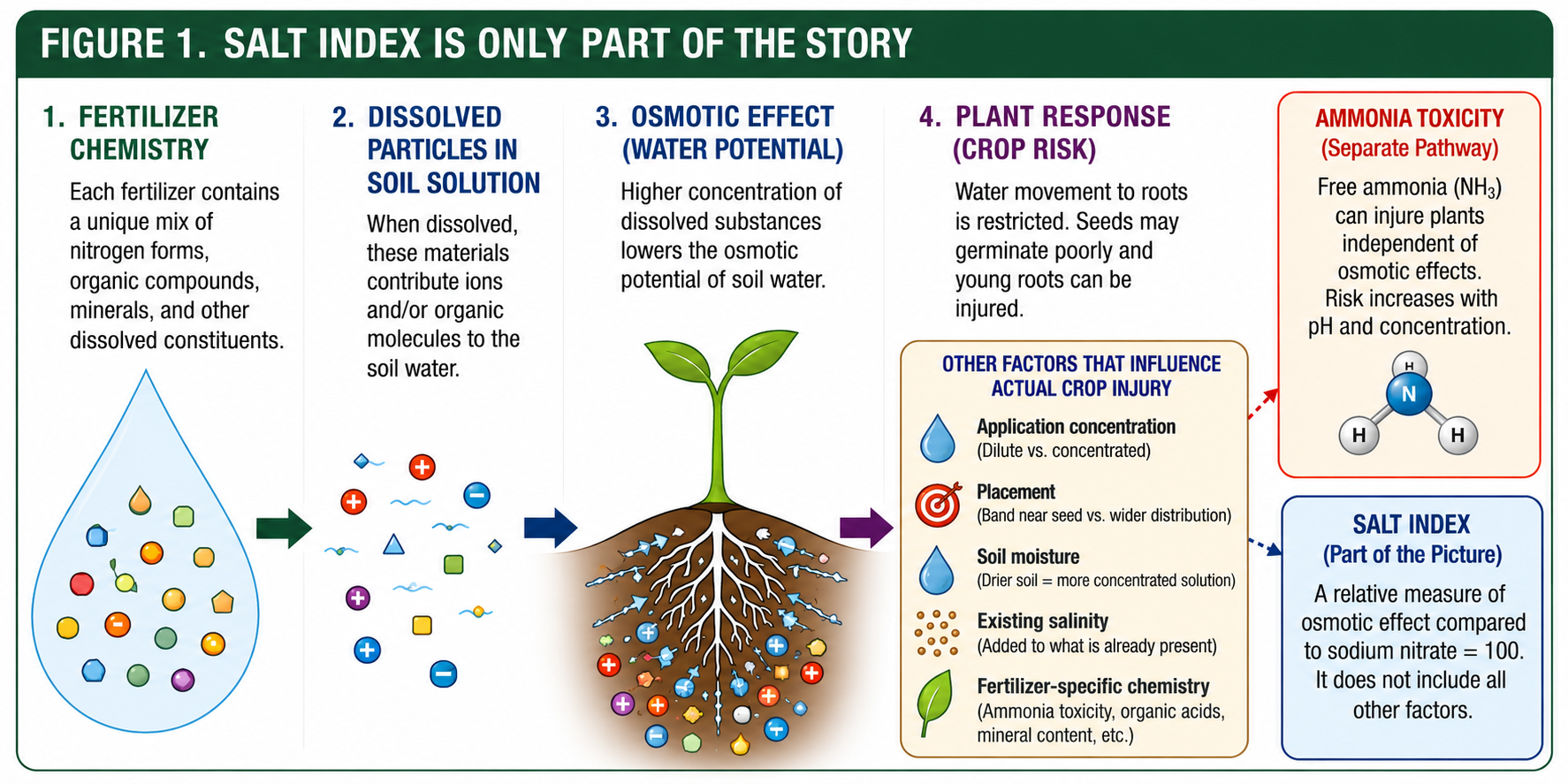
Diagram showing how fertilizer chemistry and dissolved particles affect soil-water osmotic potential and root water uptake. Additional factors include application concentration, placement, soil moisture, existing salinity, and ammonia toxicity.
Salt Index Is Not the Same as Fertilizer Safety
Actual crop injury depends on much more than the salt-index number. Application rate, concentration, fertilizer placement, soil moisture, crop sensitivity, growth stage, soil texture, and existing salinity all influence the response.
There is another important complication: not all fertilizer injury is osmotic salt injury. Ammonia can damage plant tissue through ammonia toxicity. A fertilizer can therefore have a relatively low salt effect and still cause injury if enough free ammonia is concentrated close to sensitive roots or germinating seeds.
That is why "low salt index" should never be interpreted to mean "cannot injure plants."
Organic Does Not Mean Low Salt
One of the most persistent misconceptions is that organic fertilizers are naturally low-salt fertilizers. Some are. Some are not.
A dry protein meal, compost, soy protein hydrolysate, corn steep liquor, natural ammonia, reduced-sugar molasses byproducts, and vinasse can all be used in organic fertility programs, yet their chemical compositions and behavior in soil solution are very different.
Vinasse is a useful example. It is organic in origin, but it can contain substantial concentrations of soluble nutrients, especially potassium. Published research has documented increased soil electrical conductivity and salinity where concentrated vinasse was applied.
Organic origin therefore tells us very little about the immediate osmotic effect of a fertilizer.
Soluble Does Not Necessarily Mean Salty
The opposite misconception can also cause trouble. Growers sometimes assume that if a fertilizer is completely soluble, it must have a high salt effect.
That is not necessarily true.
What matters is what is dissolved in the water and how those dissolved substances behave.
Natural Ammonia
Ammonia dissolved in water is chemically different from highly dissociated fertilizer salts such as ammonium sulfate or potassium chloride.
Aqueous ammonia exists in equilibrium between molecular ammonia (NH₃) and ammonium (NH₄⁺). Because ammonia is a weak base, it does not behave in solution exactly like a completely dissociated salt.
Traditional fertilizer references have consequently assigned ammonia a relatively low salt index per unit of nitrogen compared with several common ionic nitrogen fertilizers.
But that does not mean concentrated ammonia is harmless. Free ammonia can be phytotoxic.
Natural ammonia therefore demonstrates an important principle: low osmotic salt effect and low phytotoxicity are not necessarily the same thing.
Soy Protein Hydrolysate
A soluble soy protein hydrolysate, such as a 7-0-0 fertilizer, presents very different chemistry.
Hydrolysis breaks proteins into smaller peptides, amino acids, and other soluble organic nitrogen compounds. These materials can be completely water soluble without behaving like conventional inorganic fertilizer salts.
Their osmotic behavior can depend on the degree of hydrolysis, the proportion of free amino acids and peptides, mineral content, and other dissolved constituents.
Water solubility alone therefore does not tell us the salt index of a fertilizer.
Corn Steep Liquor
Corn steep liquor (CSL) shows how complex liquid organic fertilizer ingredients can be.
USDA and EPA technical descriptions characterize CSL as a mixture containing soluble proteins and amino acids, organic acids, carbohydrates, vitamins, and minerals.
Representative concentrated material has also contained substantial ash, indicating an appreciable mineral fraction.
CSL therefore contains both organic molecules and dissolved mineral constituents.
Its electrical conductivity (EC) and osmotic behavior can vary with source and processing, making a single generalized assumption about organic fertilizer salts inappropriate.
Reduced-Sugar Molasses and Related Byproducts
Reduced-sugar molasses and related concentrated byproducts make another useful distinction.
Removing or fermenting sugars does not necessarily remove minerals. When part of the carbohydrate fraction is removed, the remaining nonsugar constituents can become relatively more concentrated.
Less sugar therefore does not necessarily mean less salinity. The identity and concentration of the remaining dissolved compounds are what matter.
Vinasse
Vinasse, a fermentation and distillation residue, illustrates the other end of the spectrum particularly well.
It can contain substantial concentrations of potassium and other dissolved constituents and can exhibit high electrical conductivity.
Field and soil studies have shown that concentrated vinasse applications can raise soil EC and potassium.
Vinasse is therefore a strong example of why organic origin and low salinity should never be treated as synonyms.
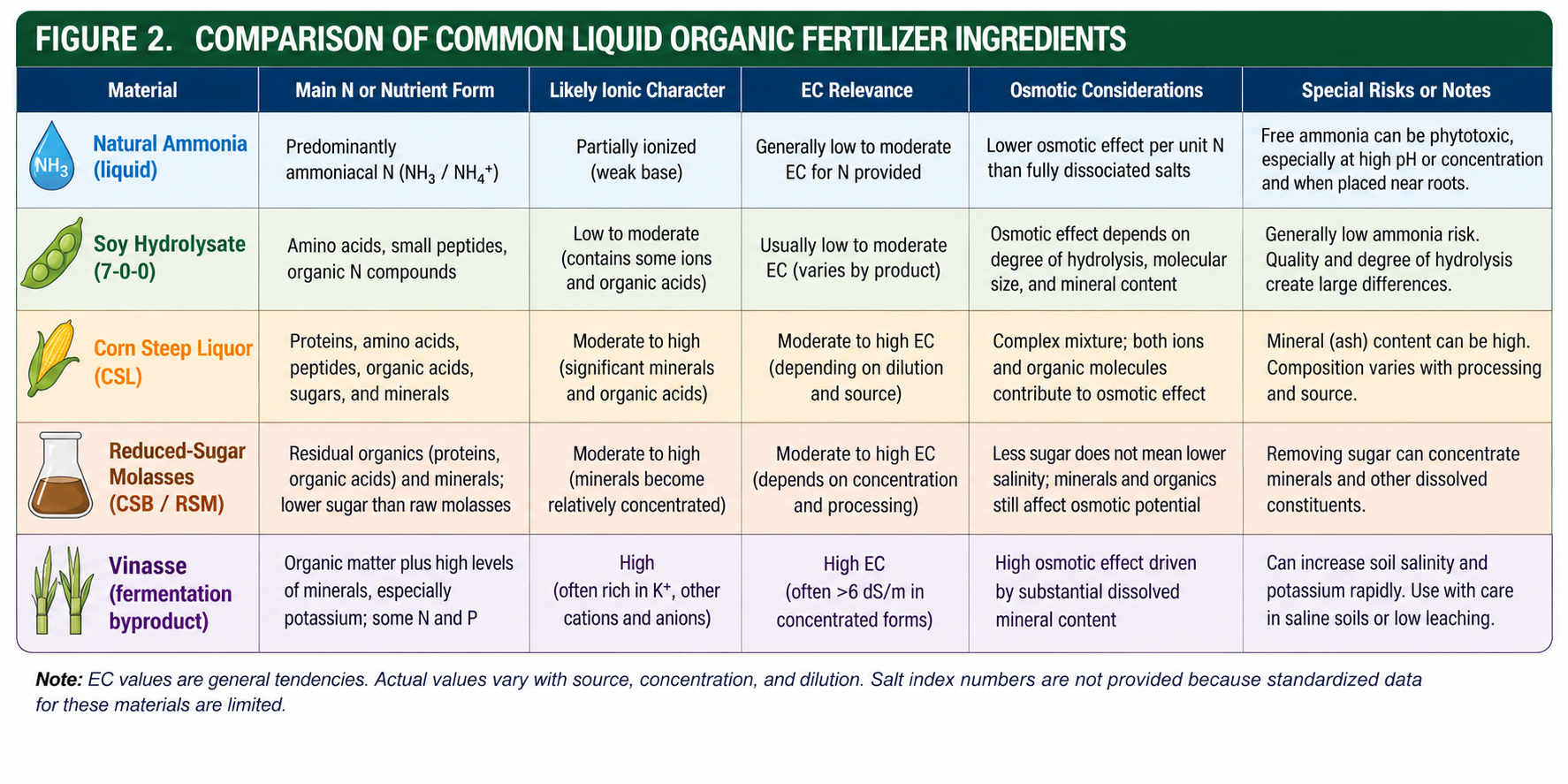
Comparison table showing differences in nutrient chemistry, ionic character, electrical conductivity, osmotic effects, and potential crop injury among natural ammonia, soy hydrolysate, corn steep liquor, reduced-sugar molasses, and vinasse.
EC, Osmotic Effect, and Phytotoxicity Are Different Questions
These terms are related, but they should not be used interchangeably.
Electrical conductivity (EC) describes how effectively a solution conducts electricity and is strongly influenced by dissolved ions.
Osmotic effect describes how dissolved substances influence water movement.
Salt index is a relative fertilizer comparison intended to characterize osmotic effects on the soil solution.
Phytotoxicity describes actual injury to the plant.
A fertilizer may behave differently under each measurement. That distinction is especially relevant to complex organic liquids containing mixtures of ions, organic acids, amino acids, peptides, sugars, and other dissolved molecules.
EC alone should not automatically be treated as a complete measurement of fertilizer safety.
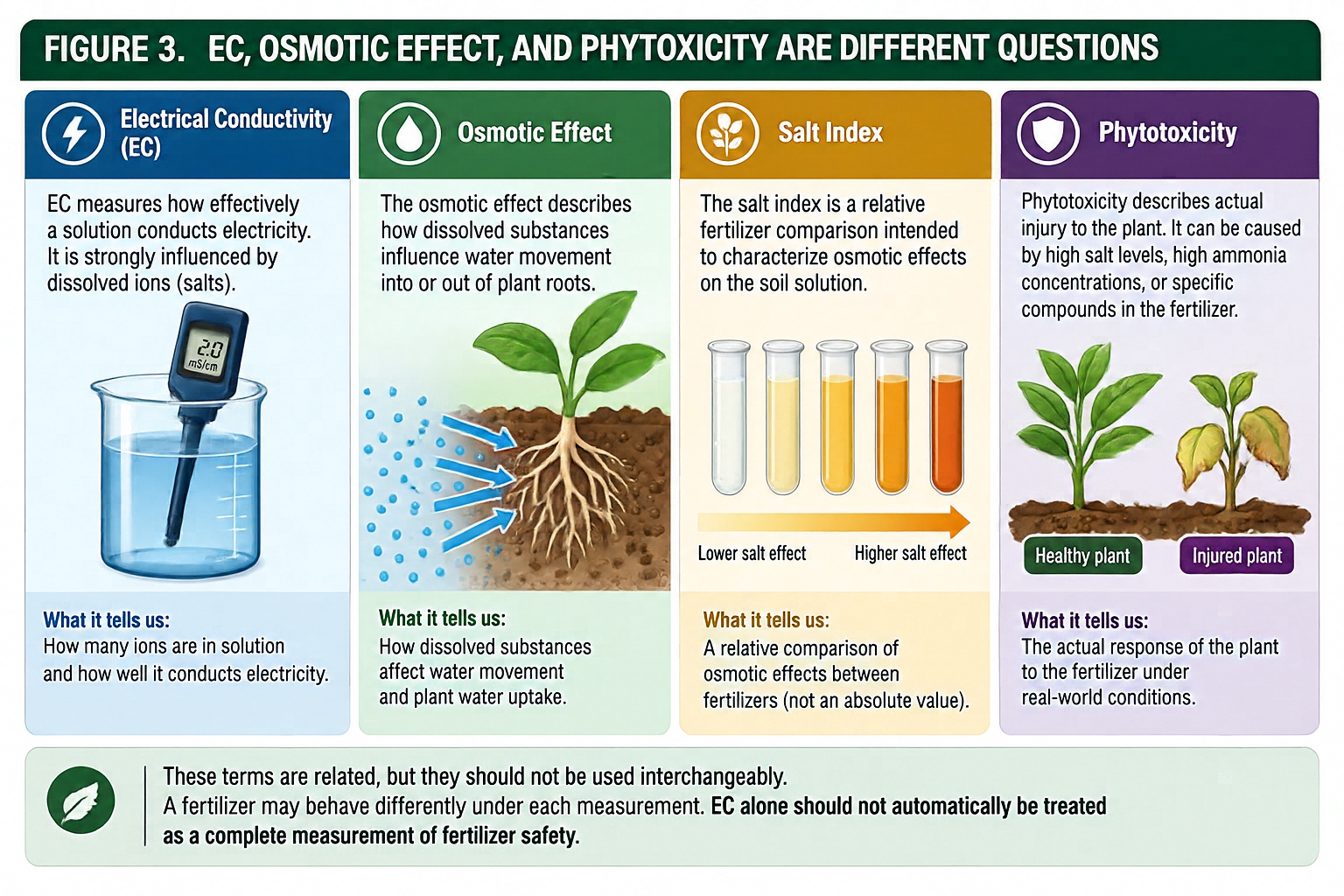
Four-panel infographic comparing electrical conductivity (EC), osmotic effect, salt index, and phytotoxicity. Illustrations show dissolved ions, water movement around plant roots, relative fertilizer effects, and plant injury.
What Matters Most in the Field?
For growers, the practical question is not simply, “Is this an organic fertilizer?” And it is not even, “What is its salt index?”
The better question is:
What happens when I apply this fertilizer at this concentration, in this soil, at this location relative to the roots, under these moisture conditions?
Five Field Factors to Consider
Concentration. The same fertilizer can be safe when diluted and damaging when concentrated.
Placement. Fertilizer distributed through a larger soil volume behaves differently from the same amount concentrated immediately beside a seed or young root.
Soil moisture. Drying concentrates dissolved materials in the remaining soil water, potentially increasing osmotic stress.
Existing salinity. Fertilizer is being added to salts already present in the soil and irrigation water.
Fertilizer chemistry. Ammonia, amino acids, peptides, potassium salts, organic acids, and other constituents do not behave identically simply because they occur in fertilizers used in organic agriculture.
Fact vs. Fiction
Fiction: Organic fertilizers cannot cause salt injury.
Fact: Organic fertilizers can contain substantial soluble minerals. Vinasse and some manure- or fermentation-derived materials provide clear examples.
Fiction: All organic nitrogen fertilizers release nitrogen slowly.
Fact: Release rates vary greatly with material and processing. Some protein fertilizers mineralize a substantial share of their nitrogen relatively quickly.
Fiction: A completely soluble fertilizer must have a high salt index.
Fact: Solubility tells us that a material dissolves; it does not tell us which dissolved species are present or how strongly they affect osmotic potential.
Fiction: A low salt index means a fertilizer cannot injure seedlings.
Fact: Salt index does not account for every mechanism of phytotoxicity. Ammonia injury is an important example.
Fiction: Salt index is useless.
Fact: Salt index remains a useful comparative concept when properly understood. The mistake is asking the number to predict more than it was designed to predict.
An Important Research Need
Standardized comparative measurements of modern organic liquid fertilizers are surprisingly limited. Natural ammonia, soy protein hydrolysate, corn steep liquor, reduced-sugar molasses byproducts, and vinasse would make particularly useful materials for controlled comparison.
Measuring electrical conductivity, osmolality or osmotic pressure, nitrogen form, mineral composition, and crop response under standardized conditions could help determine how well traditional salt-index concepts describe today's organic fertilizers.
Until those measurements are available, precise salt-index claims for complex organic materials should be treated cautiously.
Key Takeaways
Salt index measures a fertilizer's relative effect on the soil solution; it is not a complete measurement of fertilizer safety.
Organic fertilizers are not automatically low in salts.
Completely soluble fertilizers are not automatically high-salt fertilizers.
Natural ammonia, soy hydrolysate, corn steep liquor, reduced-sugar molasses products, and vinasse can behave differently because their chemistry is different.
Application concentration, placement, soil moisture, existing salinity, and fertilizer chemistry all influence actual crop injury.
Salt index is best used as one piece of information, not as a stand-alone prediction of field safety.
References
Rader, L. F., White, L. M., & Whittaker, C. W. (1943). The Salt Index—A Measure of the Effect of Fertilizers on the Concentration of the Soil Solution. Soil Science, 55(3), 201–218.
Murray, T. P., & Clapp, J. G. (2004). Current Fertilizer Salt Index Tables are Misleading. Communications in Soil Science and Plant Analysis, 35(19–20), 2867–2873.
U.S. Department of Agriculture, Agricultural Marketing Service. Corn steep liquor technical review and petitioned-substance materials.
U.S. Environmental Protection Agency. Screening-level hazard characterization and technical summaries for corn steep liquor.
Hartz, T. K., & Johnstone, P. R. Research on nitrogen availability and mineralization from high-nitrogen organic fertilizers.
University of Nebraska–Lincoln Extension. (2023). Fertilizer-Nitrogen Injury to Corn. CropWatch.
Francisco, J. P., Folegatti, M. V., Silva, L. B. D., Silva, J. B. G., & Diotto, A. V. (2016). Variations in the chemical composition of the solution extracted from a Latosol under fertigation with vinasse. Revista Ciência Agronômica, 47(2). https://doi.org/10.5935/1806-6690.20160027
Suggested Citation
The Organic Agronomist. (2026). Understanding Salt Index in Organic Fertilizers: What the Number Really Means. California Organic Fertilizers, Inc.
Permission to Use
© 2026 California Organic Fertilizers, Inc. All rights reserved.
Readers may download, save, and print this publication for personal, educational, or internal business use. Brief excerpts may be quoted with attribution to The Organic Agronomist and a link to the original article.
This publication may not be republished, altered, sold, distributed commercially, or presented as another party's work without prior written permission from California Organic Fertilizers, Inc.
Need help saving a PDF? Click here for instructions.
To save a copy to your computer:
- Right-click the yellow PDF button above.
- Choose Save link as... from the menu.
- Choose where to save the file, such as Downloads.
- Click Save.
Already opened the PDF? Click the printer icon, select Save as PDF as the printer or destination, then click Save.
