In a flooded field, only one form of nitrogen survives: ammonium.
Flooded rice soil is chemically different from every other field on this site. Nitrate applied to a rice field is denitrified and lost to the atmosphere — it is never used. Because getting this right depends on your water management as much as your rate, we build every rice program with you.

Flooded soil rewrites the nitrogen rules.
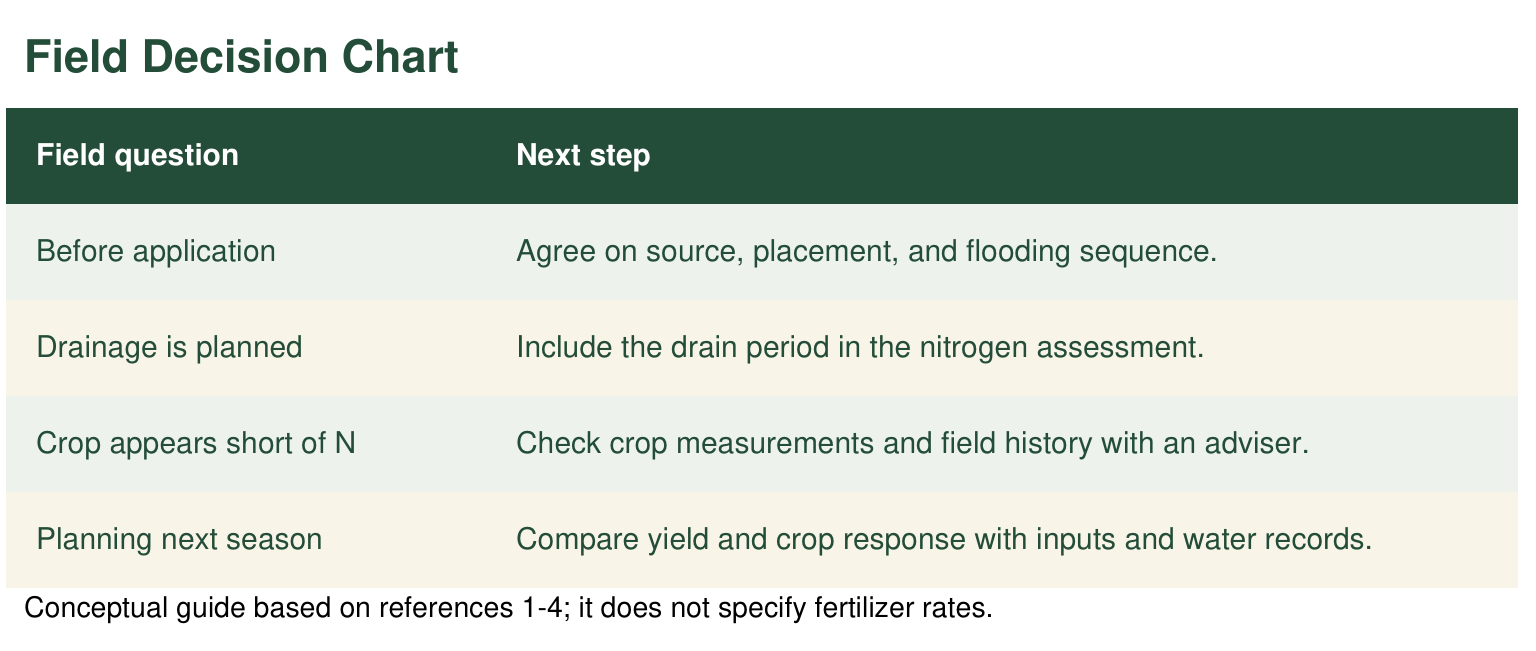
CDFA FREP’s Water Seeded Rice guidelines describe a nitrogen system unlike any other crop: once a field is flooded, the soil turns anaerobic, and any nitrate present — whether residual or newly nitrified — is denitrified and lost to the air. Only ammonium-form nitrogen (urea, aqua ammonia, ammonium sulfate) survives and is actually taken up. Because of this, the pre-plant soil nitrate test used on nearly every other crop is not useful for rice: whatever nitrate is measured will be gone once the field floods. Nearly all nitrogen is instead applied pre-plant and chiseled 3–4 inches into the soil, as close to flooding as possible, where it is protected from both volatilization and denitrification.
How much nitrogen rice needs.
These CDFA FREP figures are planning context, not a program. Actual demand depends heavily on your water management, yield goal, and straw history, which is why every COFI rice program is built to your field.
| Water management scenario | Typical N |
|---|---|
| Continuously flooded, single pre-plant application (most common) | ~150 lb N/acre average; 140–190 lb/acre range for maximum yields |
| Field drained >1 week early season (split program) | Pre-plant portion, plus midseason topdress capped near 30 lb/acre |
| Straw incorporated with consistent winter flooding | 10–20 lb/acre less than the above, from organic matter mineralization |
Most common
Split program
Every one of these numbers shifts with the factors below — which is why rice resists a one-size-fits-all program:
Let’s build your rice program.
Because the right rate and placement depend on your water management, yield goal, and straw history, we don’t publish a single number. A COFI agronomist will build a program around ammoniacal Phytamin® liquids and Phyta-Grow®, matched to your flooding schedule and field.
Talk to a COFI agronomistFlooded-soil nitrogen chemistry, application rate, and placement guidance: CDFA FREP California Crop Fertilization Guidelines, Water Seeded Rice (cdfa.ca.gov/is/ffldrs/frep). Drain-period denitrification research: Linquist, B.A., Koffler, K., Hill, J.E., van Kessel, C., “Rice Field Drainage Affects Nitrogen Dynamics and Management,” California Agriculture. Broader management context: Williams, J.F., “Rice Nutrient Management in California,” UC ANR Publication 3516. Product analysis: Phytamin® and Phyta-Grow® CDFA-registered labels, California Organic Fertilizers.
THE ORGANIC AGRONOMIST
Growing Organic Rice: Protect Nitrogen with Placement and Water Management
Explore how fertilizer placement, flooding schedules, and nitrogen availability work together to help organic rice growers improve nutrient efficiency and reduce avoidable nitrogen losses.