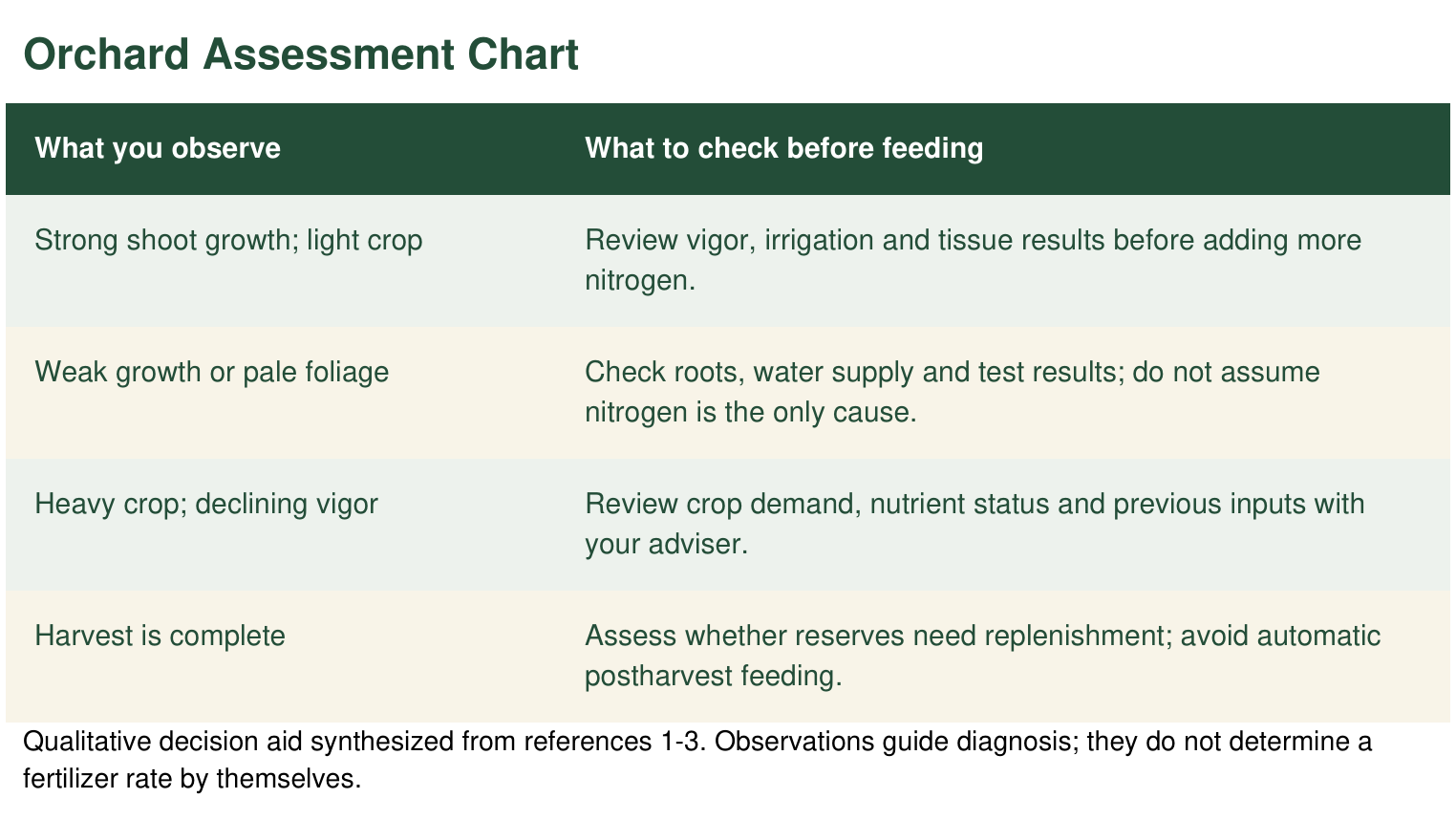
Pome fruit has a built-in nitrogen gauge: its own shoot growth.
Apples and pears don’t just respond to a per-acre number — UC and CDFA FREP pear research ties the right rate directly to yield and to how vigorously the tree is already growing. Because that balance shifts with variety, crop load, and orchard age, we build every pome fruit program with you.

Yield sets the rate. Vigor sets the ceiling.
A CDFA FREP-funded study on European pear (Glozer & Ingels, UC Davis) re-evaluated best management practice for pome fruit nitrogen and anchored it to two physiological signals rather than a flat number: efficiency of use in cropping, and vegetative vigor. The efficient rate is about 2 lb of actual nitrogen per ton of crop per acre per year — so a 30-ton/acre orchard runs around 60 lb N/acre/year. The second signal is a hard guardrail: no nitrogen should be applied once average shoot growth exceeds about 12 inches, since at that point the tree already has more vigor than it needs, and nitrogen-rich, overly vigorous growth is also more susceptible to disease pressure such as fireblight in apples and pears.
How much nitrogen pome fruit needs.
These UC and CDFA FREP figures are planning context, not a program. Actual demand depends heavily on yield goal, variety, and current shoot vigor, which is why every COFI pome fruit program is built to your orchard.
| Program type | Typical annual N |
|---|---|
| Efficient, yield-based (2 lb N/ton of crop) | ~40–60 lb N/acre for a 20–30 ton/acre orchard |
| Traditional commercial split (spring + late season) | ~90–160 lb N/acre/year |
| Common coastal apple practice | ~125 lb N/acre/year, split into multiple smaller doses |
2 lb N/ton of crop
Spring + late season
Every one of these numbers shifts with the factors below — which is why pome fruit resists a one-size-fits-all program:
Let’s build your pome fruit program.
Because the right rate depends on yield goal, variety, and how much vigor your trees already have, we don’t publish a single number. A COFI agronomist will build a program around a Phyta-Grow® Leafy Green Special base and well-timed Phytamin® Jumpstart follow-ups, matched to your orchard.
Talk to a COFI agronomistEfficient rate and vigor-based guardrail: Glozer, K. & Ingels, C., “European Pear Growth and Cropping: Optimizing Fertilizer Practices Based on Seasonal Demand and Supply with Emphasis on Nitrogen Management,” CDFA FREP Contract No. 10-0105, UC Davis Department of Plant Sciences. Commercial split-application context: UC ANR Pear Production Cost Studies. Coastal apple orchard practice: UC Cooperative Extension Sonoma County, Orchards, Fruits & Hops. Product analysis: Phyta-Grow® and Phytamin® CDFA-registered labels, California Organic Fertilizers.
THE ORGANIC AGRONOMIST
Growing Organic Pome Fruit: Balance Nitrogen, Crop Load, and Tree Vigor
Explore how nitrogen timing, crop load, and tree vigor work together to support productive organic apple and pear orchards while maintaining fruit quality.