Test first, feed the heading surge, protect the water.
An organic program for iceberg, romaine, and leaf lettuce: a Phyta-Grow® Leafy Green Special base, then in-season Phytamin® tuned to your irrigation — delivered through the late-season heading surge and guided by soil nitrate testing.

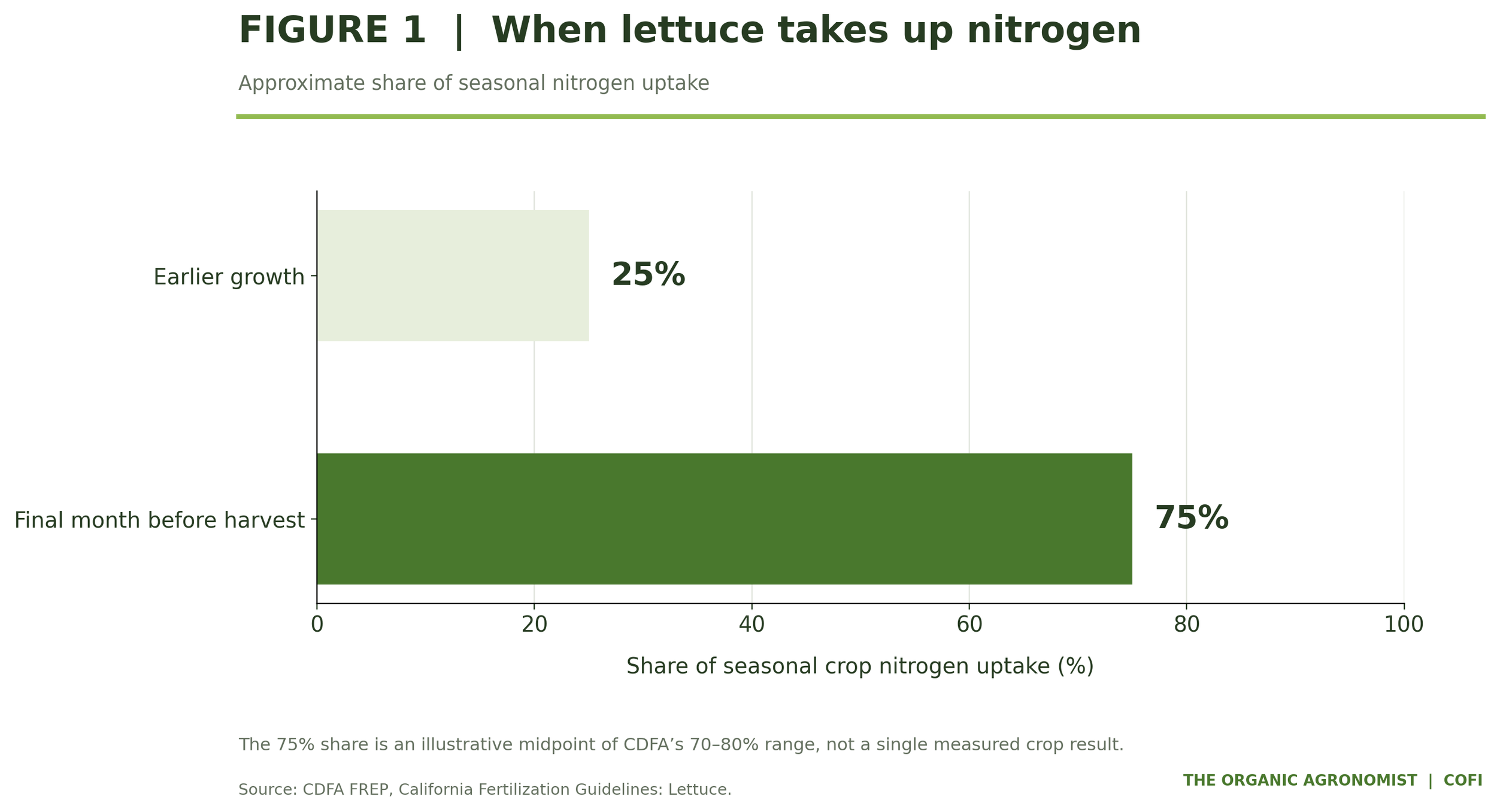
Lettuce takes up most of its nitrogen in the last month.
Head lettuce takes up little nitrogen early, then surges between heading and harvest — 70 to 80% of its total nitrogen is absorbed in the last month, at roughly 3 lb N/acre per day (UC Davis / CDFA FREP). Crisphead and romaine typically need about 100–120 lb N/acre total. Feeding that late surge takes immediately available nitrogen, which is why an ammoniacal liquid like Phytamin® fits the crop’s demand curve. This program builds a Phyta-Grow® base early, then delivers in-season Phytamin® through heading — matched to your irrigation method.
A dry base, built early.
| Timing | Product | Rate | N supplied |
|---|---|---|---|
| Pre-plant Incorporated | Phyta-Grow® Leafy Green Special 7-1-2 | 1,500–2,000 lb/acre | 105–140 lb N/acre |
| At thinning Sidedress | Phyta-Grow® Leafy Green Special 7-1-2 | 500–800 lb/acre | 35–56 lb N/acre |
| Dry base nitrogen | ~140–196 lb N/acre | ||
Incorporated
Sidedress
Replace the dry pre-plant with an injection of Phytamin® Jumpstart.
When planting into healthy, organically-farmed soil at optimum soil temperatures, the dry Phyta-Grow® Leafy Green Special pre-plant can be replaced by a direct injection of Phytamin® Jumpstart 4-1-1. Beyond its ammoniacal nitrogen, Jumpstart’s corn steep liquor supplies surplus soluble carbon — food for soil microbes — supporting the biology that healthy organic soils depend on to cycle nitrogen.
Best suited to active, warm soils: ammonification and nitrification both slow sharply below 45°F soil temperature. This is a lighter starter nitrogen load than the dry pre-plant — it leans on active soil biology and in-season feeding, so pair it with soil nitrate testing and finalize with your PCA.
In-season Phytamin®, tuned to your irrigation.
Lettuce is grown under furrow, sprinkler, or drip irrigation — and the delivery method changes how the in-season liquid is best applied. Fewer, larger doses suit furrow; smaller, more frequent doses suit sprinkler and drip. All applications use Phytamin® Pure 5-0-0 or Phytamin® Jumpstart 4-1-1, and all begin at the 45–60 day stage, as heading starts.
| Irrigation method | Rate | Frequency |
|---|---|---|
| Furrow / surface | 10–20 gal/acre | 2–3 applications |
| Sprinkler | 5–7 gal/acre | Weekly |
| Drip | 2–7 gal/acre | Weekly |
Lettuce nitrogen uptake, timing, and removal: CDFA FREP & UC Davis California Crop Fertilization Guidelines (Lettuce Nitrogen Uptake and Partitioning; 70–80% of N taken up in the final month; ~2.6–3.6 lb N/ton removed). Pre-sidedress soil nitrate testing: Hartz & Breschini, Presidedress Soil Nitrate Testing Reduces Nitrogen Fertilizer Use and Nitrate Leaching Hazard in Lettuce (CDFA FREP; ~70 lb N/acre reduction). Nitrogen demand ranges: UC and NC State head lettuce guidelines (~100–120 lb N/acre). Product rates and densities: Phytamin® and Phyta-Grow® CDFA-registered labels, California Organic Fertilizers.
THE ORGANIC AGRONOMIST
Growing Organic Lettuce: Better Nitrogen Management, Better Yields, Less Waste
Explore how nitrogen timing, soil conditions, and irrigation management help organic lettuce growers develop uniform, healthy heads while making efficient use of available nutrients.