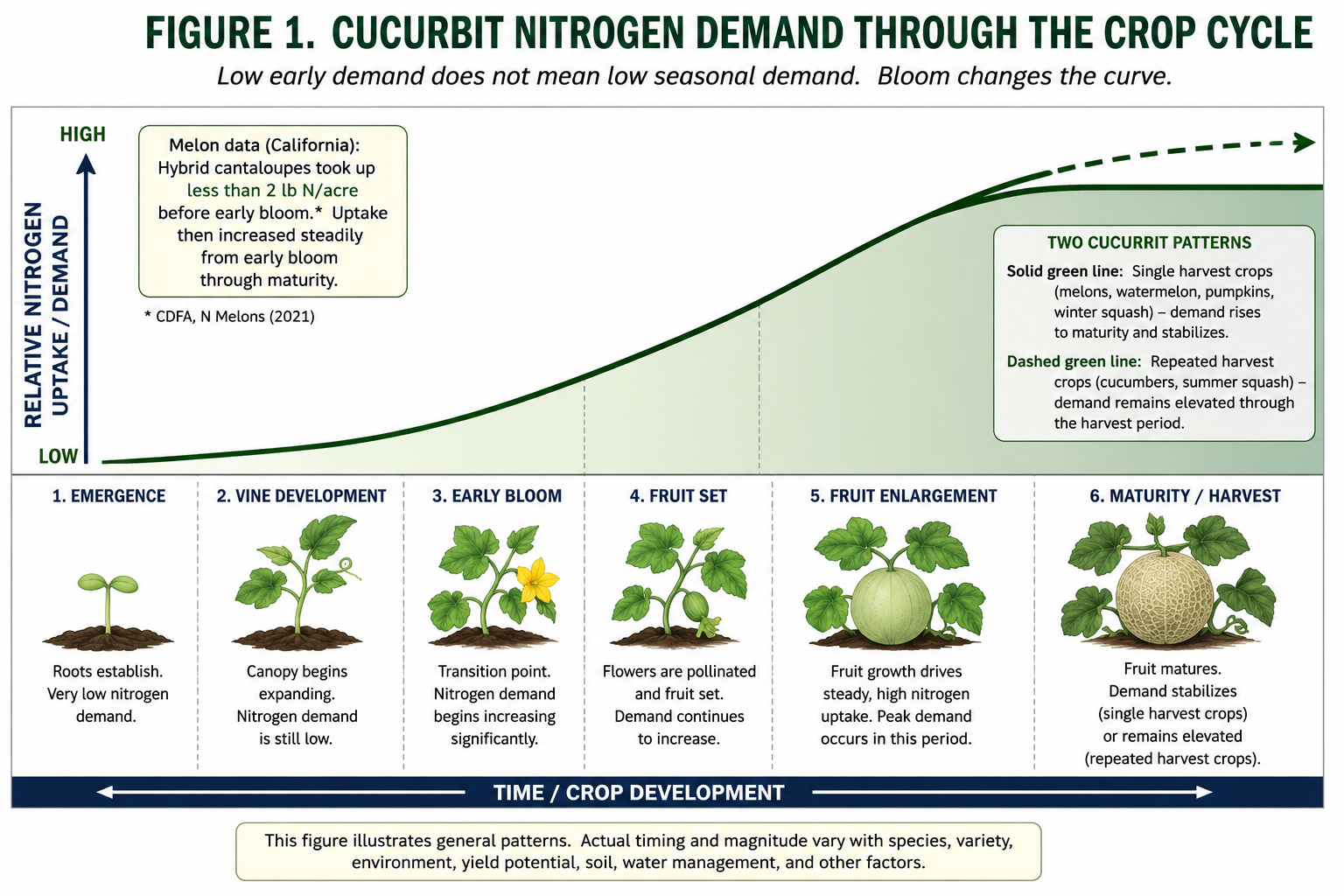
Cucurbits take up nitrogen steadily, from first bloom to last picking.
Melons, squash, cucumbers, pumpkins, and watermelon all share the same basic nitrogen pattern: very little demand early, then a steady climb from bloom through harvest. Because yield goals and crop type shift that total so much, we build every cucurbit program with you rather than publish one fixed rate.

Little demand early, steady demand late.
CDFA FREP research on melons — the most thoroughly studied cucurbit, and the model crop for the family — found that plants take up less than 2 lb N/acre before early bloom. Nitrogen applied too early, before the crop can use it, is simply at risk of leaching. From early bloom onward, uptake rises steadily and continues through maturity; drip-irrigated fields can even be fed small, constant doses of nitrogen all the way from early bloom until 2–3 weeks before harvest. Field trials also found that cantaloupe generally did not respond to applications above roughly 120 lb N/acre — past that point, more nitrogen doesn’t mean more yield, it just means more leaching risk.
How much nitrogen cucurbits need.
This CDFA FREP yield-based budget for melons is planning context, not a program — and other cucurbits track it closely, with some variation by crop. Actual demand depends on your yield goal, crop type, and soil, which is why every COFI cucurbit program is built to your field.
| Expected yield | Estimated seasonal N uptake |
|---|---|
| 10 tons/acre | ~50–100 lb N/acre |
| 15 tons/acre | ~75–150 lb N/acre |
| 20 tons/acre | ~100–200 lb N/acre |
| 25 tons/acre | ~125–250 lb N/acre |
These ranges are based on roughly 3–5 lb N per ton of harvested fruit, with fruit accounting for 50–60% of the plant’s total nitrogen. They shift with the factors below:
Let’s build your cucurbit program.
Because cucurbit nitrogen needs move with crop type, yield goal, soil, irrigation, and residual nitrogen, we don’t publish a single fixed rate. A COFI agronomist can help build a Phyta-Grow® and Phytamin® program matched to your field and your organic system.
Talk to a COFI agronomistSeasonal nitrogen uptake, yield-based N budget, and field trial response ceiling: CDFA FREP California Crop Fertilization Guidelines, Melons (cdfa.ca.gov/is/ffldrs/frep). Additional rate context: Hartz, T.K., “Nutrient Requirements for High-Yield Hybrid Melon Production,” California Melon Research Board; Hartz et al., “Cantaloupe Production in California,” UC ANR. Cross-crop cucurbit family reference: Warncke, D.D., “Nutrient Management for Cucurbits: Melons, Pumpkin, Cucumber, and Squash,” 2007 Indiana CCA Conference Proceedings. Product analysis: Phyta-Grow® and Phytamin® CDFA-registered labels, California Organic Fertilizers.
THE ORGANIC AGRONOMIST
Organic Cucurbits: Matching Nitrogen to Bloom, Fruit Set, and Harvest
.Explore how matching nitrogen availability to flowering, fruit set, and harvest helps organic cucurbits develop productive vines without encouraging excessive vegetative growth.