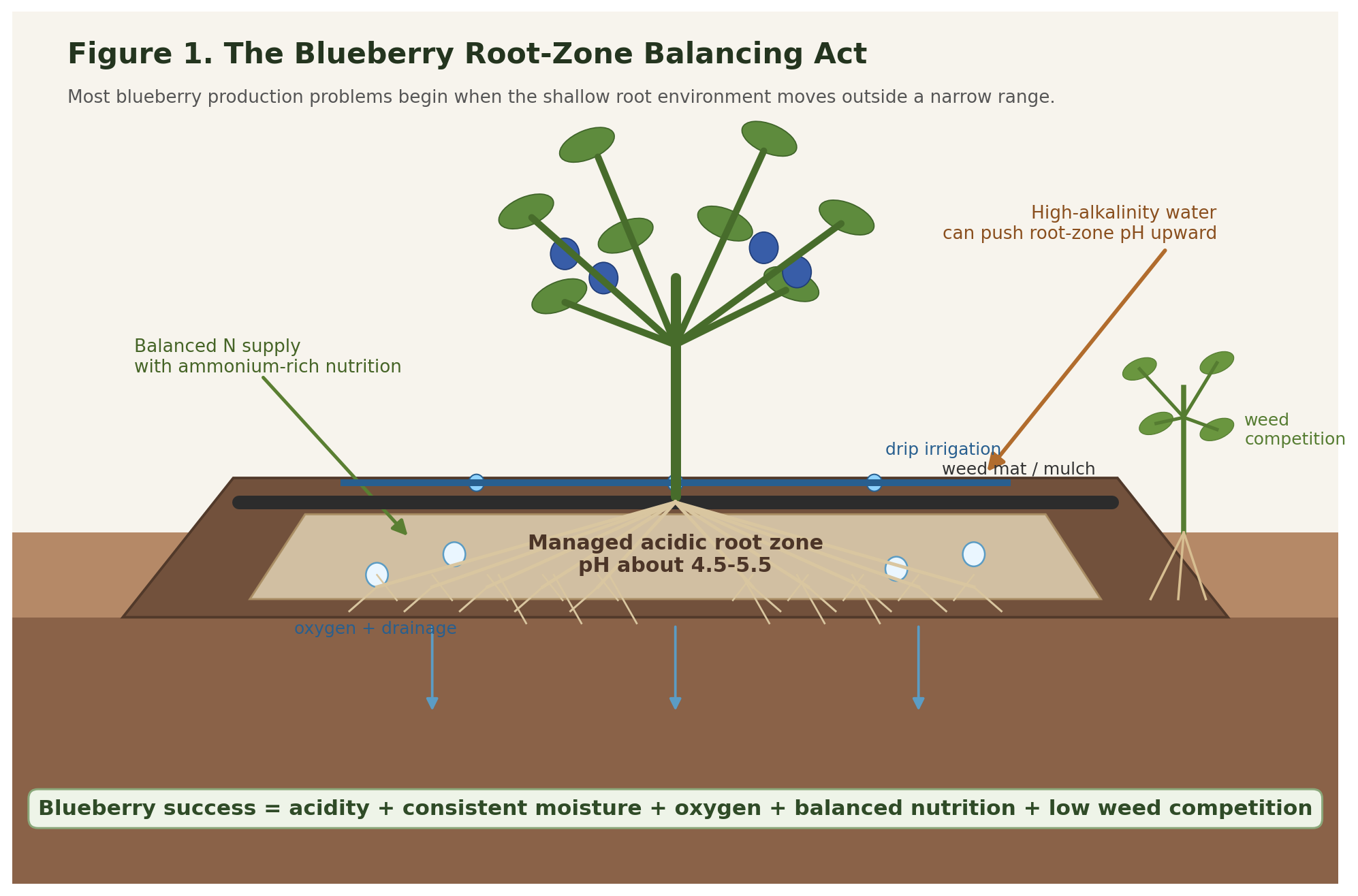
Blueberries want their nitrogen as ammonium.
That is exactly what Phytamin® Pure delivers — 100% ammoniacal nitrogen, immediately available, in the form blueberries are built to take up. Because blueberry systems vary so widely, we build each program with you.

Blueberries are an ammonium crop.
Unlike most crops, blueberries evolved in acidic soils and strongly prefer nitrogen in the ammonium form over nitrate. Research from Florida and Oregon found that when nitrogen is supplied as ammonium, blueberries absorb about twice as much of it and move it into their shoots roughly four times faster than from nitrate. University guidance is explicit: for blueberries, the nitrogen should be ammoniacal.
How much nitrogen blueberries need.
Blueberry nitrogen demand is modest and rises with plant age. These UC and regional research ranges are context for planning — not a program. Actual rates depend heavily on your specific planting, which is why we tailor every program.
| Planting stage | Typical annual N range |
|---|---|
| Young plantings (first years) | ~45–65 lb N/acre/year |
| Establishing (mid-age) | ~65–120 lb N/acre/year |
| Mature (year 7–8+) | ~145–165 lb N/acre/year |
Every one of these numbers shifts with the factors below — which is why blueberries resist a one-size-fits-all program:
Let's build your blueberry program.
Because blueberry nitrogen needs depend so much on age, soil, mulch, pH, and how your planting is grown, we don't publish a single rate. A COFI agronomist will build a Phytamin® Pure program matched to your field, your stage of planting, and your organic system.
Talk to a COFI agronomistAmmonium preference and uptake: Florida and Oregon highbush blueberry research (ammonium vs. nitrate uptake and shoot translocation); Western Nutrient Management Association proceedings; university blueberry nutrition guidelines (“nitrogen should be ammoniacal”). Nitrogen demand ranges: UC, Oregon State University, Michigan State University, and University of Georgia blueberry fertilization guidelines (age-based N recommendations, ~45–165 lb N/acre/year). Product analysis: Phytamin® Pure CDFA-registered label, California Organic Fertilizers.
THE ORGANIC AGRONOMIST
Growing Organic Blueberries
Learn how soil acidity, nitrogen availability, irrigation, and nutrient timing work together to support healthy blueberry plants and productive organic harvests.