Avocados don’t feed on a calendar — they feed on their own bearing cycle.
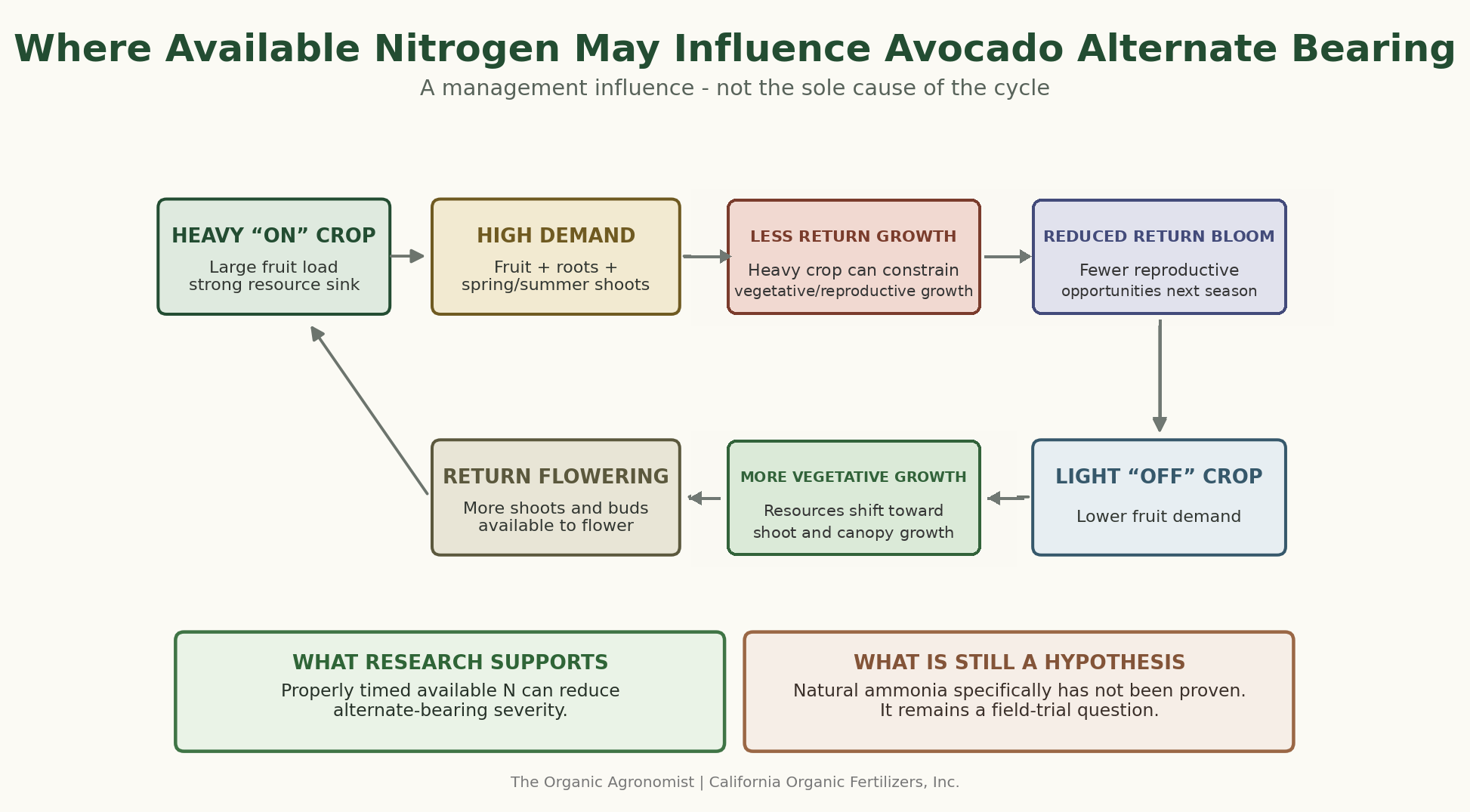
Hass avocado is alternate-bearing: a heavy “on” crop year and a lighter “off” year pull nitrogen very differently. Because that cycle shifts demand from grove to grove and year to year, we build every avocado program with you rather than publish one fixed rate.

Nitrogen demand tracks the tree, not the season.
University and CDFA FREP research on ‘Hass’ avocado shows very little nitrogen uptake during the winter dormant period. Uptake climbs sharply from March through May, when the spring flush, bloom, and fruit set of the new crop all happen at once — and in “on” crop-load years, a second demand window opens from July through October as that heavy crop sizes up. Research led by UC Riverside’s Carol Lovatt found that properly timing nitrogen to these specific phenological stages, rather than spreading it evenly across the year, measurably increased both total yield and the share of commercially valuable, large-size fruit.
How much nitrogen avocados need.
These CDFA FREP and UC research ranges are planning context, not a program. Actual demand depends heavily on tree age, crop load, and your irrigation water’s own nitrate content — which is why every COFI avocado program is built to your grove.
| Grove stage | Typical annual N range |
|---|---|
| Young, non-bearing (years 1–3) | Building gradually as canopy establishes |
| Mature, bearing — typical program | ~125 lb N/acre/year, split across 5–6 applications |
| Mature, bearing — broader guideline range | ~100–200 lb N/acre/year, by variety, soil & irrigation water N |
These ranges shift with the factors below — which is why avocados resist a one-size-fits-all program:
Let’s build your avocado program.
Because avocado nitrogen demand shifts with bearing cycle, tree age, and irrigation water, we don’t publish a single rate. A COFI agronomist will build a program around dry Phyta-Grow® and liquid Phytamin®, timed to your grove’s own phenology and crop load.
Talk to a COFI agronomistSeasonal nitrogen uptake and partitioning: CDFA FREP California Crop Fertilization Guidelines, Avocado Nitrogen Uptake and Partitioning (cdfa.ca.gov/is/ffldrs/frep). Timing research: Lovatt, C.J., “Properly Timed Soil-Applied Nitrogen Fertilizer Increases Yield and Fruit Size of ‘Hass’ Avocado,” HortTechnology. Rate guidelines and crop N removal: UC Davis Nutrient Management (geisseler.ucdavis.edu), Avocado. Product analysis: Phyta-Grow® and Phytamin® CDFA-registered labels, California Organic Fertilizers.
THE ORGANIC AGRONOMIST
Can Available Nitrogen Reduce Alternate Bearing in Avocados?
Explore how crop load, nitrogen timing, return bloom, and plant-available nitrogen interact—and where the evidence for natural ammonia still stops.